They set their own learning and test questions
Why not ask coaches: “What would you like to learn?”
Then get them to assess what learning they think has happened
Ask them to create their own learning topics and exam/test questions
That’s what I tried to do and I took a risk!
Some background – 5 hrs expanded to 21 hrs
I was working with a group of 8 coaches. We had 3 days discussing Coaching Practice and Methodologies as part of a BWF (Badminton World Federation) Level 2 Coach Education course. Learning that normally was covered in 5 hrs, we now had 21 hrs!
Yes, that’s correct 21 hrs to cover what is normally done in around 5 hrs!!
So plenty of formal and informal conversations following questions from the coaches. Plus plenty of tasks mixed with interactive feedback, practical tasks that were linked to on-court coaching.
The organisers valued the time to create deeper learning and to remove time as a barrier to delivery
Coaches select their own learning topics
 The coaches have an opportunity to vote on what they would like to consider over the 3 days by selecting from a list of topics. Each person had 3 votes to share over the different subjects
The result of the vote would provide me with a summary of their needs, wants and interests.
I intended to cover all the topics, but this task allowed me to give more time to the ones they thought they needed.
Each topic already had a session planned that was either 60 mins, 2 hrs or a half day. The session length varied in the number of practical tasks, and the duration of feedback and off-topic (sideline) discussions.
If the subject received a high number of votes, I certainly was going to give it the attention they requested.
The unexpected positive aspect of doing this was the number of questions and considerations created by people exploring what was to be included in each subject. They quizzed me as to what would be included in each and what they would learn.
Doing this within the first hour of the course created an interaction and openness that I hadn’t expected. On reflection, it was a great way to find out what they thought they needed.
Which of these topics would you have voted for – how would you use your 3 votes?
The ‘Exam’!
Towards the end of day 2, the organisers sprung a surprise on me – they wanted a written, marked exam that produced a score for each of the coaches. To check the coach’s understanding, they said.
I’m not a fan of exams to indicate an understanding of coaching methodologies, and certainly not a fan of surprise exams!
However, the client asked for one, so we had to produce something, they were paying 🙂
I had several questions in my mind –
- Should I give each coach a score from my subjective observations, ignoring the client exam request
- Should I create a multiple choice quiz – where I hide the ‘correct’ answer amongst wrong answers
- Should I ask for an essay or a presentation – but then they need time and to do it overnight
- Or, do something that I’d never done before! 🙂
I asked the participants
“what questions would you ask each other to check for understanding?”
What happened next
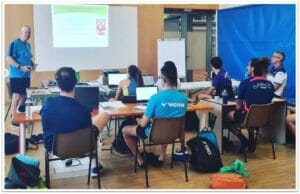 During the next 15 mins, the coaches started to create their own exam questions!
It was a risk as I had no idea of what they would say, how many would they create and crucially, would I agree with their questions!
Would their questions be relevant to the material that we’d been considering, I started to panic!
Maybe it wasn’t such a good idea to ask coaches to set their own exam questions.
What would the course organisers think!
Would they be happy with this approach?
How we navigated the questions

We set about discussing what we should examine, what we had done that we could test, no, what had we done that should be ‘tested’
Individually, we each created a list of things that each person felt were important to remember. The key points, concepts, and methodologies that we’d use again.
People varied and discussed openly what they thought was important to them, and others questioned why this or that should be rested. It was a fun experience
Each person had a list of the aspects they wanted to be tested on.
Their list, not mine
Then we discussed how the questions would look. If we were marking them, how would we do it, and what would we expect to see as answers.
The mechanics of how to phrase a question suddenly became important. The wording used was critical so that it was clear to others and hopefully prompted the answers we wanted
And that was the most interesting thing. The coaches started working backwards from the answer (the important concept/learning) and then had to create a question to prompt that.
Everyone had to change their mindset from coach to coach developer to coach assessor
The benefits
Just doing this task was a type of test/exam, and hopefully, people didn’t realise this initially.
The coaches behaved like Coach Educators, exploring what could be tested, how to test and crucially the value of testing using exam questions.
The task required coaches to carry out their own self-reflection/review to determine what they valued. All in a psychologically safe way, i.e., how could they fail this task? 🙂
I liked the fact that they had identified a subject matter and then used a process to define a question, based on an answer they wanted. It was intriguing to me.
We still covered nearly all of the topics, but some were ‘hidden’ inside others. There were many common coaching themes and critical points that applied throughout.
– – – – – – – – – – – – – – – –

As always, I’m very grateful if you have read this far 🙂
If you’ve had a conversation with a friend, especially about this topic why not share some and send me an email contact@badmintonandy.com
I’d welcome any ideas for topics and conversation starters.