How can you use your good playing skills
Will Coach education and CPD help you to use them
What coaching skills will you need that will compliment your playing skills?
Have you read Parts 1 and 2
Which of the points was the most impactful for you?
I’ve had a few people give feedback to me and say that many of them are now obvious to them but weren’t in their first 6 months of being a coach.
If you’d like to contact me and explain how you dealt with any of the challenges, I’d love to hear from you. Send me an email at contact@badmintonandy.com and we can start chatting.
My goal is to help you avoid the ‘traps’ and ‘pitfalls’
How you hear this advice is up to you
CPD, is it worth your time?
Attending official courses isn’t enough
You must also continue with your CPD ( Continued Professional Development), it’s certainly worth your time and money.
Did you think that a BWFL1 or 2 would be the end of your training? 
Expect most CPD to challenge you in some way.
It will certainly take up your time from the court and at home. This should happen at least 2-3 times a year; if it isn’t, then question your employer or yourself.
If you work for yourself as a professional coach, you may decide that you haven’t the time or the inclination to continue your training/development.
This would be a mistake.

Time spent training will help in more ways than you think. Taking a course that relates to small business management will certainly help you complete your tax returns at the end of the year!
Your biggest problem may be that your National Governing body or your club does not provide the systems to help or support you financially.
I’ve seen this cause frustration for many coaches and also cause (unseen) problems with their coaching. The effectiveness of their work diminishes over time as they become stale, void of new ideas and insights.
What additional training would like this year?
People asking for your advice
Sometimes wanting you as a mentor
People will ask you for advice, especially if, in their opinion, you have been a good player. New coaches will expect you to know the answers to all their questions.
You may not think you are a mentor, but people will show you ‘respect’ and want to hear what you have to say.
Is this really a problem?
The temptation could be high to help and offer advice, however, be careful of what you advise.
The context of your advice is very important.
The advice you give will be based on what? Especially since your playing experiences far outweigh your coaching ones.
Unless you ask questions, then your advice will often only be general and limited in use. Be careful; your advice could be taken out of context and not always work.
Are you willing to say “I’m sorry, I don’t know what to advise you”.
These typical questions may sound specific but often it’s difficult to advise as they are BIG topics, often with no quick fixes.

- How can I improve my backhand?
- Tell me how I can make the shuttle spin like you
- When should I split and how can I train my split-step?
- What is the secret to a quick grip change?
Not valuing discussion
Sometimes actively avoiding it
How often have you sat down with another coach and had a discussion, an open, in-depth discussion about coaching?
Or would you prefer not to talk about coaching as it’s obvious what to do, and why would anyone question what you do – you already know what to do!
How do you respond if you are asked a question that makes you feel uncomfortable?
Hopefully, you know at least 1 person (hopefully 3) that you are willing to engage with. People with a subtle difference of opinion or viewpoint, not just a mate.
I’ve found that there is much to be gained from meeting with other coaches and talking openly about topics.
It’s a great opportunity to hear something new, find a different viewpoint, or be informed that someone else has faced the same challenges.
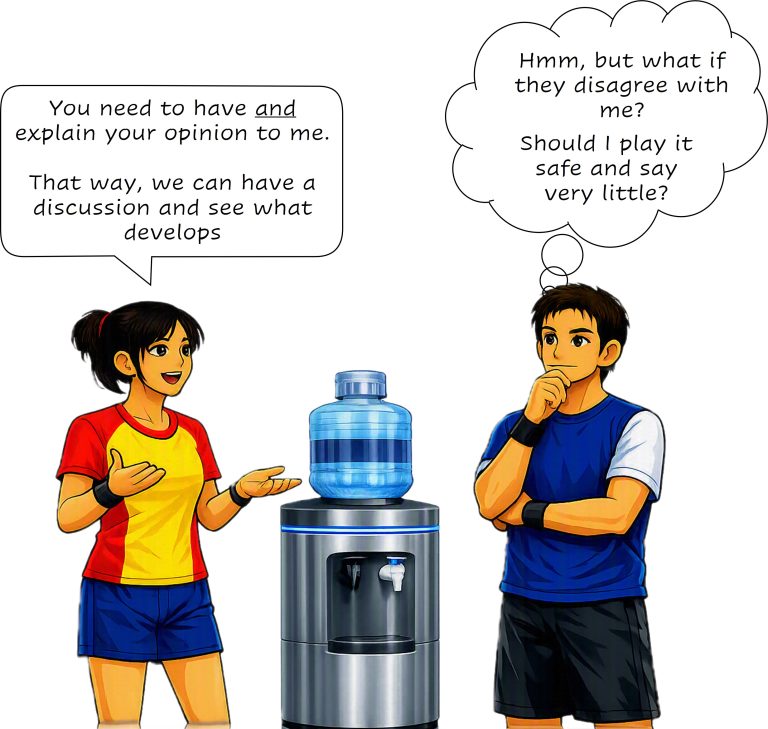
Of course, there are those embarrassing moments when someone disagrees with the viewpoint you have. If it’s the first time another coach has asked you to back up your beliefs, that moment can feel very strange and uncomfortable.
How important is it for you to develop ‘challenging’ relationships?
If it is, do you actually participate and seek out people to talk with?
Do you like having coach-to-coach discussions?
Or, do you find it difficult to realise the value?
You may decide that talking about coaching with other coaches can be difficult.
It’s likely you will not agree on everything or understand some of the things they are proposing, or they will disagree with you and tell you so!
How would that make you feel?
I wonder if you will find it hard to generate enthusiasm to talk about coaching!
Especially if people disagree or just keep questioning you during the discussion.
You tell people that it’s a simple game and that you’d rather be on the court than talking about it.
If your opinion is that there aren’t many coaching ‘secrets’ to learn and ‘at the end of the day’ it’s just about hitting shuttles and knowing how to win points. That’s exactly what you did on court and it’s only ‘experience’ that your players need.
So you decide to stop allowing people to talk ‘coaching’ with you.
Are there times when you deliberately do not talk ‘coaching’ with other people.
You become (maybe without knowing it) skilful at avoiding difficult conversations and difficult people who would rather critique the work that you do and the ideas you have.
Maybe you believe that some people ‘overcomplicate’ coaching
Coach to Coach discussions
- Challenge yourself as you did as a player, although this time instead of facing opponents it’s about finding people to help/challenge you to become a better coach.
- Be brave and embrace that there is always something to learn.
- Seek out a variety of people who are willing to help. Be aware that your friends may not want to question you.
- Create a ’roundtable’ discussion group. A minimum of 3 people who are prepared to share, challenge and advise.
- Be motivated to add to your knowledge
Struggling to know what you stand for
When you were a player, your knew your goals and target
You may have had several, and these probably changed over time as circumstances altered.
I presume that, generally, you knew what you wanted to achieve. Plus, you may have had several ways to measure your success.
Will the same will apply to your coaching?
There is a big difference between being a player or a coach in terms of how you measure your progress and the different types of successes available to coaches.
Have you given any thought to how a coach can measure their success or failures, their effectiveness? 🙂
As a player, you started as a novice, playing novice events. You may have had high goals/targets, but you knew that over time you would improve and play better against better opponents.
There was always an obvious challenge ahead, a path to follow.
As a coach, what are your measures? I’d really like to know.
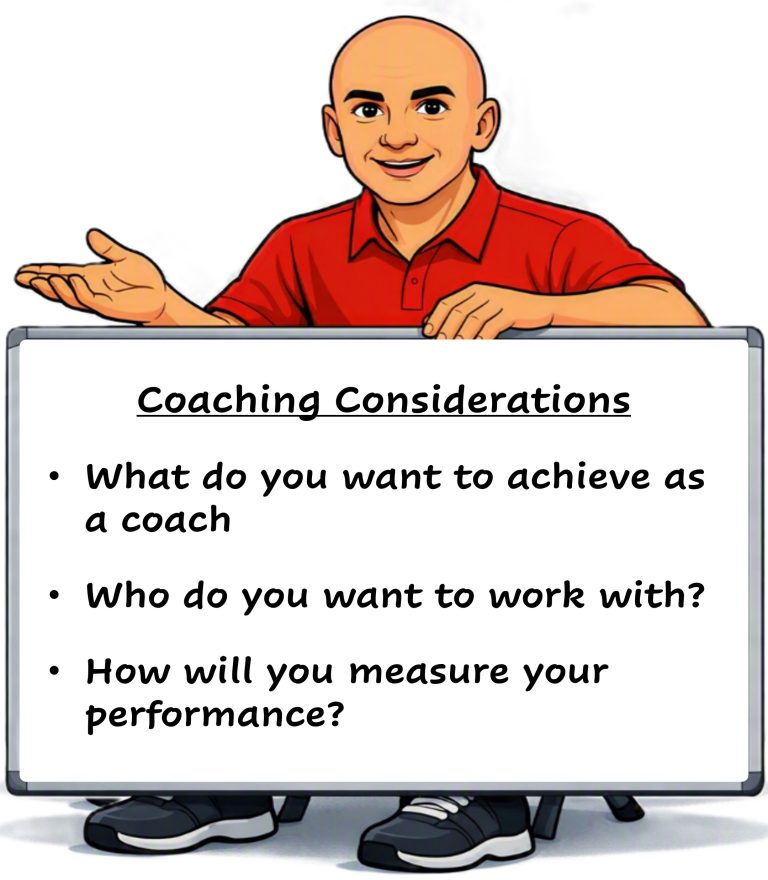
How do you measure your effectiveness as a coach?
Do you have a method?
When you start coaching people, ‘expect’
When you start coaching, it is feasible that you could start at an elite level, going straight from playing to coaching, possibly with none or very limited coaching experience or qualifications.
You will be expected to succeed from day one, to deliver an experience equal to winning high-level tournaments.
Expectations still happen if you start at a lower level. You are the ‘Coach’, so people expect to improve and learn something new.
Do you find the expectations from others challenging?
Possibly people will expect more as you change roles from player to coach and give you less time to gain expereince.
In a way, it’s similar to learning to play and suddenly finding yourself in the final where people expect you to deliver.
I hope in some way all the advice in this post and Part 1 and 2 will help you deal with this situation.
Further reading
All the suggestions here have come from talking with my friends who made the change from Player to Coach.
I’m thankful for all their advice and tips as many are about failures that happened to them.
Often they managed to overcome each but sometimes it took years, a change of circumstances, or an explosive moment with players, coaches or organisations.
The struggles and surprises that happened to them could happen to you!
Send me a question
I’m always grateful if you have read this far.
If there is anything that you have read that has helped or that you disagree with, then please send me an email.
I promise to read all your comments
It would be great to hear from you contact@badmintonandy.com


![Keep your racket up - Duplicate - [#38056]](https://badmintonandy.com/wp-content/uploads/2026/09/keep-your-racket-up-scaled.webp)