
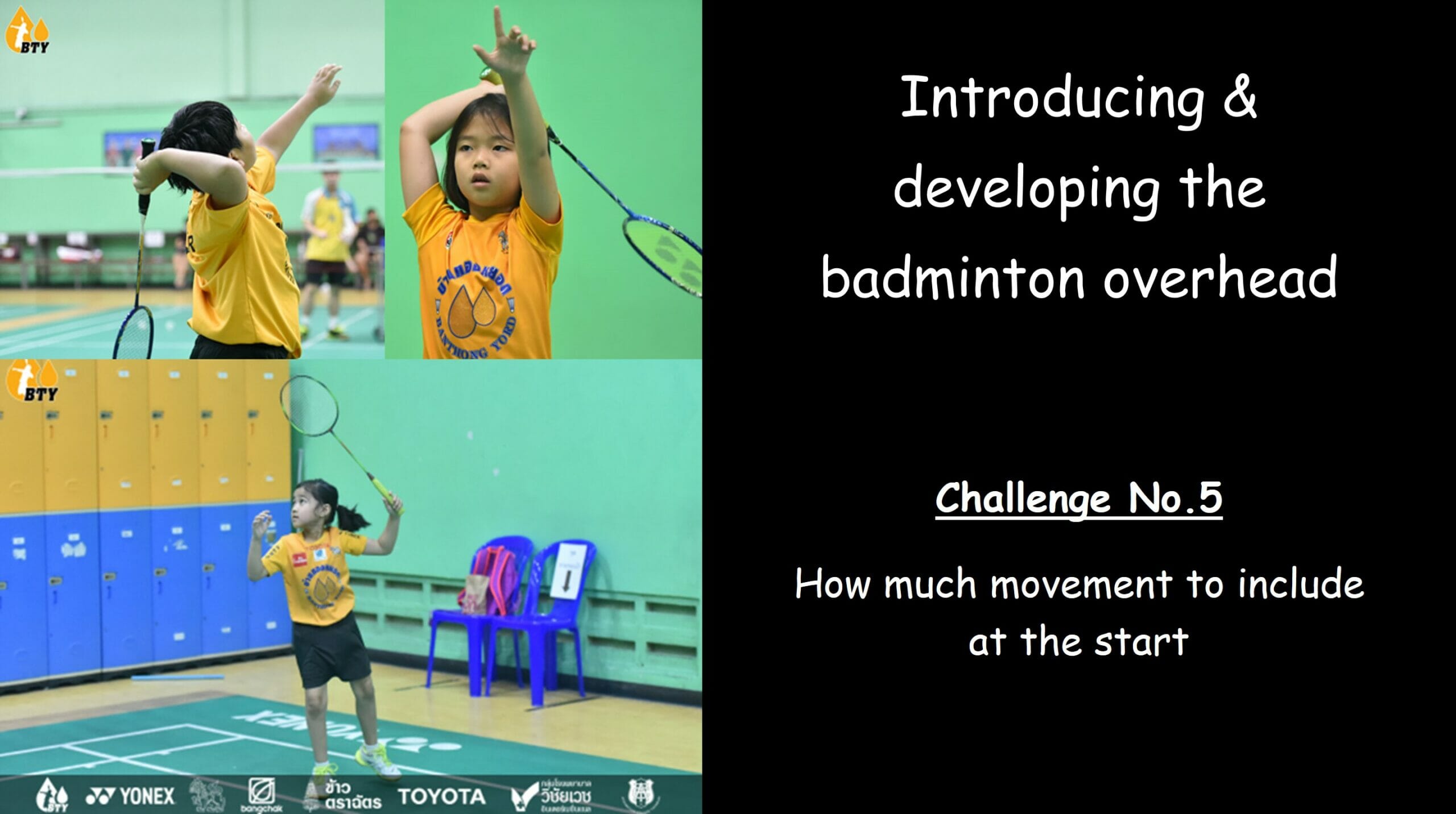
Full or part movements
What do your early practices with beginners look like
When & how to include movements can be a tough decision
Overhead movements without any previous experience can be problematic
But also, stripping away too much movement needs consideration
Understanding why you choose what you do is important
This post is part of a mini-series that examines the various challenges that coaches face when first introducing overhead forehand striking to beginner players.
Your challenge is to decide how much movement you think is effective as a first experience when you are working with young beginner players.
Will you isolate various parts, practice them and then ‘stitch’ them back together? Or, would you practice larger movements within constraints?
You may feel challenged or ‘prickled’ at some of the points raised. My aim is to give you ideas to consider.
It’s important to know why you chose not to do something.
There will be times when you could make a choice but choose not to as it doesn’t benefit the player or players in front of you right now.
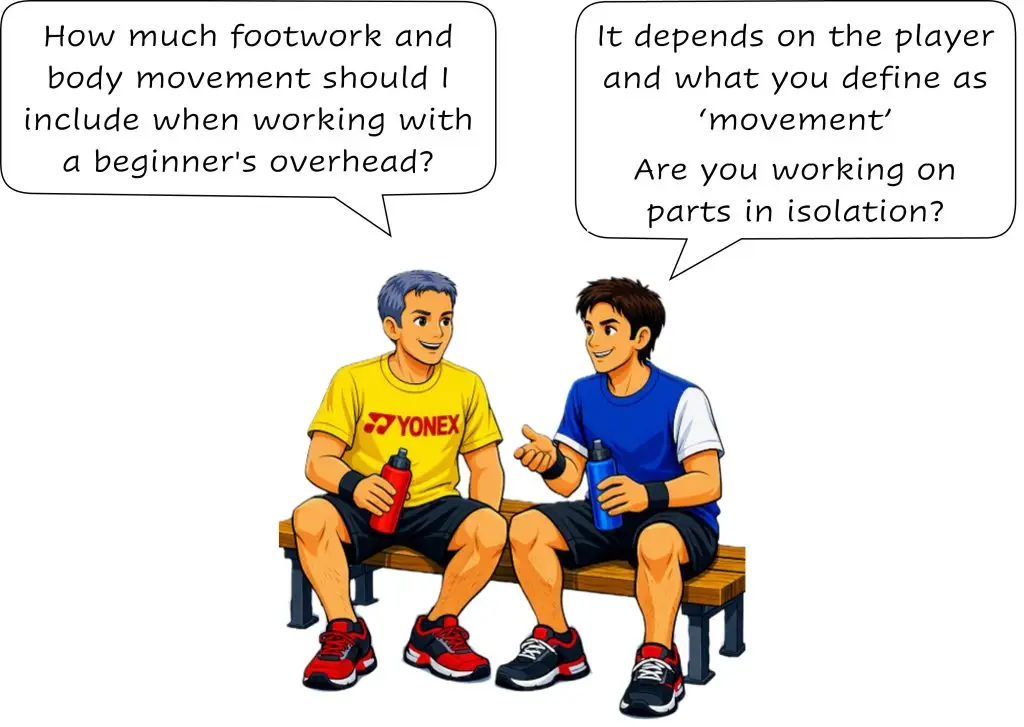
I’m not here to change your mind, just to ask you to consider your ‘why’
Why you chose to do what you do
You have a choice
If your goal is to get players striking overhead very early in their development, are you happy with what you experience and observe?
Striking and moving for overheads is complex and sometimes full of messy outcomes for young beginner players.
Deciding how complex the task is (especially the movement element) is a skill that coaches need to develop.
Do you prefer to remove movements such as pushing up off the ground (mini-jump),
Or, do you prefer to isolate the throw with almost no movement at all?
I’m a little undecided about the question of how much movement is best to include, especially if it includes striking a shuttle delivered by another player or a coach.
Over the years I’ve seen a few different methods and a combination of these methods and I’ve tried lots of different methods.
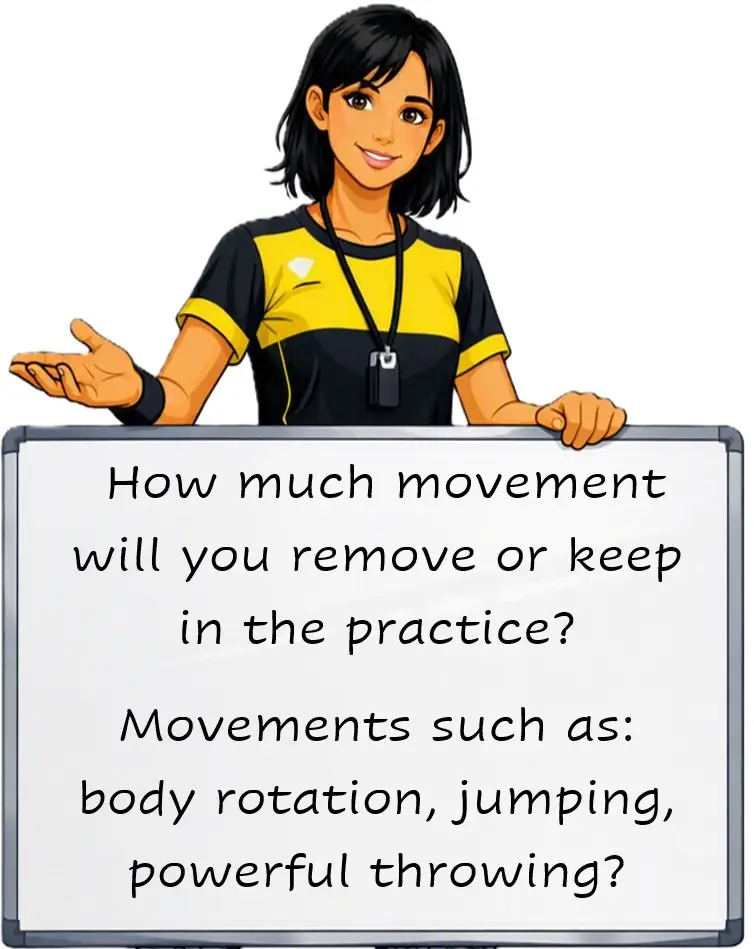
How soon would you introduce a whole body rotation plus striking?
I can understand why coaches, players and even parents would expect to start with a complex overhead hitting practice. It’s what happens in a rally, and they believe that in order to ‘play’ badminton, you need to start hitting overheads.
My issue is that most coaches know what will happen in this practice and either accept it or just deal with the consequences afterwards.
I’ve often heard coaches say “I can correct any technique ‘errors’ afterwards; it’s just important that they get a feel for the whole movement early on”
All coach education courses I’ve seen only ever show the coaching of the overhead as a whole striking movement.
What do you generally expect to happen in beginner overhead striking practices?
Especially if you include whole movements.
Recognise any of these...
What do you expect to happen in beginner overhead striking
- Players using push actions with limited or no backswing
- Having most of their weight on the front leg with the rear leg off the ground at the time of contact
- Players not connecting & either miss-hitting or missing the shuttle completely in more than 40% of the attempts
- Appearing to feel de-motivated and losing enthusiasm for the practice, verbalising that the practice is too difficult or tough
Do you see these results?
If you do, what are your feelings about each?
The argument for the whole movement
There must be good reasons to start with a complete overhead throwing action that includes striking and movement to the shuttle, as many coaches do exactly this.
However, do we know their reasons, their ‘why’?
If coaching is a ‘deliberate’ activity, then we must assume the reasons for a coach’s actions have been thought out. The ‘how’ and ‘why’ of what we do is important.
I sat down with a coaching friend and chatted about the reasons for introducing overhead striking as a complete action, including movements. It was an open, enjoyable, but sometimes ‘prickly’ conversation.
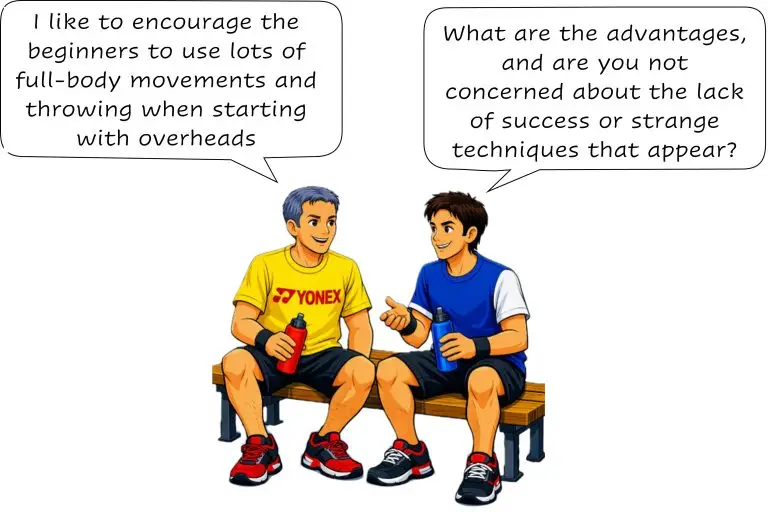
We came up with these statements – what thoughts do they trigger?
- It’s important that players see and experience moving & striking as without this they have no reference to what is being asked of them. (Trying and failing is ok)
- If the coach can give a great demonstration then why waste the opportunity? Ask players to copy what the coach does.
- It’s a faster way of teaching as it allows the players to self-organise once they see what is required to move and strike overhead.
- Breaking the movement into smaller parts (chunks) is too time-consuming, and then requires these parts to be put back together.
- There are some young players who have very few issues overhead striking overhead (maybe they have already experienced this from another sport). Why limit these players with part practices.
- Not being successful at the start of a process is part of the learning. Errors can be corrected later.
How many of these statements do you agree with?
The argument for isolating certain elements
It’s important to explore alternative approaches, and that’s just what we did.
This isn’t a criticism of coaches who decide to start with whole movements, which include striking with complex movements. Often if we explore what alternatives there are and what benefits they bring, the coach can be better prepared and have more options.
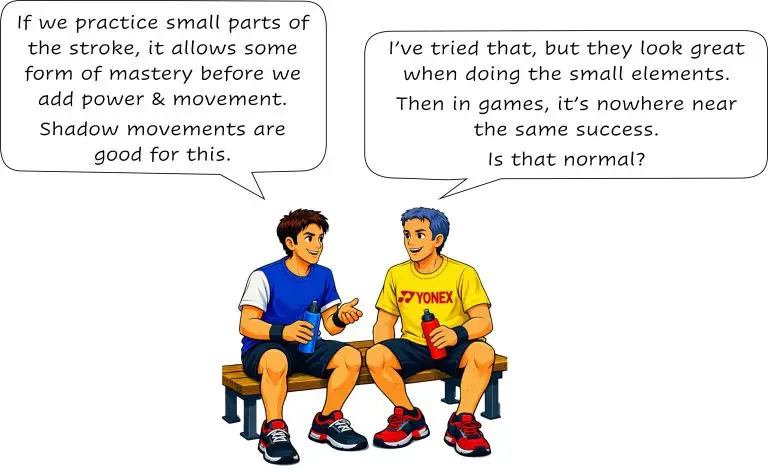
We came up with these statements – what thoughts do they trigger?
- Reducing movements, both arm and body will allow for a greater change of sucess
- Its easier for the coach to instruct and give information for each element. "Put your racket here", "place your foot there", "follow 1, 2, 3 hitting action"
- Once each element is 'mastered' then others can be added to it to form a larger action.
- Players can show in slow motion the hitting technique, ensuring that each element is coordinated with the pevious.
Using previous experiences
What thoughts and questions do these create?
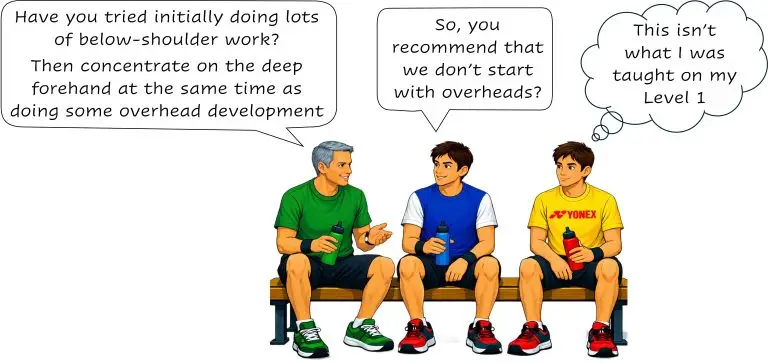
- Starting with below-shoulder strokes will develop player confidence, constrain grips, and provide 'confidence in the coach' and the process
- Its worth repeating that player confidence in their development and the coaching process should not be underestimated. Positive previous experiences before starting overhead development are essential.
- The deep forehand is an easy development from below shoulder strokes and allows for the experience of a power stroke with an appropriate grip to transfer power.
- All the above points need only to be in the first 10-15 lessons, but the foundations laid will last much longer.
Develop parts of the overhead forehand through different practices and methodologies
Employ these before starting to coach it specifically : have a plan
Its your choice
Whatever you choose (and it’s up to you and only you to choose), be deliberate in your coaching and reflect on the results you see.
Consider what experiences could help players in this complex movement.
How could you best prepare players, emotionally and technically?
All I ask is that you consider how much and what movements to introduce and when. That you are happy with the reasons why it’s your preferred method and that it’s best for the player in front of you at that time.
Reflection is your friend
My desire is that you will consider the discussion points and challenges; I hope you have time to do that. The ideas and suggestions listed here are my best advice at this time. It’s up to you to decide what to take, use, and maybe reject.
Please do not assume that every statement or bullet point about the overhead forehand listed is essential or has an equal weighting. Some are ‘could haves’ and others are essential ‘must haves’
I’m still not sure that there is one method that works best, but there are certain factors that you need to consider. The other posts in this mini-series will hopefully give you lots to consider.
How much of the (one-size-fits-all) overhead forehand information
shown in coach education courses applies to beginners?
Send me a question
I’m always grateful if you have read this far.
If there is anything that you have read that has helped or that you disagree with, then please send me an email.
I promise to read all your comments
It would be great to hear from you contact@badmintonandy.com

![Keep your racket up - Duplicate - [#38056]](https://badmintonandy.com/wp-content/uploads/2026/09/keep-your-racket-up-scaled.webp)
![Introducing the badminton overhead – Challenge No.3 - Duplicate - [#36874]](https://badmintonandy.com/wp-content/uploads/2023/05/Badminton-Forehand-Overhead-3-scaled-1.jpg)
![Introducing the badminton overhead – Challenge No.2 - Duplicate - [#36821]](https://badmintonandy.com/wp-content/uploads/2023/05/Badminton-Forehand-Overhead-2-scaled-1.jpg)