
What have you learned that you would share?
Those coaching tips that will help at anytime
Not only in difficult moments, but also to inspire
How many of these would be on your list?
Be inquisitive and work to improve your reflective skills
Judge things slowly, be open to learning
There are many forms and types of knowledge that you will probably spend a lifetime mastering as a coach.
However, also be happy knowing that all the mistakes that you make in your first 3 yrs (and you will make some big ones) are worth making.
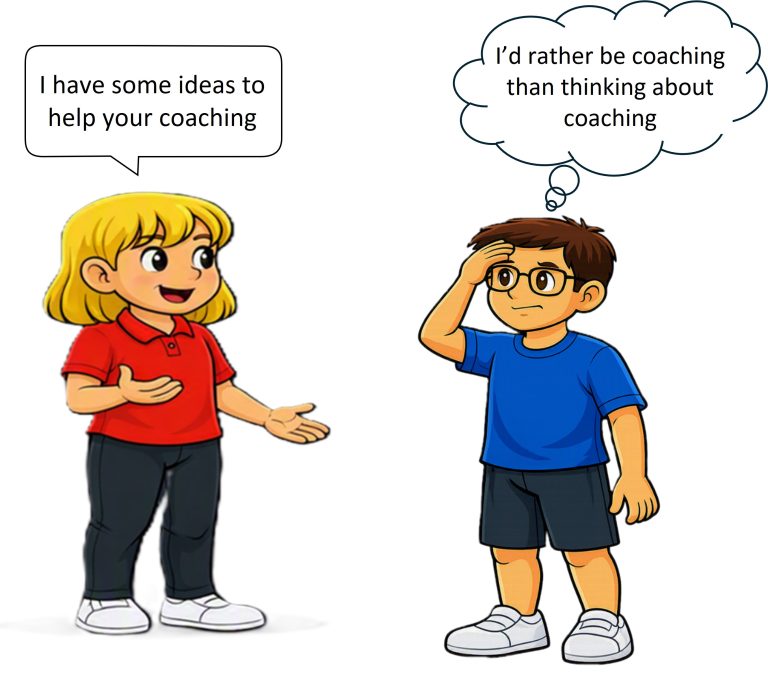
Having the knowledge that you cannot know everything, even if you were a good player, is really important. It’s easy to say, but often harder to live with.
Once you start asking questions of people who you think may know how to help, the fun begins.
Asking different types of questions in different contexts then becomes a life skill in itself.
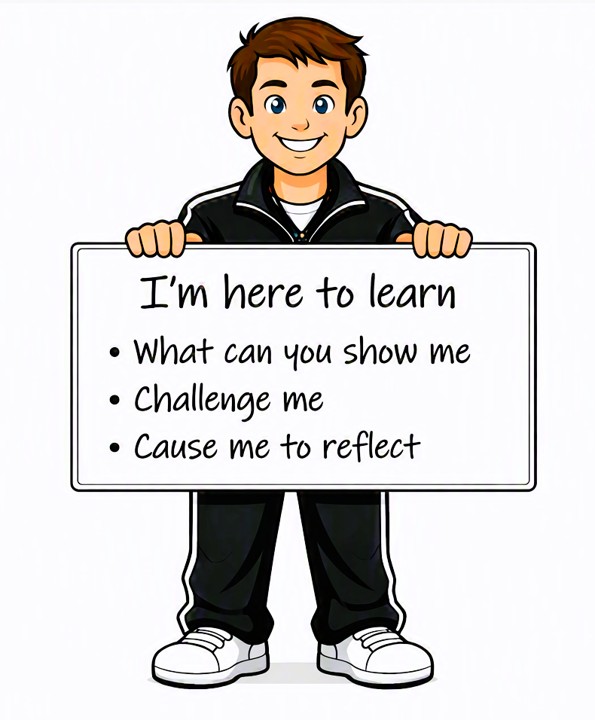
Create a supportive and challenging network
It’s tough to develop alone
The way you develop and use your network is crucial. Do you open yourself up to the critical challenge?
How often do you contact others to ask what they think, or whether they could help you understand an alternative viewpoint?
Hopefully, you have 3 or 4 people whom you can regularly call to provide a different opinion or just a viewpoint on your thoughts.
I’ve found that there is much to be gained from meeting with other coaches and talking openly about topics.
It’s a great opportunity to hear something new, find a different viewpoint, or be informed that someone else has faced the same challenges.
You may not like the idea of having a coach to coach discussions and see little value in it. You may decide that talking about coaching with other coaches (coach to coach) makes you feel uncomfortable.
Consider if this ‘difficulty’ is something from inside you, and just your reaction to their words. It’s super tough to be successful without working with others and engaging in debate/exploration.
Have a 'sphere of agreement'
Different viewpoints at different times
Throughout your coaching journey, I hope you find or have found lots of ‘it depends ie context is very important.
I’ve found that there are many seemingly opposing ideas and concepts that in certain contexts, I can agree with and use, and in others, I don’t think that they are applicable.
Equally, I hope that there are some ideas promoted that you can’t see any value in.
Create a “Sphere of Agreement” within which you allow yourself to have different viewpoints and some that are outside the sphere.
Of course, be respectful of other people’s viewpoints, they are allowed to hold the, as long as they don’t cause harm.
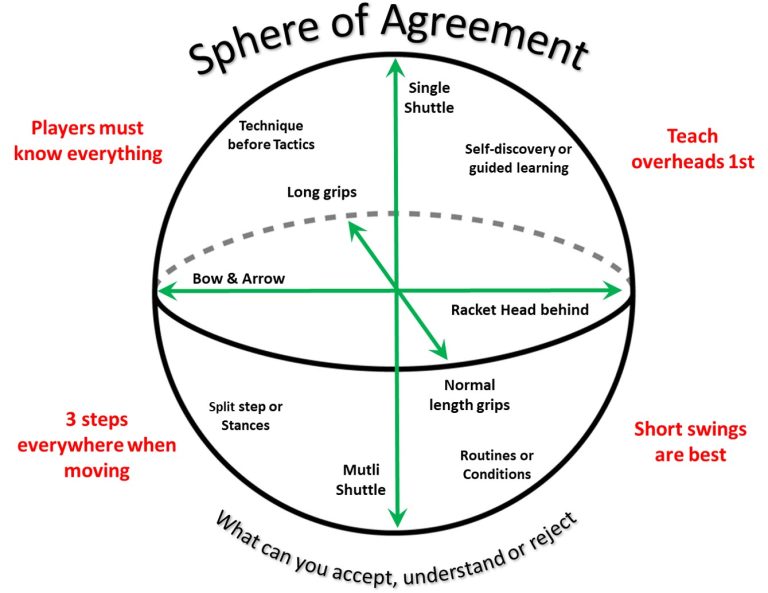
It’s your sphere, and it’s up to you to work through people’s arguments
You don’t have to agree with them, but accept that they have an opinion. Trying to convince everyone that your viewpoint is correct is often too emotionally draining.
What viewpoint would you take on these concepts and is there a case of “it depends” ie there are contexts where you could agree or disagree with your own viewpoint.
… The use of single vs multi shuttle training
… The position of the racket for overhead strokes
… When tactics should be introduced,
… Should overheads be introduced early to novice players?
Do you have a firm, established, non-negotiable view on these?
Some topics may cause you to have differing opinions depending on the context.
How you coach is as important as what you coach
(possibly more)
Do you know different ways to teach the same thing?
How you found the ‘best way’ or are you like me and still searching?
It took me several years before I realised that using exactly the same method to coach did not work with all my players. If you coach everyone the same way and worse still, you coach everyone like you were coached, trouble lies ahead!
You must pay attention to your players’ current level, motivation, needs, wants, requirements.
Unfortunately, always doing the same practices and giving the same advice is an easy habit to fall into when you start
You will have a limited understanding of different methods, especially if you have no formal coach education. Therefore repeating the same with all players will be very tempting, but it’s not coaching.
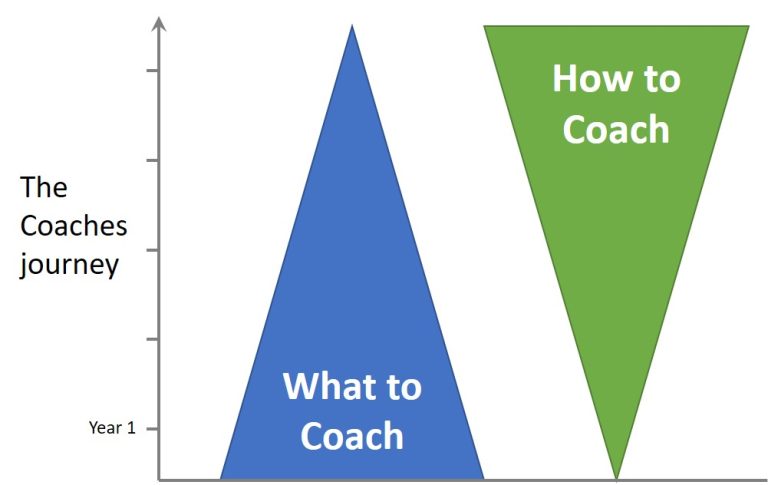
It’s very easy to start to love the technical side and believe that knowing ‘What to coach’ is all you need.
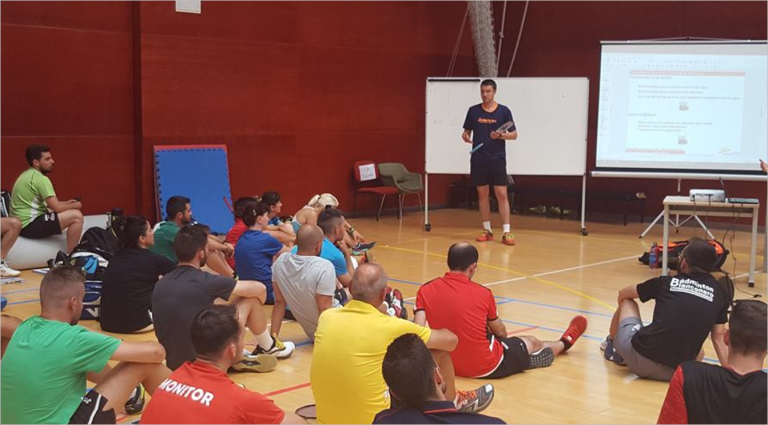
It will not take you long (in years) to accumulate lots of ‘what to coach’ (the techniques and maybe the tactics) but will you also be working on expanding your ability in knowing different ways of ‘How to coach’?
The how-to-coach knowledge challenge will keep you interested for a lifetime,
I promise 🙂
Work to understand the players' motivations
Give them more and more reasons to be motivated
It’s obvious and it’s true!
Your challenge is to create an environment, a task, or a desire that utilises the power of motivation. This applies to players, coaches, and parents.
It took me a while to understand how many different ways there are for creating an environment and mindset.
Working with players, coaches or parents who are motivated to learn and find out more is a fantastic situation to be in.
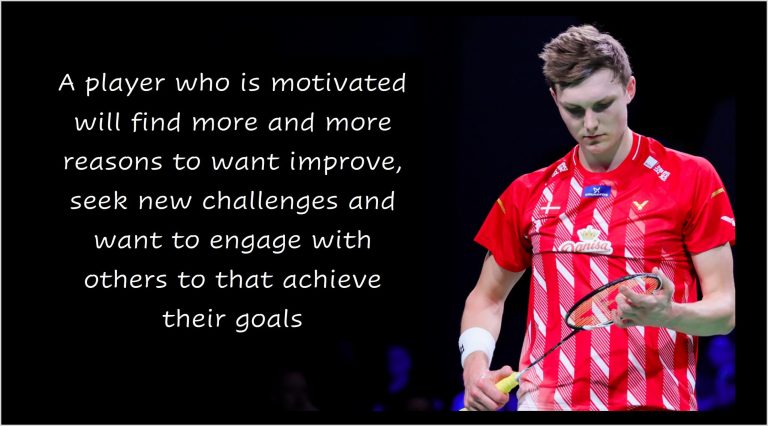
Become great at understanding how many different forms there are and what triggers, plus suggestions you can use.
I recommend that this starts from before you are on court, delivering the 1st lesson.
Ask the player to write down 3 things that they would like to improve and 3 reasons why they love badminton.
The information they bring and the task they’ve completed is just the start but it will give you so much to work with.
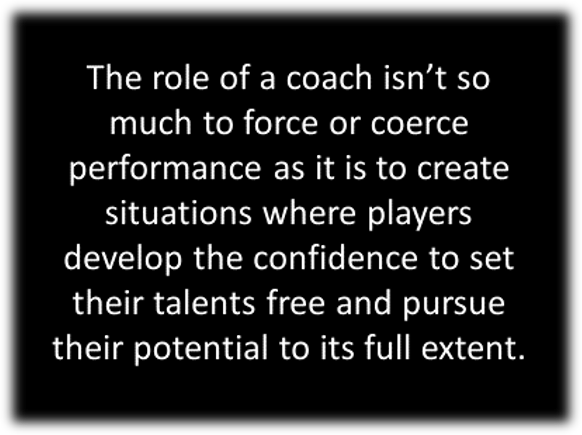
Do you agree that motivation is the most important factor in learning?
Identify the skills (not just techniques) of the game
What ‘skills’ are you developing in your players?
You may think that technique is a skill. It’s not; technique is just a way of executing something on the court, often with no relation to the opponent, the situation, or a strategy.
What would you add to this list of skills
- Decision making: the choices players make whilst in the game: some quickly almost without knowing, others with an intention based on immediate knowledge
- Strategic thinking: the tactics you use in a game, the tactics you prepare in advance
- Courtcraft: what to between rallies, how to prepare for competition, what to do away from the court
Be aware of not just practicing techniques, and especially technical practices that are in isolation and worse still have no opponent and maybe even no shuttle.
Become great at incorporating tactical elements in all practices.
How early in a player’s development do you introduce a tactical thought
Have you thought about doing that?
Do not strive for or wait for 'perfection'
Perfect practice should not be your goal
Establishing good, robust technique, tactics, courtcraft, etc that works well under the pressure of competition is the goal.
However, to win or be happy on the court you don’t have to play perfect badminton.
Be careful in your coaching that you don’t imply that the goal or the aim of the practice is perfection. There are dangers in doing that.
Rather than wait for a perfect technique to appear, I’d advise that you regularly move a practice on (make it tougher) as soon as the task, the goal is maybe only 60-70% of what you were aiming for.
Ok, this may be tough for you as a coach to accept, as there will still be ‘errors’ and room for improvement left.
In practice, try to create a culture that allows both players and coaches to look for challenges rather than perfection.
That means asking players if they want to make the practice harder or tougher or more applicable to their needs.
Sounds complicated?
It could be, you will have to work as a coach.
Want to read more?
- please think about how you view consistency: the short post and the long post
- how players react to errors is very important, everyone makes them!
- be prepared to accept 'mistakes', maybe you need to redefine what an error is in all its different forms
- how players react to errors is very important, everyone makes them!
- what do the experts say about reaching perfection on the court
Once you set the practice at a level slightly higher than ‘comfortable’,
all sorts of things start to happen
Your coach education is not just a course
Make it a lifelong passion to seek more knowledge
When you passed your 1st qualification, did you think you were ready to coach?
I did. Oh, how wrong I was!!
I faced lots of problems the first 12 months. However, they didn’t go away; the more I thought I knew, the more I kept seeing questions.
I recommend that you either create a great group of challenging friends or seek out a mentor. Why not do both? Have you done either?
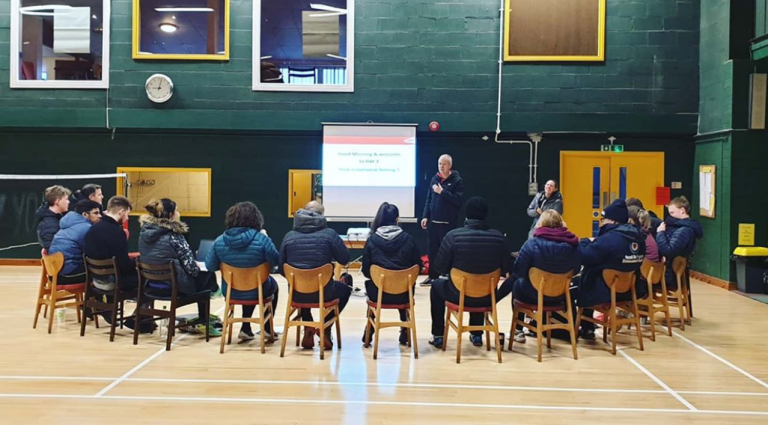
Please don’t think that I’m saying coach education isn’t important; it is.
It will be a gateway to lots of ideas, and you will meet other coaches, plus you will hopefully get a qualification that opens more doors.
However, those 4 or 6 days amount to very little over the few years in terms of time, and you will forget most of what they taught you.
Or, worryingly you will remember some and just repeat that over and over.
Be motivated to continue learning. Attend different courses, conferences, webinars, and talk to other coaches!
Listen to podcasts, read books and most importantly, do all this with a thirst for more knowledge. Become your own tutor, maybe even start assessing yourself.
What have you done in the last 6 months to expand your coaching knowledge?
How long is your list of things you want to know more about?
What are your 'absolutes'
Non-negotiable guidelines that shape your coaching and coaching behaviour
If you haven’t thought about this, then why not go in search of those strong beliefs you’ve created over the years you’ve been coaching. I’m sure you must have some, we all do!
They will probably include those things you insist on from your players, yourself, the way you coach, some aspects of technical essentials, and how the game is played.

It’s important to consider what absolutes you may have. I’m using the term absolute so that if focus your mind.
Go in search of those values or principles which are currently in your opinion, unquestionable and exact. Find yours and identify why you use them and why you believe so strongly in them
There really is a lifetime to become an effective Badminton coach as they will change as you acquire more experience and knowledge. Take a moment now and think about what your current absolutes are under the headings on this image.
It would be great to see your list or have a conversation with you about those on my list that you don’t consider should be there.
Past experiences are not always what you remember
Your memories are not as accurate as you think, they can skew your thoughts
It may be very tempting to repeat the things that you thought worked for you in the hope that they will help others; doesn’t it seem obvious?
When you were younger, you practised hard, and improvements happened; therefore, it is easy to believe the same will happen to those on the other side of the net when you coach.
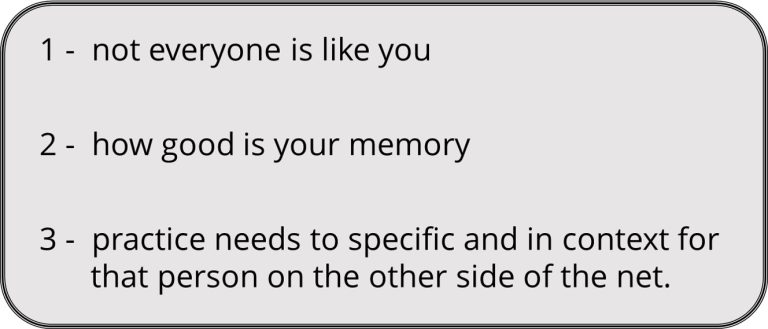
You may feel that there are no secret techniques; you believe that it’s all about ‘quality’ work done with dedication.
However, here are 3 considerations for you that I hope will get you thinking. Take a look at this image. I believe that the most powerful one is no. 3.
Do you agree that the way to help someone is to find a need that is specific to them and delivered to them in a way/method that is productive?
Be careful ..
- if you find yourself referring to what you did when you were a player, what worked for you, what you enjoyed, and assuming that others must be of the same opinion
- when you think back to the advice you liked, and then just repeat it to your players without knowing the original context in which it was given
- if you find yourself deliberately not talking with other coaches and you judge them harshly as they 'never played' to a good enough level
Be specific to the needs of your players, not practises you’d like
Send me a question
I’m always grateful if you have read this far.
What have I missed that you expected? Send me an email.
I promise to read all your comments
It would be great to hear from you contact@badmintonandy.com


![Keep your racket up - Duplicate - [#38056]](https://badmintonandy.com/wp-content/uploads/2026/09/keep-your-racket-up-scaled.webp)