
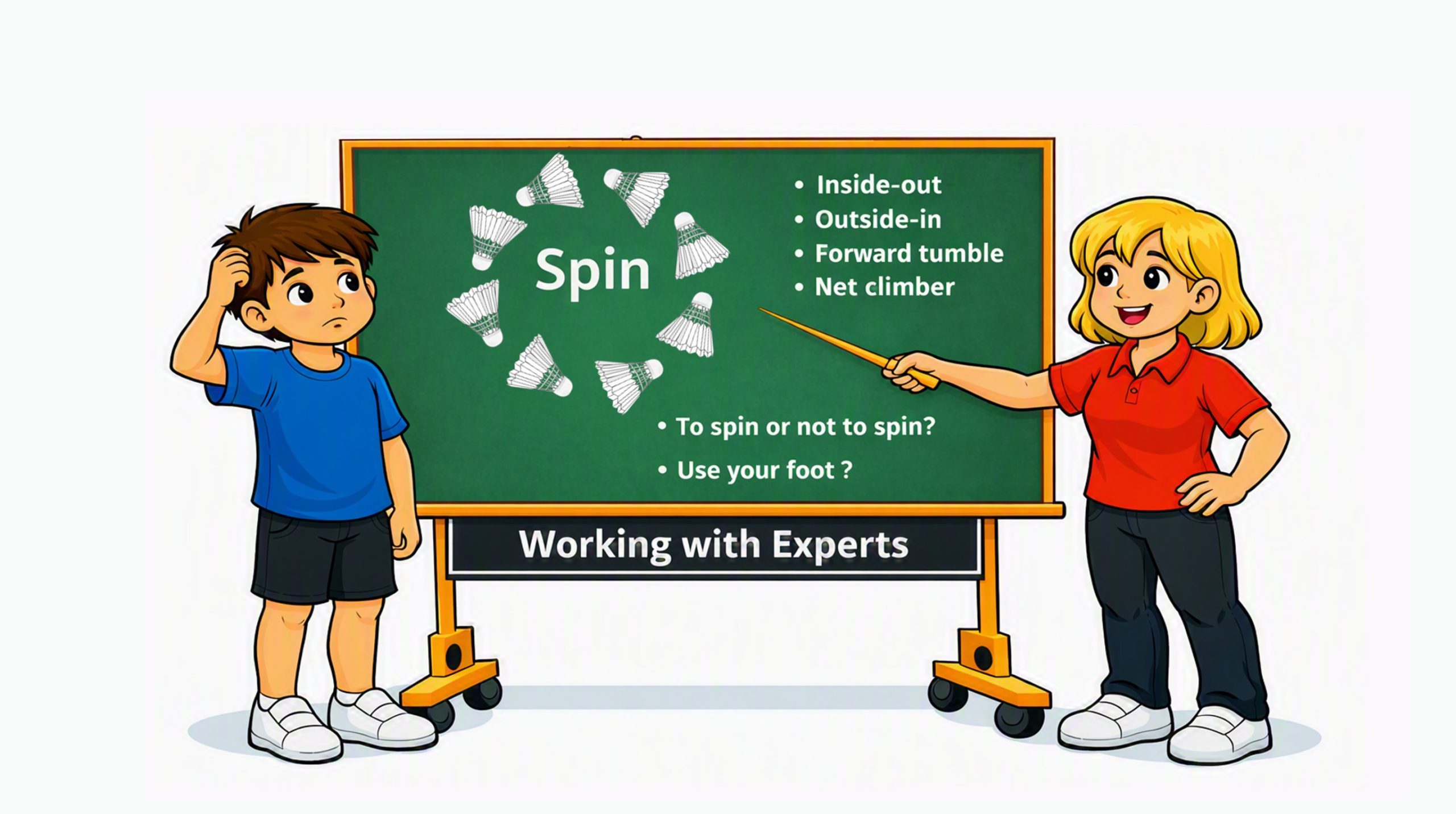
The process is exciting and sometimes mysterious
Working with experts will test your coaching abilities
Your aim is to improve technical ability,
but more importantly, the tactics and strategies to use in competition
General advice about practice
The practices you use are the key to development,
not the amount of technical information you impart to players
- Create practices that enhance the opportunity for continued development and that create real game advantages.
- Lots of player input will be required, create experiences, and challenge
- Provide hints and tips : be careful about the amount of technical information that is given
- Do talk with other coaches how their methods but remember the way coaches talk to coaches is NOT the same as the way Coaches talk with Players
Other information to help
Have you seen these two posts for more ideas?

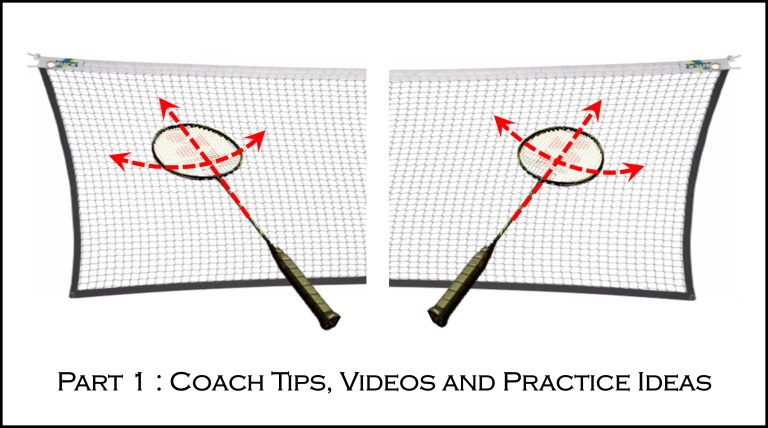
You will meet people who have ideas of their own; their advice may differ from mine.
You will have to navigate this yourself
Working with experts
One day, the player will develop skills equal or better than the coach's
The challenge is how to help someone with more advanced skills than yours.
Coaches need to become adept at finding ways to assist the development of experts that do not always involve them being on the court.
Hand-feeding is the traditional way of practising spins when coaches are on the court and there is a danger that experts will become great in practice at playing spins to hand feeds.
Whilst this will establish proficiency in practice and start to reproduce the ‘required technique’, there is a danger of developing practice performance rather than game skill.

Players will ask a feeder to stand in a certain place, feed with a specific direction and trajectory, all so that they can ‘feel’, devlope a known spin.
The traditional next step is to move from hand-feeding into net games. Whilst I do support the use of net games, especially with competitive elements, they are not always similar to the situations in real matches.
To develop experts, you will need more than hand-feeding and net games.
The way you design the practices, the difficulties you introduce, the suggestions you make, the questions and discussions you have …. that is a coaching skill you can use.
Conider uisng racket type feeding (within rallies) or mini-conditioned games that increase the opportunities for spins of the type your players want to practice.
This certainly applies to the ‘counter-spin’ work
Ensure that practice is regular and varied, including match-like scenarios
Allow players to believe that these practices are the key to development
Counter spins
The art of returning spins is important and a skill not often spoken about
All players and especially experts must learn to return spinning nets not just with lifts but counter spins returned back to the net.
The ability to become great at performing these skills should be instilled into all experts.
Mnay coaches et up a practice where they hand-feed a spinning the shuttle; however, this isn’t the most effective method.
Do you think a coach can spin the shuttle just as it flies in a competitive match?
I’m sure they can make the shuttle spin, but how realistic are your hand-spin feeds compared to what happens in a match?
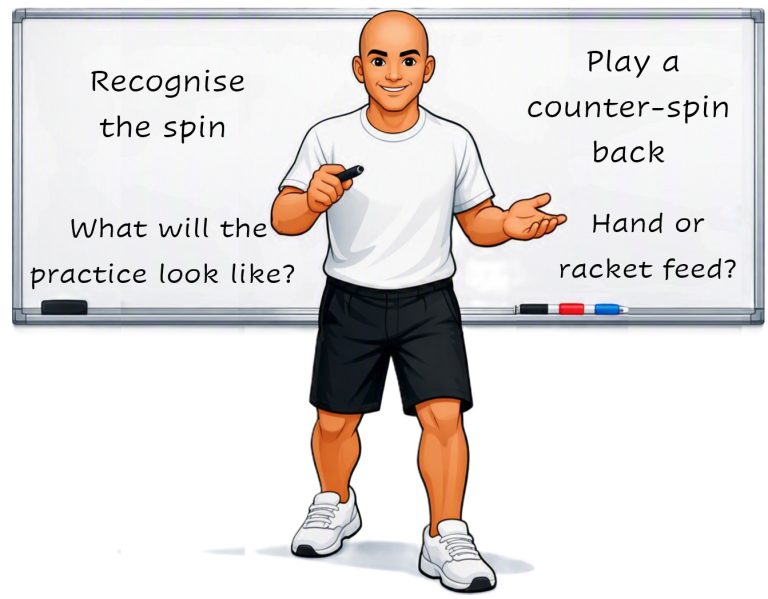
Also, the ability is not just the technical aspect but knowing when to try a counter spin, and for that, you will need an opponent who plays with the intention of an opponent, not always a feeder.
I recommend that you make use of ‘partner practices’ detailed below
To master counter spins is a fantastic goal,
are you working towards this?
The importance of practice partners
Maybe the key to long-term development
As often as possible, players need to practice net spins with other players. This is the most effective form of practice.
Don’t just have players hand-feeding each other; create practices with elements of both cooperation and competition.
The practice may look something like this
Player A : blocks or pushes (like a serve) over the net that would land around the service line.
Player B : attempts to play a tight net from this push/block (initially without spin)
Player A : moves forward and spins
Player B : tries to either spin the return immediately, or let it drop and play back to the net, to return
I know you may think that this practice sounds very simple, but it’s more realistic than hand feeding as there are subtle variations contained within.
Player A can decide how fast or flat to serve/block. To which side of the opponent should be ‘feed’ (will the return be different). They could feed straight or slightly crosscourt.
Player B could take it very early and return with a ‘fast net’ or hit a loopy ‘feed’. They could try to spin (even if they are away from the net). They could direct the net return away from the opponent, making them adjust.
There are huge amounts of information and opportunities available when players practice together if you create the structure/rules.
Not all of this will sound like coach instruction. Most of the valuable information can be seen or experienced as they work together in these practices/challenges.

Encourage players to practice with each other and at times make it tough for each other
Isn’t that what happens in a match 🙂
Information and experts: how much and when
This text may be seen as contradictory as elsewhere on this site I have often said that should consider the amount and type of information they impact to players. This is especially applicable when working with beginner players.
Players learning a new skill or technique will benefit its the practice (or task) that provides them with the information they need (constrain and shaped) rather than listening to the coach.
If you are working with experts, you may need to discuss and impart information that previously you would not give to beginner and intermediate players.
Some experts will demand information, be prepared for that!
Many are generally better at being able to conceptualise information. I mean that they can extract usable elements to try out on the court. They can listen to stories, receive technical prompts or watch others.
Their expert skill allows them to consider the information then act.
However, this isn’t necessarily the case for all expert players My recommendation is to be aware and flexible in your style of coaching and understand that information should be given.
Allow the expert to request and take what they need.
Be prepared to offer information when asked,
but be prepared to assess how much and how useable it is
Be prepared for these challenges
Some experts prefer to see and do rather than listen and discuss
- Coaches – can you reduce your verbal content? What visuals can you present to the players?
Some experts are comfortable with a slower pace of development as they see it as refinement
- Coaches, are you prepared to stand back and let players work it out for themselves. It will take longer. The number of errors may increase, will you be worried, as practice is never perfect.
Being challenged by experts who use ‘ why questions’ concerning the practice, the information, the contractions and the confusion they feel
- Coaches – are you prepared to back up what you say, and does it refer to what happens to a real match.
Some experts will have forthright (almost certain/stubborn) viewpoints and a reluctance to change
- Coaches – sometimes don’t insist, let experts decide and then reflect. Set up situations, games, scenarios where outcomes are not always predictable and may test their current thinking and techniques.
Obsession
Be aware that some experts can become obsessed with technique. Especially technical perfection in practice.
This can easily happen concerning strokes like net spins.
Wanting to improve and create awesome skills that you can perform on the court is not the issue. It’s great to have that desire. However, enjoying practising in a way that only seeks to improve practice performance and not include game-like stress and situations can lead to problems.
It can be easy to create a practice where the sole intention is on a technical outcome.
Be aware that to achieve this, some experts will oversimplify their practices in order to achieve what looks like perfect performance, but how simply should practice be made just to increase the performance, especially when working with experts.
Be aware if you are engaging in simple practices
in order to achieve a high degree of practice perfection
Do's and Dont's
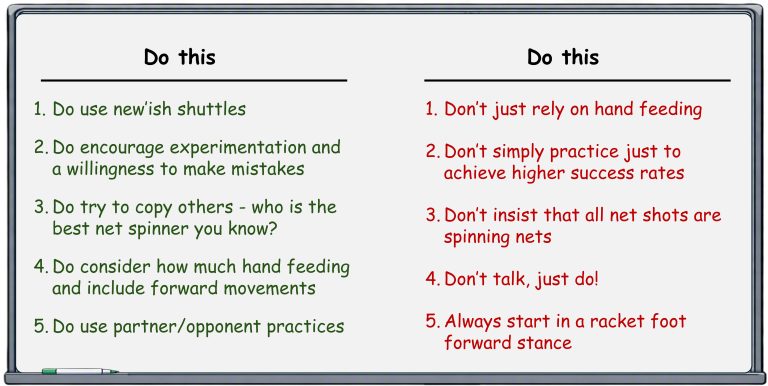
Everyone will have an opinion on how to play and coach net spins,
Listen to what others say, request confirmation from people you trust,
Look to see if it happens in a game; try it out with players.
Send me a question
I’m always grateful if you have read this far.
If there is anything that you have read that has helped or that you disagree with, then please send me an email.
I promise to read all your comments
It would be great to hear from you contact@badmintonandy.com

![Keep your racket up - Duplicate - [#38056]](https://badmintonandy.com/wp-content/uploads/2026/09/keep-your-racket-up-scaled.webp)
![Introducing the badminton overhead – Challenge No.3 - Duplicate - [#36874]](https://badmintonandy.com/wp-content/uploads/2023/05/Badminton-Forehand-Overhead-3-scaled-1.jpg)