Practice isn't a choice between two extremes
Game or Drills
This creates unnecessary tension in coaching discussions
Thinking about badminton practice as a continuum of game-likeness
provides a more useful framework
Asking coaches to decide between Games or Drills creates unnecessary tension in coaching discussions.
Coaches can find themselves confused when hearing arguments about whether players need more technique work or more game-based practice, when in fact effective coaching usually involves both.
Worse still, they find themselves stuck, unable to clearly define their practice principles as they find themselves agreeing with both sides of this discussion.
- Rather than seeing practice as either a drill or a game, consider:
- How much player choice is there?
- How much uncertainty do the players have?
- Are these levels appropriate to the players skills in this specific practice?
Do you agree?
Badminton is more than hitting shots. It is about deciding which shot to play and when, while facing an opponent determined to outplay and outthink you.
Does your practice progressively help players to decide when and how
to use the techniques you coach them
Game-like practices help players to:
- Transfer techniques to match skills.
- Make better decisions, become adaptable
- Develop tactical awareness
- Solve problems independently
- Perform under conditions that are found in competition
Too often, practice focuses on developing and perfecting a technique, with little thought given to what comes next.
Effective coaching helps players develop techniques and then, as early as possible, progressively challenges them to apply it in environments that increasingly resemble the game itself.
Consider allocating more time to helping players use the technique
rather than ‘perfecting’ it in single-shot practice rallies
If you want players to perform better in matches, they need opportunities to practise the skills that matter most in matches.
Game-like practices do exactly that.
They challenge players to treat games as a competitive challenge against an opponent (and sometimes themselves) : to make decisions, solve problems, adapt their movement, and respond to what is happening over the net, or the thoughts that are in their own head..
While traditional drills can improve technique, game-like practices help players learn how and when to apply those techniques in competition.
Players don’t compete in drills; they compete in games
A beginner learning a forehand defensive block may start with very controlled practice.
A feeder uses an overhead feed, hitting or throwing it by hand. The player moves to the side to block it over the net.
As the player develops, they may practise both faster defensive shots that land beyond the service line and higher, slower blocks that land shorter. Plus straight and crosscourt.
The feeder can also vary the feed by changing the speed, angle, and placement of the shuttle.
The player gains some competence.
The coach now has a choice
The practice so far is often only a 2 shot rally : feed and defensive block. The coach now needs to decide what to do next.
Should they continue to develop the player within the same practice: doing more repetitions, asking for more accuracy, refining the subtle variations in technique the coach sees.
or
Should they take the part-developed stroke and introduce an ‘opponent’ who will provide different down shots (pace, position, indecision) and also return the shuttle.
The key decisions for the coach
- Should variation or variability be introduced into the practice?:What type and when. Added at the start of the two-shot rally or towards the end?
- What will happen to performance?: Does the player have sufficient competence to achieve a reasonable level of success? What does success now look like?
- How will the player react?: If perforamce drops, to the increased varaiatiosn. To the loss of controlled parctice drill.
- How will the coach react: If performance drops, to increased variation. To the loss of a controlled practice drill?
- How much game-likeness is required?: If this stroke is important in competition, it needs to work under competitive conditions. Is the current practice providing the game-like demands necessary for that to happen?
At what point would you introduce an opponent?
What evidence would tell you the player is ready?
Key characteristics of game-like badminton practice
Game-like practice is not about making every activity look exactly like a match. Instead, it exposes players to the information, decisions, movements, and tactical challenges they will encounter in competition.
Effective coaches adjust the level of game-likeness to suit the player’s current needs while keeping learning connected to the demands of the game. Rather than simply repeating techniques, players learn to apply skills, make decisions, and adapt to changing situations.
Key characteristics of game-like practice include:
- Uncertainty and Variability: The next shot, movement, or situation is not always predictable, requiring players to adapt and solve problems.
- Decision-making: Players make purposeful decisions with consequences, such as creating space, applying pressure, attacking weaknesses, or regaining control of the rally.
- Reading the situation: Players make purposeful decisions with consequences, such as creating space, applying pressure, attacking weaknesses, or regaining control of the rally. They are encouraged to "look over the net at wthe effcet of what you do"
- Tactical problem-solving : Practice presents realistic game challenges that encourage players to identify and implement effective solutions.
- Consequences for success and failure: Activities include meaningful objectives, scoring systems, or competitive elements that reflect the demands of competition. These do not have to be additional 'punishments' to those found in a match..
- Representative movements: Players perform realistic badminton movements, including footwork, recovery, timing, and changes of direction that mirror match play.
- Interaction with opponents : Players respond to the actions of opponents or feeders, creating the continuous interaction found in real games.
The more a practice contains these elements, the more game-like it becomes
When you might reduce game-likeness
Reducing game-likeness is not a failure of the coach
Game-like practice and representative learning environments can help players develop perception, decision-making, movement adaptation, and tactical awareness in ways that isolated drills often cannot.
However, this does not mean that every practice should be as game-like as possible.
Effective coaching is about matching the learning environment to the player’s current needs rather than committing to a single approach.
Sometimes this means increasing game-likeness, while at other times it means providing greater support and structure

Reducing game-likeness when beginners need:
For beginners, reducing game-likeness can provide the structure and support needed for their learning.
Predictable activities help players focus on practice without being overwhelmed by too many decisions. While decisions are important, they can provide too much stimulus and ‘freeze’ players. The learning journey takes time and has many ‘pit stops and lay-bys’.
Simplifying practice can also increase success, helping players build confidence before progressing to more game-like environments.
- A break, and seemingly overwhelmed by practice. Remove elements to provide greater predictability. (Some game-likeness may still be present)
- Technical guidance provided through a heavily constrained practice (eh Wallwork for grips, serves, or overhead actions)
- More repetitions with a high success rate (many reasons why)
Reducing game-likeness for new learning when:
There are times when players are learning an entirely new movement or technique that is not yet established enough to withstand the demands of a game-like environment. At these times, players may benefit from less game-like practice.
A controlled environment allows them to focus on the movement or technique without being distracted by too many decisions or variables (different shuttle flights, speeds, opponents seeking an advantage).
- The skill or technique has not been encountered before by the player (eg the first time overhead backhand, the deep forehand from a quick flick, defensive bh alternative movements)
- Technical errors are preventing development and success and are resulting in anxiety or frustration
- Players need to experience something (however minor) that feels successful. Without experiencing repeated failure.
Reducing game-likeness during rehab:
Players returning from injury often benefit from less game-like practice at the start and at various stages of their recovery
Movement demands and physical loading can be controlled as a result of reducing the requirement for decision-making. The increase in predictable activities can help players regain trust in their bodies before gradually returning to more game-like training and competition.
- Reduce those stresses caused by decisions and preparation to move loads.
- Allow controlled movements to be progressed in a structured way
- Provide player confidence through repetition, and understanding how their body is reacting to the defined workload.
Reduce game-likeness only enough to achieve a specific aim,
then progressively increase it again as soon as the player’s needs allow
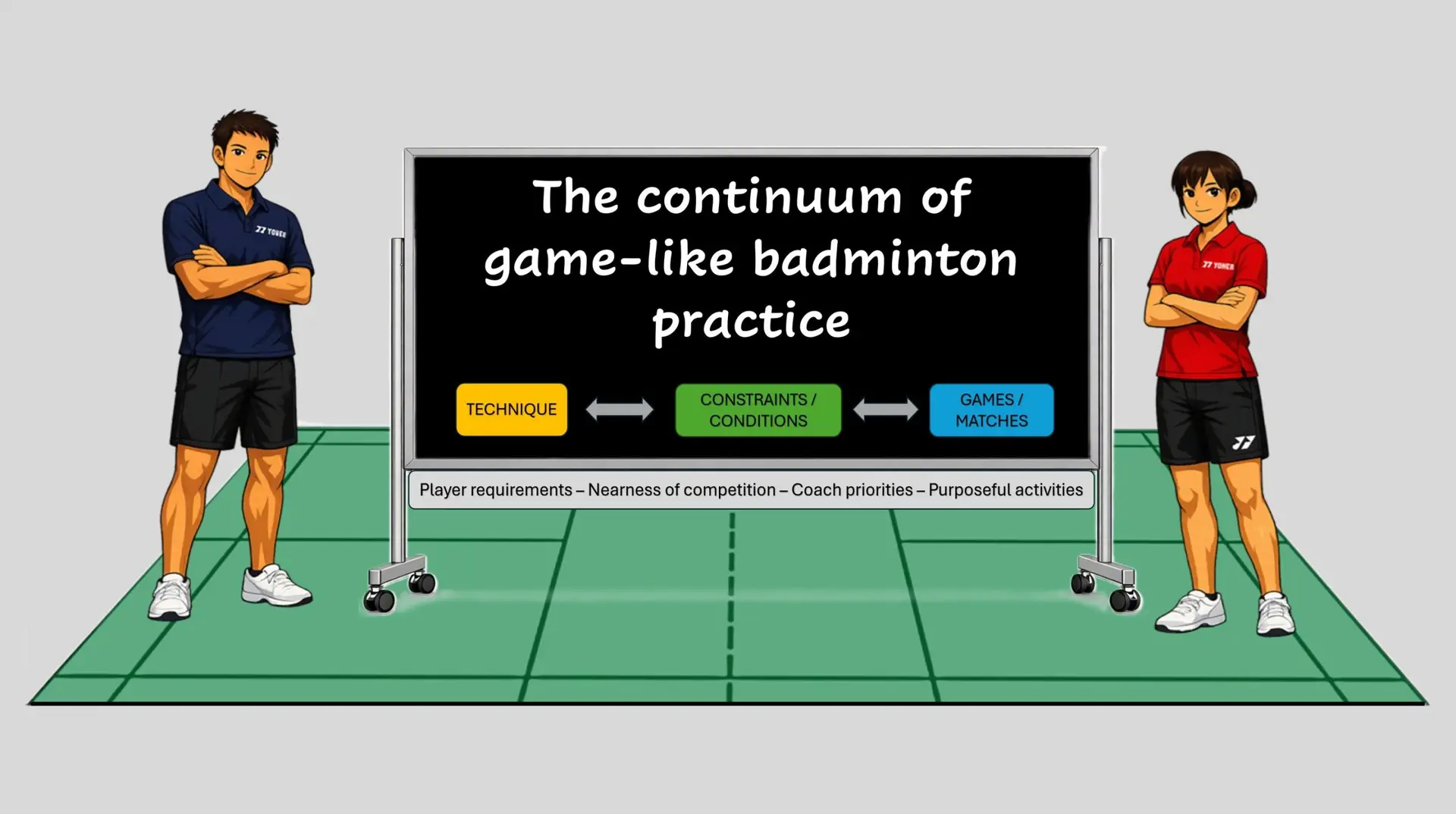
View practice as a continuum of game-likeness
Technique-closed-type practices; at the other, Games & Conditioned Games
Practice design need not be a choice between two extremes
The drills-versus-games debate can create unnecessary tension and often doesn’t help conversations between coaches. Only having 2 extremes forces coaches and coach educators into ‘camps of philosophical agreement’.
A continuum of game-likeness offers a more useful framework, allowing coaches to gradually increase decision-making, uncertainty and tactical awareness while developing technique and hopefully find that useful conversations can still be had.
In reality, effective coaching usually involves both ends
Most coaches use both, and hopefully, many subtle variations between
Net shot practice example
An approach with beginners and sometimes with very good players (the reasons will be set out in other posts) is to design a practice where a player repeatedly performs the same net shot from the same position.
This deliberately contains very little game-likeness, particularly if the shuttle is fed by hand and the feeder does not return the shot.
The player knows where the shuttle is going, what stroke they will play and where they should move next, if at all. As a result, the activity removes variability, stress and allows for technical repetition but places very few demands on perception, anticipation or decision-making.
Consider the reasons why a practice with very limited
or no variability and decision-making would be used with beginner players?
A step further along the game-likeness continuum might involve a racket-fed sequence where the feeder can play one of two feeds, a tight feed or a longer flatter feed.
The player also has choices to play either a tight net return or a lift. The player still knows the general purpose of the practice, but must now observe the shuttle struck by the feeder, recognise the situation (what the feeder does next) and select an appropriate response.
Although the range of options remains limited, the player begins to experience uncertainty and make decisions rather than simply reproducing a movement pattern.
Consider when you would introduce
variability and decision-making for both feed and player?
At the opposite end of the continuum lies a conditioned game designed around net play that contains many of the characteristics of competition.
Through carefully designed constraints and rewards, players are encouraged to create and exploit net-court opportunities whilst remaining free to choose how they achieve success.
They must observe, decide, move, adapt and respond to an opponent’s actions. No two rallies are identical, and success depends not only on technical execution but also on perception, decision-making and tactical awareness
Viewed in this way, game-likeness is not an all-or-nothing concept. It exists on a continuum, with coaches able to gradually increase uncertainty, variability and decision-making demands as players develop
The challenge is not choosing between drills and games, but deciding where
on the continuum a particular practice should sit to achieve the desired learning outcome
Read more from this mini series
The most successful badminton programmes do not choose between drills and games.
They deliberately use both, helping players progress from technical competence towards competitive performance.
Click on this image to see all the posts in this mini-series.
They explore lots of different questions that coaches have regarding the inclusion of game-likeness in badminton practices.
It is now your challenge to read, reflect, and then decide what you want to do with your practice design.

Don’t ask whether a practice is a drill or a game
Ask whether it provides the right level of game-likeness for the player’s current needs
Send me a question
I’m always grateful if you have read this far.
If there is anything that you have read that has helped or that you disagree with, then please send me an email.
I promise to read all your comments
It would be great to hear from you contact@badmintonandy.com