You may be tested more than you expect
How many of these challenges have you experienced
How did you resolve or overcome them
The idea of game-like practice sounds straightforward,
but the coaching is often much harder than simply feeding shuttles
When a coach tries to replicate a real match environment or simply include player decisions, they can run into challenges.
Within most coach education courses, game-likeness in practice is a commonly discussed concept. Coaches are increasingly encouraged to create sessions that resemble the demands of competition rather than relying entirely on repetitive drills.
However, how often are these 6 challenges discussed and advice given on how to manage or overcome them?
The challenges are outlined and discussed in part, but you will have to develop answers about how to resolve them.
Maybe the last one is a big reason why you don’t favour game-like practice.
Consider the points below, experiment to find solutions,
Maybe even change your current mindset.
The conflict of Perfect Practice vs Messy Reality
What are you striving for in your practice?
Many coaches search for the perfect practice: one where performance is high, technique looks “correct”, and players achieve consistent success.
Introducing game-like elements changes the practice. Players face uncertainty, make more decisions, experience more mistakes, and may even feel uncomfortable. As a result, the practice may look very different from what the coach expected.
This is where an important coaching challenge begins.
When performance starts to look less than ‘perfect’, how do you respond?
Do you reduce the game-like demands to regain control and success? Or do you accept some messiness because it may support long-term development?
- Before answering, consider what you value most in practice:
- Low error rates
- Consistent technique?
- High levels of physical effort?
- Learning and development?
- Preparation for competition?
- Your answers will influence how you respond when practice becomes less predictable
What do you want the most from your practice?
How are you influenced by what you see happening once it starts?
The Perfect Practice trap
The pursuit of “perfect practice” can sometimes lead coaches to mistake good performance for effective learning.
- A practice can look successful when:
- Errors are rare
- Technique appears consistent
- Success rates are high
- Players achieve every target set by the coach
These observations are reassuring because they are highly visible, measurable, and often align with what coaches expect progress to look like. However, they may also indicate that the practice has become too controlled and insufficiently game-like.
- Often this happens when:
- Players know exactly what is coming next
- Decision-making demands are low
- Repetitions are high and predictable
- The coach controls most variables
- Feeding, movement distance, and pacing are carefully managed by the coach
Consider what is causing the practice to be ‘Perfect ‘. It generally happens when the amount of decision-making from the player is low: they know what is required, what to expect. Also the number of repetitions before interruptions is high: often very high ie numerous sets of 12-16. This second point can lead o ‘Practice Performance’
The coach is ‘controlling’ the practice, maybe over-controlling it, by initially setting the previous 2 aspects, but also by making minor adjustments (maybe unknowingly) to the feeding, pace and movement distances.
Perfect practice often reflects coach control rather than player adaptability. The goal is not perfect performance in practice, but performance that transfers to competition.
If practice looks perfect,
ask yourself whether it still looks like badminton
The Messy Reality
Game-like practice encourages players to operate more as they would in competition. Although the practice will be coach-designed to include considerations, constraints, and requests.
All of these are aimed at creating conditions to guide learning, as the player must deal with greater uncertainty, make more decisions, and adapt more frequently.
- As a result, coaches should expect to see:
- More errors
- Less technical consistency
- Variable performance
- Different solutions to the same problem
- Emotional highs and lows
- Fluctuations in performance between sessions
Many coaches see these outcomes as signs of poor practice or coaching failure. Yet in reality, they often reflect the realities of competition and create opportunities for learning.
This can be uncomfortable. Coaches may watch a player move from near-perfect technique in a drill to a much less polished performance in a game-like activity and feel as though progress has disappeared.
Often, it hasn’t.
The player may simply be learning to perform the skill while managing the uncertainty, pressure, and decision-making demands of badminton.
If practice always looks tidy, predictable, and coach-controlled,
players may be learning to perform drills rather than learning to play badminton
Summary
If you want players to perform better in matches, they need opportunities to experience the demands of matches. Game-like practice helps create those opportunities.
The aim is not perfection. The aim is development.
Players must learn to adapt, solve problems, make decisions, and perform under pressure. Sometimes that process looks messy, but those messy experiences are often where the most valuable learning occurs.
Players don’t need perfect practice
They need practice that helps them perform when the game becomes unpredictable
Demands on the feeder
Game-like feeding requires much more than feeding shuttles
One aspect of game-like practice that is often overlooked is the skill of the feeder.
Coaches frequently focus on the player’s ability to perform within a game-like environment, but the quality of the practice is heavily influenced by the person creating it.
To recreate a rally or mini game that represents even part of a competition, the feeder, often the coach, requires a badminton understanding and playing skill. They need to move, prepare, and position themselves realistically, observe what the player is doing, and then select an appropriate response. They must vary the pace, trajectory, timing, and location of their shots in a way that resembles a real rally.
At a minimum, the feeder should move, prepare, and position themselves as they would during a rally. They should observe the player’s actions before selecting their next shot, rather than delivering pre-planned feeds in a predictable sequence.
The more realistic the feeding behaviour, the more realistic the information available to the player.
These observations are reassuring because they are highly visible, measurable, and often align with what coaches expect progress to look like.
In highly game-like practice, the feeder is not simply delivering shuttles
They become an active part of the environment that shapes learning
Why game-like feeding is difficult and mentally taxing
The challenge for the feeder is that they must provide enough consistency for learning while maintaining enough variability to represent the game.
Too little variability, and the player stops adapting.
Too much variability and the player may become overwhelmed.
- The feeder must simultaneously:
- Observe player performance
- Make real-time decisions
- Control feeding accuracy
- Adjust difficulty levels
- Regulate practice intensity
- The feeder is continually deciding:
- How predictable should the next shot be?
- How much uncertainty should I introduce?
- Does this feel like a game or part of a game?
- How much challenge is appropriate?
- Do the outcomes I'm seeing align with the practice aims?
This level of engagement is often required for two, three, or even four hours during a coaching session.
As fatigue increases, practices often become less representative. Coaches may unconsciously shorten movements, simplify feeds, reduce variability, or return to predictable patterns because it is easier to sustain.
This is one reason many game-like practices gradually drift back towards controlled feeding drills.
Creating realistic badminton experiences requires the feeder to think like a coach,
perform like a player, and sometimes behave like an opponent
Simulating "invisible" match pressure
Game-like emotions can be hard to create
The challenge is how and when to make practice feel like a competition or parts of it, rather than practice being different.
Real competitive matches demand intense attention from players: not only for running, jumping and stopping, but also for managing anxiety, the score, fear of losing and the pressure to find a way to win.
Practice should evoke the same questions: “How can I gain an advantage?”, “How can I stop my opponent from gaining the advantage?” and “When should I go for it?”
Not every rally is equally important, but every rally/stroke can have an impact
Is it possible for this to happen in practice as it would in a match?
Practice can feel too tough for everyone
Staying as mentally engaged in practice rallies as in matches can be emotionally draining for both players and coaches acting as feeders. When the demands become excessive, players—and sometimes coaches—may experience “saturation” (click to read more).
At times, reducing match-like pressure and creating a “safe” practice environment is the better option. Deciding when to ease the demands, and for how long, can be challenging for coaches.
Is it possible to always practice as if it were a match?
That every stroke/rally is important
Difficulty in tracking and measuring progress
Hard to quantify
What looks like performance in practice may not become performance in competition
What looks like struggle in practice may become success in competition
One of the hidden challenges of using game-like practice is that player improvement often becomes harder to see, even when learning is taking place.
Success is easier to measure in a closed drill: 18 out of 20 lifts land inside the rear tramlines.
Coaches can count successful repetitions, measure accuracy, monitor error rates, and compare performance from one session to the next. The environment is controlled, so improvements tend to be visible and consistent. Coaches assume that a reduced error count is a sign of progress.
However, it’s not the same when game-like thoughts are introduced.
The challenge is that coaches often continue to use drill-based measures of progress when observing game-like practice. The very skills that matter most in competition, such as adaptability, decision-making, and tactical awareness, are often the hardest to count.
Players have to make decisions under varying levels of pressure. Therefore, errors and variations in technique are more likely, as these factors can affect performance.
- They are not just executing a technique, they are simultaneously:
- Reading information, responding to the 'opponent'
- Make real-time decisions
- Adapting their movement, their stroke choice, their thoughts and expectations
- Considering what the various outcomes could be, which they want, how they would like their opponent to act
As a result, performance often becomes less predictable and less consistent. Coaches cannot expect progress to look like a steady upward line.
Instead, performance may fluctuate from week to week (good one week, poor the next), be great until more pressure (in different forms) is applied.
This can be uncomfortable for coaches because it creates uncertainty about whether the practice is working.
However, this variability is often a normal consequence of learning to perform in realistic environments.
The ultimate measure of progress in practice is
how well they perform when practice looks more like competition
Managing player frustration
What do you players believe progress look like
Players who spend long periods in predictable practice can become accustomed to visible success. When game-like elements are introduced, they may feel they are getting worse when they are actually experiencing the challenge of adapting skills to competitive situations.
Many players practice expecting improvement to be visible every session. Sometimes, coaches may hold the same expectation.
But what happens when learning doesn’t look like improvement?
Practices that generate high success rates can leave players feeling competent. However, practices that promote long-term development often involve struggle, adaptation, and periods where performance appears to get worse before it gets better.
If players believe progress should always be visible, they may interpret mistakes as failure rather than evidence that they are being challenged appropriately.
How often do you design practices that are challenging enough to create mistakes, uncertainty, and frustration?
Importantly, how do you prepare players for this experience?
The coaching challenge is to help players understand that frustration is not always a sign that learning isn’t happening. Sometimes it is a sign that meaningful learning has begun.
If players expect progress to look smooth,
they may mistake productive struggle for failure
The Illusion of Competence
One of the hidden dangers of less game-like, predictable practice is that it can create an illusion of competence.
Players experience repeated success, make few mistakes, and begin to believe they have mastered a skill. From a coach’s perspective, performance looks excellent: technique appears consistent, error rates are low.
The problem is that much of this success is often driven by the predictability of the practice rather than the adaptability of the player.
When game-like elements are introduced, performance often drops. Players who previously looked highly skilled may suddenly make more errors, hesitate over decisions, and struggle under pressure. This can be frustrating for both the player and coach, who may feel that progress has been lost.
In reality, the player is not getting worse. They are experiencing the difference between reproducing a skill and adapting a skill.
Do you take the time to explain that
mistakes and inconsistency are a natural part of learning
Sometimes learning can feel like a struggle
Coaches can help by preparing players for an understanding of what this ‘lumpy, messy, sometimes unpredictable learning’ looks like.
Rather than focusing solely on successful outcomes, celebrate improvements in decision-making, adaptability, problem-solving, and resilience. These qualities may be less visible than a successful shot, but they are often more important for long-term development.
Instead of asking: “How many shots did they get right?”, which draws attention to absolutes in terms of numbers.
ask,
Did you see opportunities to make it tough for the opponent? What were they and what happened?
The challenge for coaches is helping players distinguish between practice performance and player development. Just because a skill looks good in a controlled practice does not necessarily mean it is established well enough to withstand the uncertainty, pressure, and decision-making demands of competition and an opponent..
Helping players understand this distinction can reduce frustration when performance drops in more game-like activities. Instead of viewing mistakes as failure, they can begin to see them as a natural consequence of learning in a more representative environment.
Learning doesn’t always feel like progress
(How do you help others to appreciate and understand that)
Loss of coach control
From controlling practice to shaping learning
One of the coach’s primary responsibilities is to help players improve. Traditionally, many coaches have been trained to do this through Demonstration, Instruction, and Correction.
The coach decides what will be practised, how it will be practised, and often what success should look like.
Within this approach, the coach is highly visible in the learning process. They explain, demonstrate, observe, and correct. As a result, coaches can feel that they are directly responsible for player improvement.
However, introducing game-like elements can challenge this perception.
The coach still sets the practice goals, constraints, and learning environment, but they no longer control every action within it. Players begin making their own decisions. Feeders vary their responses. Different solutions emerge. Learning becomes less predictable.
For some coaches, this can feel uncomfortable.
The coach does not lose influence when game-likeness increases.
Their influence shifts from directing actions to designing learning.
The fear of not being the driver of change
When practice introduces and includes game-likeness, player behaviour often becomes more variable. The coach may see more mistakes, unpredictable decisions, and outcomes that were not planned. Also, progress is harder to measure.
The practice can sometimes appear chaotic, particularly when compared to a highly controlled drill.
This can create a feeling that the practice is drifting away from its intended purpose, or worse, that the coach is losing control.
In reality, what is changing is not the importance of the coach but the nature of the coach’s role. The coach moves from being the provider of solutions to the designer of learning experiences.
When you compare practice types, which one is easier to see development?
Most coaches have experienced the benefits of blocked repetition and predictable feeding. They often produce cleaner technique, fewer mistakes, and rapid improvements in practice performance.
The difficult question is: do they produce better techniques, or do they produce better players?
Many coaches only begin to ask this question when they notice a gap between practice performance and match performance.
You may have heard coaches say: “They can do it perfectly in practice, but they can’t do it in a match.”
Or perhaps you’ve said it yourself.
This is often the moment a coach begins to recognise the limitations of highly controlled practice.
How coaches can overcome this challenge
Redefine the coach’s role
Instead of seeing yourself as the person who creates change directly, see yourself as the person who designs the conditions for change.
Your influence comes through the learning environment, the content of your practice, not just through your corrections.
Accept a temporary loss of performance
As game-likeness increases, performance often becomes less consistent. This does not automatically mean learning has stopped.
In many cases, it means players are learning to perform under more realistic conditions.
Develop trust in the process
Players do not learn to play badminton solely by reproducing movements. They learn by adapting those movements to changing situations.
Some messiness is not a sign of poor coaching. It may be evidence of meaningful learning. It also doesn’t mean that it’s an opportunity for coach correction.
Start small
If you are uncertain of how to start, what to do and unsure of the benefits, start with small changes. Plus, understand that game-like practice does not need to mean full match play or even look like a game; just part of a game, a rally with decisions, is a start.
Consider having small amounts of uncertainty, decision-making opportunities, and opponent interactions (including the feeder)
Players do not become independent performers by following instructions forever
They need environments where they can test and develop decisions for themselves
Read more from this mini series
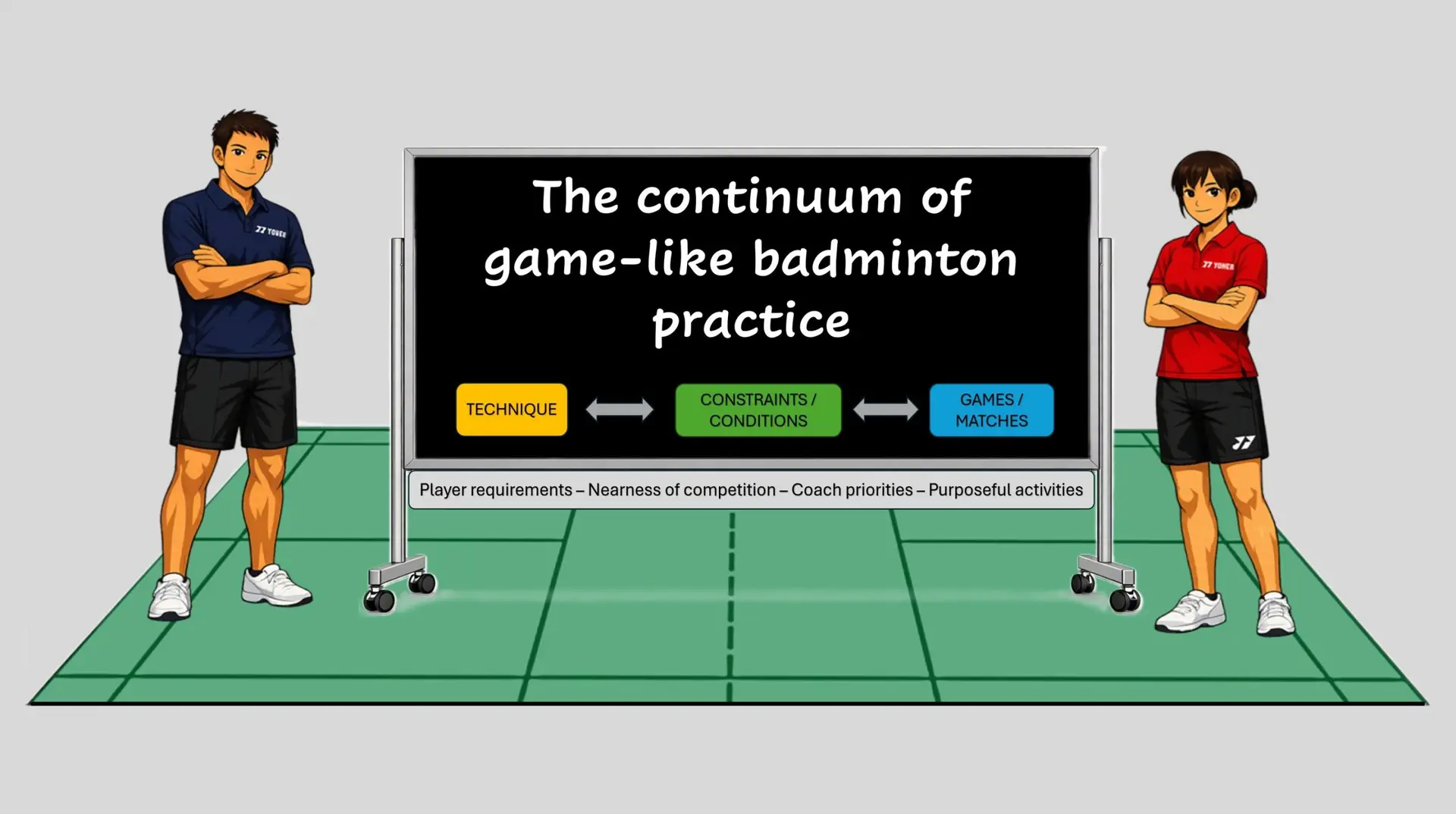
The most successful badminton programmes do not choose between drills and games.
They deliberately use both, helping players progress from technical competence towards competitive performance.
Click on this image to see all the posts in this mini-series.
They explore lots of different questions that coaches have regarding the inclusion of game-likeness in badminton practices.
It is now your challenge to read, reflect, and then decide what you want to do with your practice design.

Many coaches say they value adaptability.
Far fewer are comfortable watching the mistakes and uncertainty that adaptation requires
Send me a question
I’m always grateful if you have read this far.
If there is anything that you have read that has helped or that you disagree with, then please send me an email.
I promise to read all your comments
It would be great to hear from you contact@badmintonandy.com