
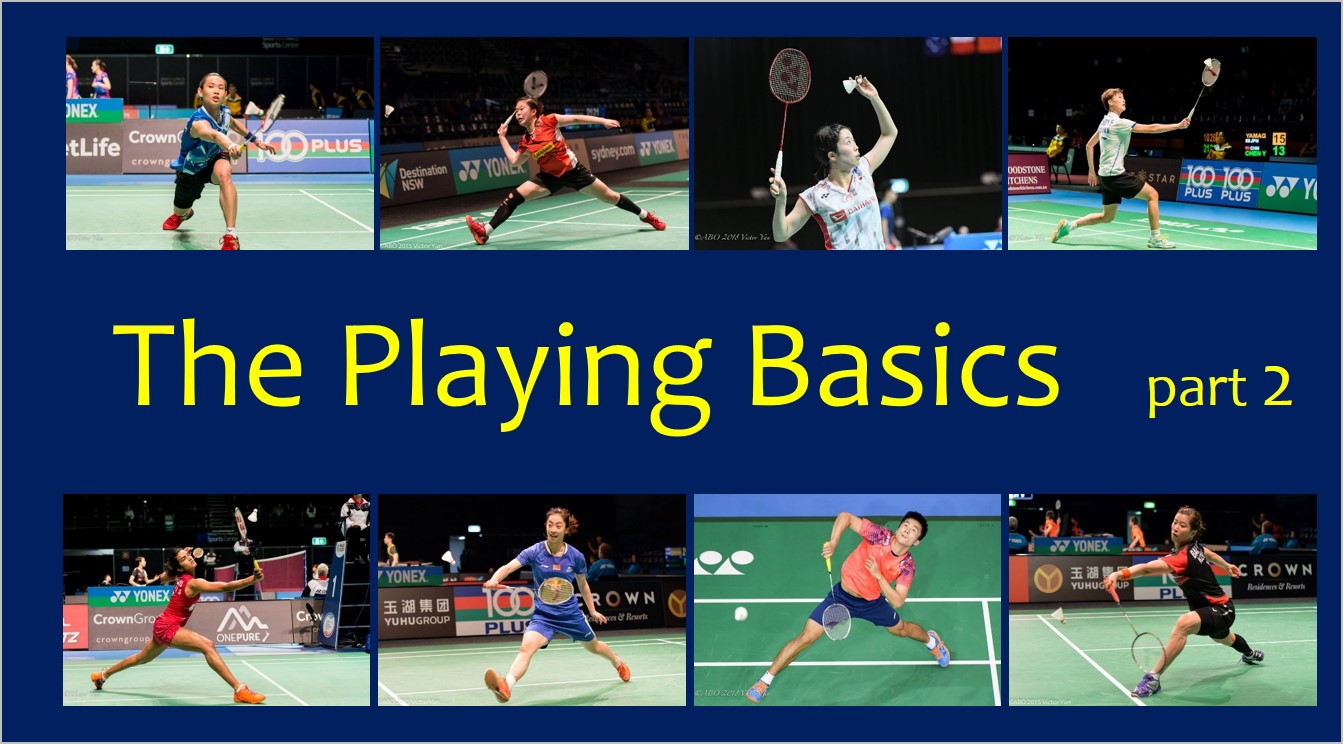
Technical Badminton Playing Basics
Part 2 of the 4 posts
The components underpin all strokes and movements
Technical Basics 1 - 4
- Hitting at a balanced extreme range from the body
- Hold the racket with a sideways grip
- Early preparation always
- Hand cocking for power
Striking at a ‘comfortable’ extreme range to the body
The keywords are “Extreme” and Comfortable”
You may find that the terms seem contradictory. How can you be comfortable at this extreme range?
It is as much a state of mind as it is a physical challenge.
It involves staying balanced and in control so you can recover quickly for the next shot rather than overreaching. But, crucially, it requires the shuttle to be taken ‘early’.
This often results in : a long lunge (jump lunge), or a getting off the ground (either by a vertical jump, or a sideways jump).
It does not mean overreaching or trying so hard that recovery is not achieved i.e. falling over.
Yes, there will be times when there is no alternative but to totally commit to getting a shuttle with no thought about recovery.
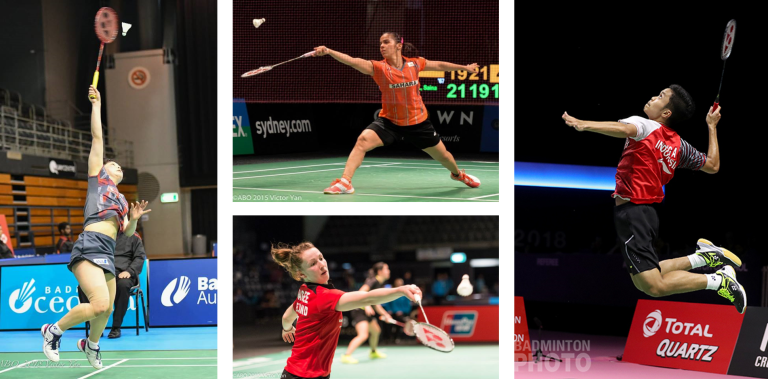
The advantages of this mindset and action
- That the racket reaches the shuttle as early as possible
- A full transfer of power is achieved. The racket should move in a smooth action with no ‘stops’ or ‘stutters’
- That players movement to and from the shuttle will be be efficiently timed.. Some movement benifit from being syruck at a comfortable range from the body.
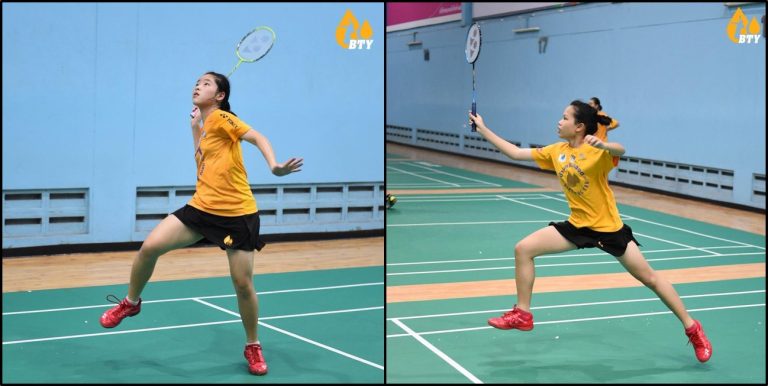
There is more to feeling comfortable at an extreme range than just stretching when getting the shuttle back over.
Players who develop with this as a core basic will still feel in control of themselves when they are pushed to their limits.
They will be able to reduce the time for the opponents to react, prepare and move. They will in some instances develop more power.
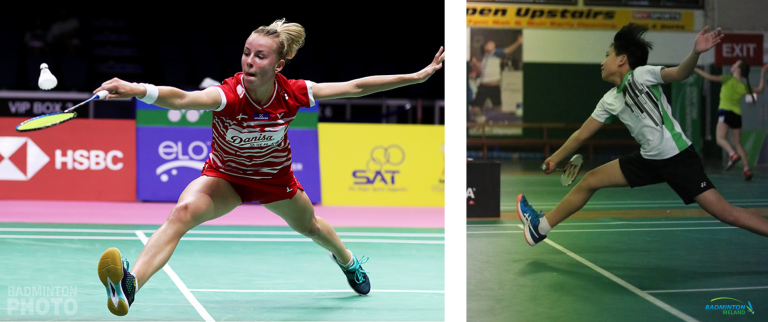
Encourage this Badminton Playing Basic from the very early stages of development
Hold the racket with a sideways grip
For the majority of strokes, a sideways grip will be a basic
The Playing Basics do not name the various grips often named in Coach Education. This is deliberate.
There is no need to practice each grip independently when a sideways hold (grip) of the racket will enable ‘lots’ of shots to be played without significant changes.
As there is no single way of holding the racket, but many variations (even more than the named grips), then it would be futile to practice each grip independently.
One of these tasks is the early use ‘Wallwork‘ practices that will encourage a sideways hold that will enable ‘lots’ of shots to be played without significant changes.
I have found it amazing how the use of ‘Wallwork’ practices prevents some of the classic errors, such as ‘pan handle’, but is also very easy and simple to coach.
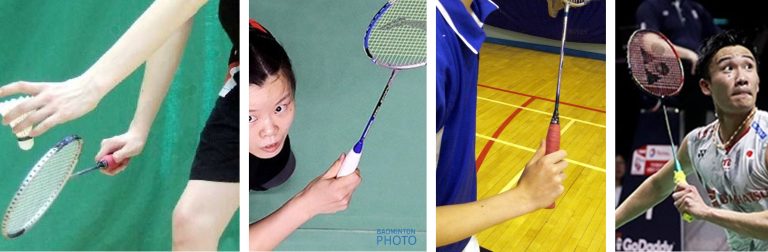
Early establishment of ways to ‘hold’ the racket can be achieved through the use of
Wallwork and practices using simple tasks, challenges, motivation and self-discovery
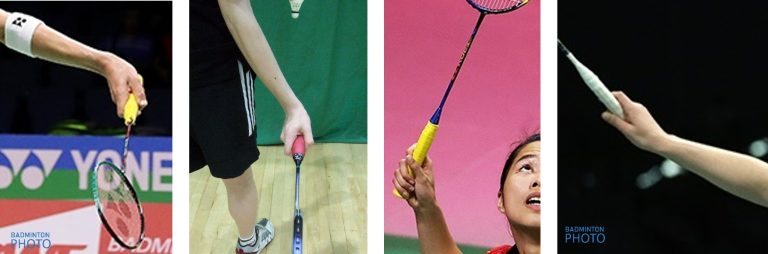
From the very first experiences, players start to hold the racket with a generally sideways grip
Problems are most likely to occur in the early stages of development
Early Preparation (always)
As a basic this is probaly the most obvious
Early preparation means getting into the preparatory hitting position for the stroke as you start to move towards the shuttle.
It is also useful as an aid for creating deception, giving the appearance of having “time” in which to play the shuttle. I have found this to be a most useful aid when teaching novice players.
Encourage EP (early preparation) everywhere, I promise that you will not be disappointed by the effect this has on your players’ development.

Hand Cocking and Racket Position for Power
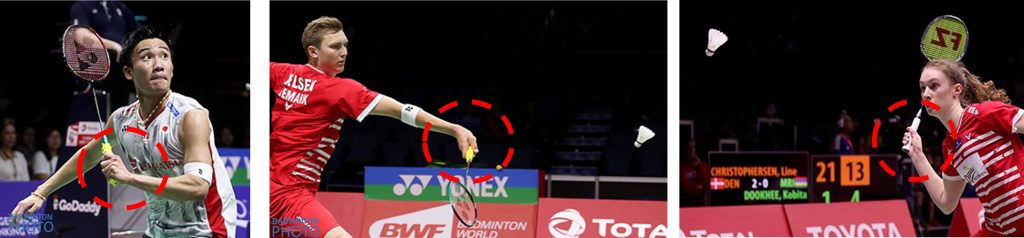
This hand position is a preparation for power
For the majority of power strokes, the racket hand must be “cocked” prior to contact, often early in the preparation.
This hand position is a preparation for power. The photographs below demonstrate that this hand position is evident in many strokes. It is easier to see in the preparation of net flicks.
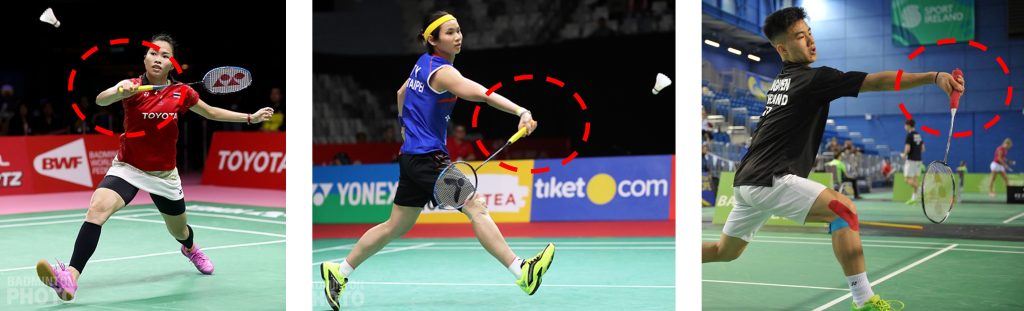
These photographs are great examples of how the hnad is used in similar ways but for different strokes. All preparations for power, if required.
Have you thought about this before and allowed or encouraged it in your practice sessions?
I would love to hear your thoughts.
Which of these Playing Basics did you find created an image immediately in your mind?
It certainly took me a while to understand no.4 and to realise how important it was.
The excitement then grew when I realised that once ‘hand cocking’ was at least part developed some of the traditional errors stopped appearing.
In part 3 we will explore
5) Pretension in starting and moving
6) Categories of 4 main hitting actions
7) Legs and arms wide for balanced movements
Send me a question
I’m always grateful if you have read this far.
If there is anything that you have read that has helped or that you disagree with, then please send me an email.
I promise to read all your comments
It would be great to hear from you contact@badmintonandy.com


![Early Preparation always - Duplicate - [#38141]](https://badmintonandy.com/wp-content/uploads/2026/09/early-preparation-always-scaled.webp)