
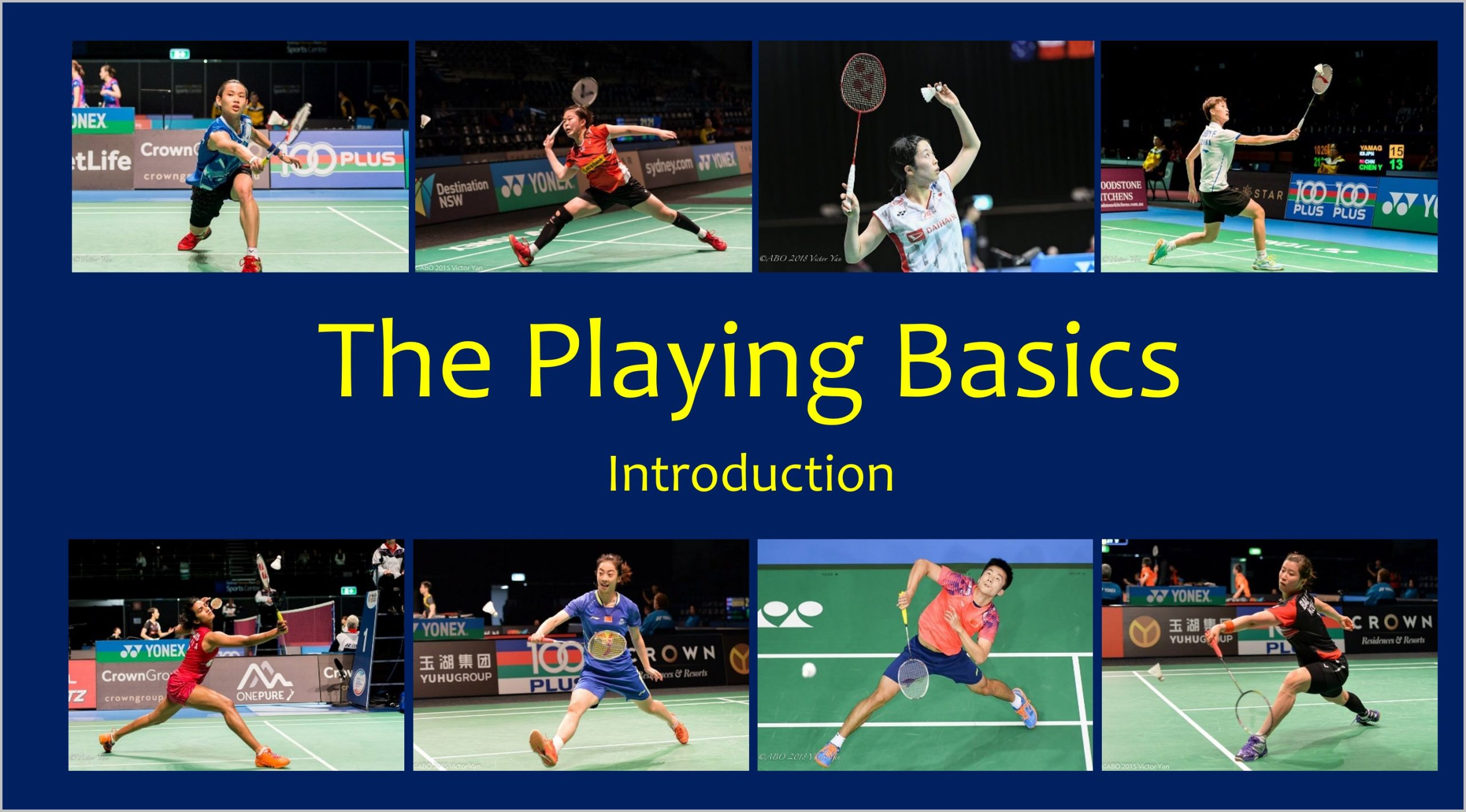
What are the Technical Badminton Playing Basics
I had an afternoon to prepare a list!
Those components that underpin all strokes and movements
I was asked
“What do you think are the core technical skills we should develop in young players?
What would you say?
I somehow ended up with this challenge at the end of a week of coaching in Denmark with my good friend and mentor, Roger Mills.
He insisted that we should be able to produce a list of Badminton Basics (Technical) that underpinned all strokes and movements.
Not a list of strokes, but their components. The aspects that were fundamental to success.
A mini series in 4 parts, to give you time to consider and try out the content. Hopefully, you will find that every time you read them, you create new thoughts and questions.

Principles : desirable, not absolute
They represent a flexible approach rather than a rigid rule
Importantly, they allow for exceptions when necessary. At times, they must be balanced against other, often conflicting, factors.
They will serve as guiding beliefs that shape coaching behaviour, reasoning, and, most importantly, coach decision-making for practice design.
Hopefully, you find that these principles offer flexibility for adaptation based on specific contexts or situations.
These are not strokes
Don’t expect a list of strokes
The statements describe the components of hitting and moving skills, but not strokes.
Some components are nearly complete skills, whilst others form smaller but critical aspects of larger, more complex movements.
Your challenge will be how to introduce these to your young developing players.
What practices will you design, how will you ‘scaffold’ (layer) the practices by designing challenges, tasks, all increasing in complexity over time.
It wasn’t an easy learning experience
When I was introduced to these Badminton Playing Basics, I could not really understand why there were no strokes mentioned
I thought that the list must contain strokes such as a smash, a serve or a backhand. However once I was shown that each component could be developed in many different ways and then could be used in a variety of strokes, I began to see things differently.
I recommend that you initially focus on these components. Try to develop partial mastery of these simple skills before larger more complex strokes and movements are introduced. The components of hitting and moving skills can be improved in their own right through different practices.
To be honest it wasn’t an easy learning experience
It took a while to understand that I didn’t just have to practice one stroke in isolation.
I was given an insight into creating situations where a core element was developed that then appeared in many strokes and movements.
So with novice players, rather than coach a whole stroke, I was encouraged to coach specific elements of strokes that ensured the whole stroke would be easier to perform and learn.
This was different from the traditional repetitious work and statement “today we will work on ………” (stroke).
Using the Playing Basics as a guide
Especially when working with beginners
The Playing Basics can guide you in developing essential underpinning techniques when working with beginner, novice players.
Major changes or corrections in technique are very difficult to successfully make once a pattern has been established.
Motivation can be influenced, habits can be developed, but an inappropriate technique that limits development could block many future improvements.
I am not suggesting that a player’s first coach should seek perfection, no, that is not the goal! But if you allow or ignore some (inappropriate) techniques, then they can be very difficult to correct or change.
Good or near-correct patterns can be improved, but some imperfect techniques seem to stay around no matter what you do to remove them.
How many ‘classic’ technically limiting faults (errors) can you name?
Could you write out a list of those techniques you wish would never appear in junior players?
Using these Playing Basics has helped me to establish some core elements in a simpler way than traditional teaching using named strokes.
The problem is that game-like movements and strokes are generally complex and large in nature. They contain many moving parts that all need to be appropriately timed and sequenced.
Plus, there are the subtleties such as how to hold the racket, and use of body shapes.
Concentrating on developing a few of the Playing Basics in warm-ups, mini-games, and small hitting games/tasks will give you an opportunity to develop these elements before trying to work on named strokes.
Consider incorporating these concepts into your practice aims
Developing these will reduce the chance of a limiting technical fault from forming!

In part 1 we will explore the first 4 of the Badminton Basics
and take a deeper look at what they mean and how you could use them
Send me a question
I’m always grateful if you have read this far.
If there is anything that you have read that has helped or that you disagree with, then please send me an email.
I promise to read all your comments
It would be great to hear from you contact@badmintonandy.com

![Introducing the badminton overhead – Challenge No.3 - Duplicate - [#36874]](https://badmintonandy.com/wp-content/uploads/2023/05/Badminton-Forehand-Overhead-3-scaled-1.jpg)
![Introducing the badminton overhead – Challenge No.2 - Duplicate - [#36821]](https://badmintonandy.com/wp-content/uploads/2023/05/Badminton-Forehand-Overhead-2-scaled-1.jpg)
