
What factors create a great shadow badminton
There are many components you can vary
Be prepared to start making choices
What, if any, are the negatives and how to ensure that you
maximise the benefits and avoid the pitfalls
What is Shadow badminton
It’s a practice that requires you to move in a game like way without striking a shuttle
It’s not complex, you just move around the court (or an imaginary court) as you would in a game. Or, is it really that simple?
Have you considered
- why you use this practice: the goal, the desired outcome
- the directions you move
- the patterns you make
- how you are directed
- the intensity : speed and duration
- and finally, what should you be thinking!
I would like to show you a scientific paper or study on the effectiveness of shadow work
to help technical and physical development … but I have never seen one!
Why do this type of training
Some of the reasons people told me they do shadow practice
I’ve asked players, coaches and badminton people as to why they think shadow training should be included in a training plan.
Their reasons make interesting reading. If you were this person’s coach, would you be happy or worried about their replies?
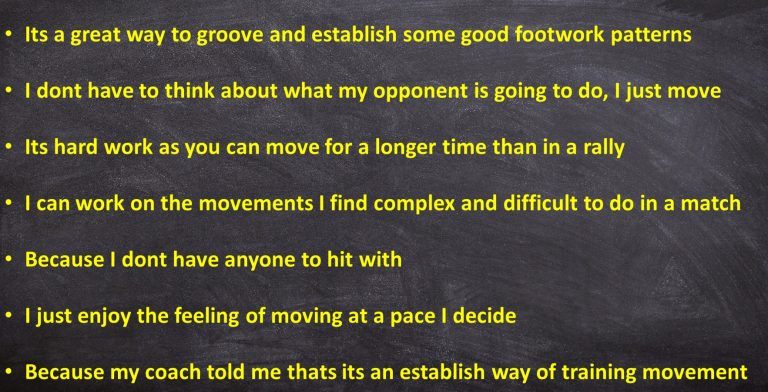
Would you add any of your own?
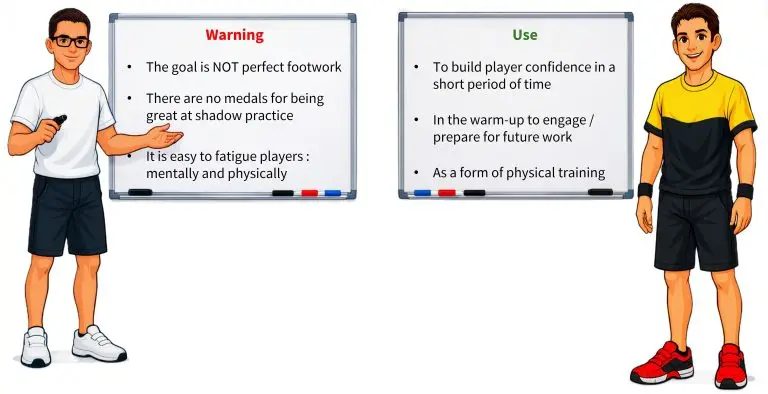
The aim must be to improve your match play
The aim isn’t to become great at shadow work in itself
The different types
Prescribed patterns
Players know exactly where they are moving to and from and repeat these patterns. These sequences can involve any number of points on the court. Often it varies from 2 points to upwards of 6. Any more than 6 makes it difficult for you to remember.
Partner/Coach directed
Another person points or calls out where the player moves next and the speed at which they should move. Often these are longer sequences than the prescribed patterns.
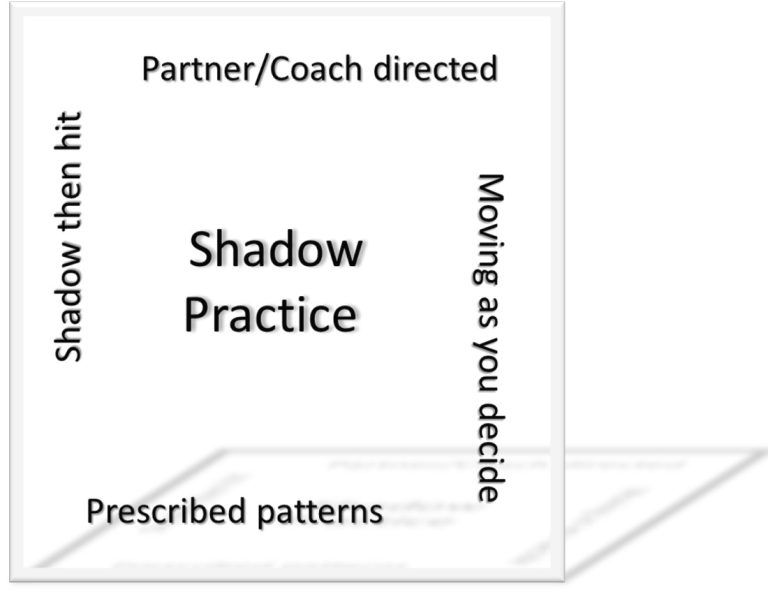
Moving as you decide
It’s exactly that, you decide where to go on court. I recommend that you develop a great ‘game-like’ imagination 🙂
Shadow then hit
Players perform a shadow stroke/movement, then strike a shuttle that has been delivered by a feeder or is positioned on the court prior to starting. Be careful of picking shuttles up and moving them around the court, the stress on hamstrings, glutes and lower back may surprise you, it’s not a ‘badge of honour’ to be unable to walk the next day!
Shadow Speed Test
Equipment/targets are positioned within the court. The player moves to either prescribed or random patterns. The time taken is measured, and the patterns can be varied, directed by sound or visually on a screen in front of you.
Have you tried these 5 different types, which do you prefer?
Do you know of others?
Components to consider: time, distance, intensity

Design your shadow badminton training using these headings
Duration
Consider the duration of each individual rally and set, and the time taken to complete each set of movements. Then the total time of work & rest that forms the session duration.
The individual rally/elements could last from 10 secs to upwards of 2 minutes for one rally.
I’ve also heard of a single session lasting over 20 mins without stopping (watch the video at the end of the post).
- What do you think is an acceptable range of reps and sets, is total duration a factor?
The speed of movement
I’ve seen movements done at game speed, much slower than game speed and also players moving as fast as possible from shot to shot. It can be difficult to maintain good form when speeds are increased.
Partner-directed movements can also complicate the speed element as it relies on the pointing/directing to be as game speed.
- Do you have any tips to ensure that the speed is controllable?
The distance to be covered
This isn’t the total distance covered in a session; it’s the distance for each element of the movement.
A commonly used practice is to reduce the court distance to a 1 step shadow practice. Watch the video at the bottom by Peter Rasmussen
- What benefits do you see in 1 step shadow practice? Have you tried?
Certainty/Uncertainty
The question is, are movements known or unknown? Both are commonly used.
Of course, if it’s a player self-directed shadow, then all the movements are known. However, the player could imagine moving in a controlled way and then suddenly (as in a game) have to move quickly and in a different direction to that initially thought of.
Partner-directed movements are almost unknown unless prescribed drills/routines are used. Do you have good and bad partners who direct you around the court, are they as motivated as you?
- Are you sure that the uncertainty element is as in a game and that the partner-directed movement make sense?
Player imagination
This may be the most important factor
Without being able to create a rally situation in your mind (players & coaches) can you be sure that the practice is as effective as it should be?
Game-like imagination is not remembering where to go next or what footwork pattern to use (these may not even be desirable). Players can gain far more if they can visualise the rally, the situations, the emotions, their reactions, the successes, and the failures.
- Coaches, how do you encourage your players to use their imaginations, what questions/conversations do you have?
Where would you rank ‘Player Imagination’ ?
Aspects to 'think about' while doing shadow practice
Which is the most important?
Are you asking players to think about these components?
… Technical components
… Visualisations
At various stages of learning, it could be argued that some are important,
but not all are beneficial to long-term development
Technical
… The mechanics of how to move
… The speed at which you will move to and from the strokes
… Where are your eyes looking
… Early Racket Preparation
Visualisations
… The situation on the court: defensive, attacking, waiting, exploiting, etc
… Replicating a choice of emotions felt in a match
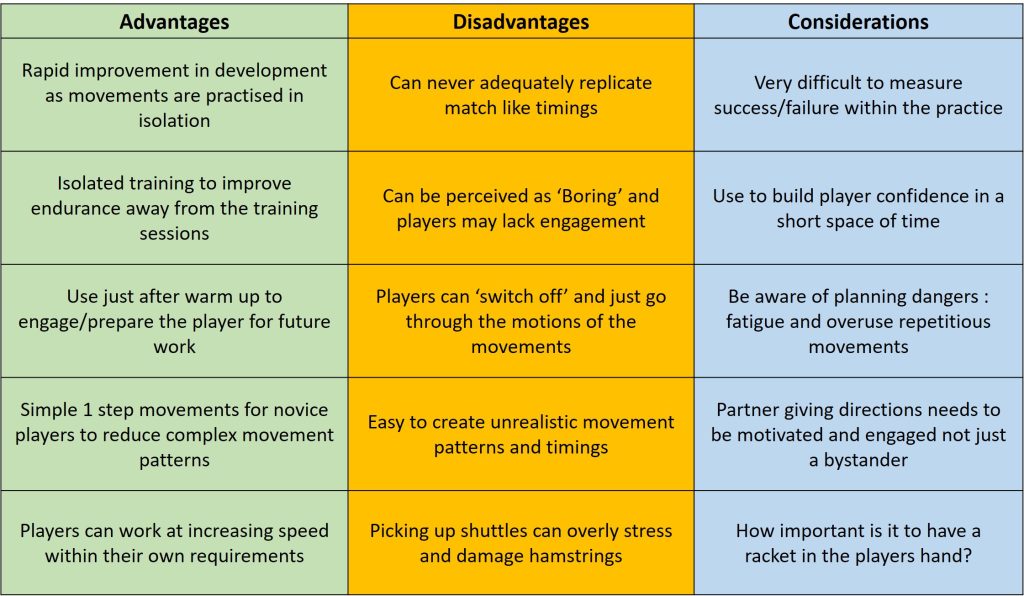
How would you answer these questions?
How effective is it for technical improvements?
What durations should be used?
Do longer shadow sessions produce better movement skills?
Are there any hidden dangers?
How to avoid the dangers you’ve identified?
If you want to read my thoughts, click on the image

What these 2 videos and create some thoughts
What could you take from either video and use with your players.
Please apply a critical coaching viewpoint.
Send me a question
I’m always grateful if you have read this far.
If there is anything that you have read that has helped or that you disagree with, then please send me an email.
I promise to read all your comments
It would be great to hear from you contact@badmintonandy.com


![Early Preparation always - Duplicate - [#38141]](https://badmintonandy.com/wp-content/uploads/2026/09/early-preparation-always-scaled.webp)
![Keep your racket up - Duplicate - [#38056]](https://badmintonandy.com/wp-content/uploads/2026/09/keep-your-racket-up-scaled.webp)