
Part 2 : The frequent questions coaches ask
The guidelines and recommends to consider
Based on 16 frequently asked questions
Did you find any new ideas after Part 1
Click here if you haven’t read it
How would you reply, what advice would you give?
Some of my players will not ‘compete’ in the games
What themes can I use in the games?
How important are ‘free play’ sessions?
Why use bonus points rather than deductions?
What themes and rules should I avoid?
What rules should I include?
What are the critical elements and questions to use when designing the session
How much coaching should be done in a sparring session?
What are the tests for effectiveness of the sparring session?
Some of my players will not ‘compete’ in the games!
Yes, it’s true
During the sparring session, some of your players may not compete, and some may not even try to win!
There are many reasons why, but all need to be considered and addressed.
My advice at this time would be to introduce the advantages of sparring in all its forms to your junior players.
Encourage them to be adventurous, brave and understand what development in practice means.
If you are working with more senior ‘established’ players, convincing them may be much harder for you, but of course, it is possible.
Work with players individually and as a group and look for opportunities to change their mindsets.
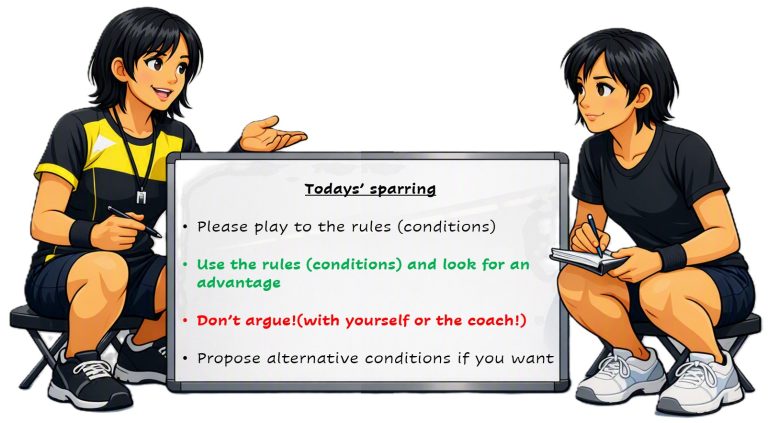
Do you believe that some of your players don’t try in sparring sessions?
What themes can I use in the games?
Let’s explore Free play and Themed play
Free play
Even though there may not be any rules/conditions, that doesn’t mean that players aren’t playing without strategies.
They are using the tactics and the mindsets that they choose.
Many of the tactics and strategies they use could be very similar to the conditioned games they have played previously. That should be the case, IF, the previous experiences were worthwhile.
The difference in free play is that both players will be selecting and creating their own tactics. Plus, they will NOT be known to the opponents and sometimes not even known to the coach.
However, with a good coach/player relationship, I would expect the coach to have an awareness of what is being tried.

Themed / Conditioned Games
Every coach or group organiser will have a list of games that they feel are useful for development, and be able to create mini variations of these games.
Not always written, but I recommend they are.
Every game should conform to these key points
- Does the game look and feel like a real match?
- Are players able to make game-like decisions and hit winners at any part of the rally?
- Can your players identify the purpose of the game and how it can be replicated in a real competition?
- Can players still win without achieving ‘bonus points’? (if they are part of the game)
- Does the game reward the positive player
- Do you have 1 or more variations prepared?
Look out for a future post explaining all about the Pros & Cons of Conditioned games
How important are ‘free play’ sessions?
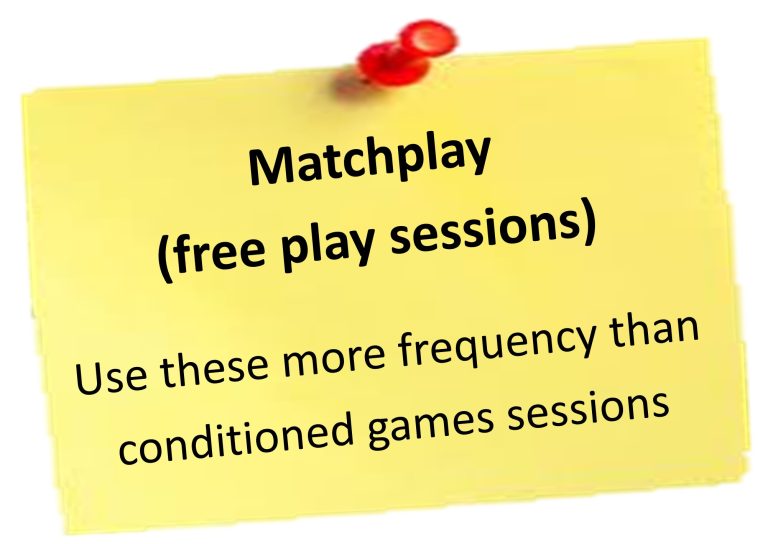
Free play or Matchplay sessions are very important
Be careful of using conditioned games too much. Some players just love to play and be competitive within normal rules.
You may experience frustration and pushback if the majority of your sessions have conditions.
Ensure that the players understand the purpose of the session; even match play sessions can benefit from the organiser explaining the aims and giving some directions to the players.
Consider using these phrases in your introductions
- “Free play means that you can decide how you want to play. I’d recommend that you decide how you want to play (tactically)”
- “Why not consider trying something new and assessing if it’s worthwhile”
- “We will not be recording scores today only who wins”
- “Games will be played to 15 or 21, if there is the 3rd set it will only be played to 11 or 15 (agree prior to the session)”
- “Be your own coach today and assesses your performance as you would in a competition, don’t be a passenger in the games”
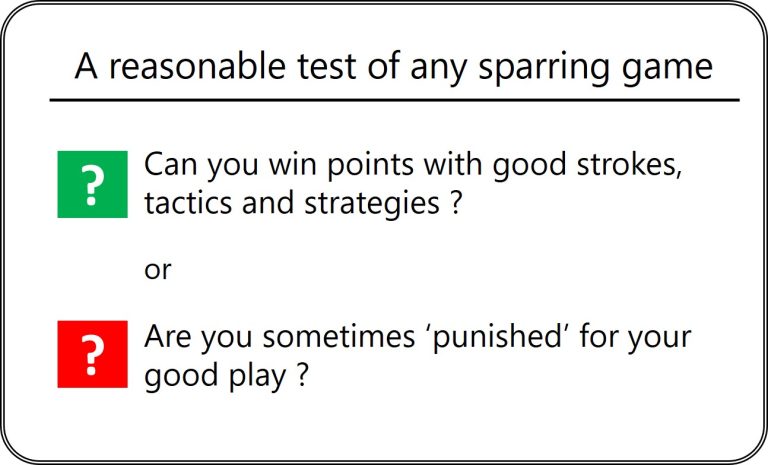
Why use bonus points rather than deductions?
I prefer to use bonus points rather than deductions
In all games, I believe that the use of rewards is key to encouraging a competitive and realistic environment. Ok, I accept that in a real match there are no bonus points.
However, the emotion gained from achieving say a 3 point bonus (in a game to 11) could replicate that important, hard-won point in a close competitive match.
The aim is to incentivise players with bonus points so that they plan, prepare and execute within the rally to achieve them. It’s great preparation for tournaments and using a game plan.
I’ve found that there are more frustrations and arguments when points are deducted.
Do you agree with me that bonus points have the possibility to create positive play, however deductions can be viewed as a punishment?
Methods to help players gain insight
- Layering: be deliberate in your methods by adding new information/experiences over a long period of time (weeks, even months)
- By doing, by engagement, by refection: use all 3, each are different but essential
- Mix up experiences: this is called interleaving. Create opportunties and environments for ‘ah-ha’ moments, don’t just repeat the same themes continuously
- Linking it to tournament experiences: ask them what they needed, then create games/situations to show how sparring can help
- Challenges and puzzles: create hidden learning points in the form of challenges within the games
Develop players who understand what can be gained from sparring
request input and be ready for their contributions
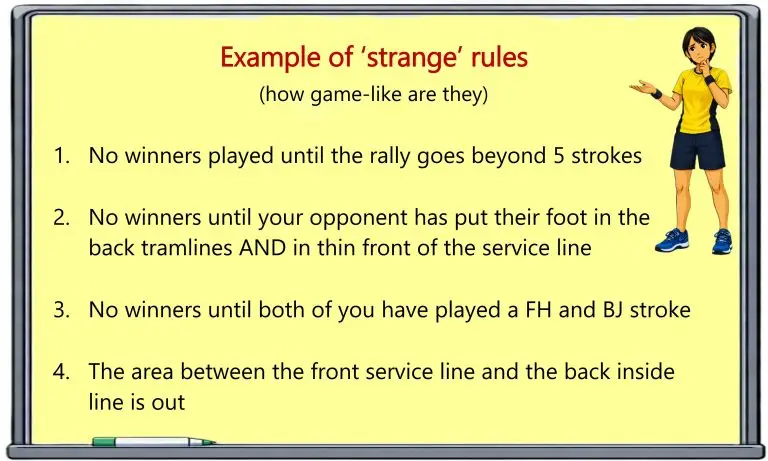
What themes and rules should I avoid?
This is a tough question
It depends on the playing standard, the aim of the session and the previous knowledge/experience of the players.
Some rules work in one setting and then don’t in another, even creating arguments where previously there were smiles and enthusiasm.
Here are some general rules to follow
- Stick to normal badminton rules as much as possible. Certainly avoid “you can’t score until you have done x,y,z”
- Excluding a part of the court completely throughout a rally is not desirable. If players wish to do this themselves within free play games, of course that’s acceptable .
- Create insentives to play to other areas.
What rules do you not like?
What rules should I include?
Use rules, guidelines and discussion points
Try to ensure that the players understand why something is being introduced and how it should help them to get the most from the session.
However, they may not realise it at the time, be prepared 🙂
- Be competitive: even if the theme doesn’t suit you make it a competitive tough game
- Play with the theme (condition): use it, work with it, try to benefit from it
- No arguments: if you have a problem explain what it is but don’t just become grumpy and argue
- What does it mean to be successful: Winning the match isn’t always essential
- If you are confused, "Ask": do you have any questions that require a response
What are the critical elements and questions to use when designing the session?
-
Questions
- What is the aim of the session
- Who will set the aim – it doesn’t just have to be the coach
-
Considerations
- What is the session duration? How will you ensure that everyone gets a roughly equal share of court time?
- The nearness of competition – is it immediately before a big event or part of a training block? These factors make a difference.
- Will there be coaching, wh will do that, how often and when
Test Questions
- Does the game look and feel like a real match?
- Can players still win without achieving ‘bonus points’? (if they are part of the game)
- Do the players understand the game within a few attempts?
- Its sparring, so is there competition awithin game-like rules and guidelines?
How much coaching should be done in a sparring session?
Yes, but it depends on what you mean by coaching
- During the session, there are different ways to ‘coach’, have you considered?
- No coaching, no interaction: just coach observations and feedback at the next session, not this one
- 2 coaches working: sitting behind the court as in a competition
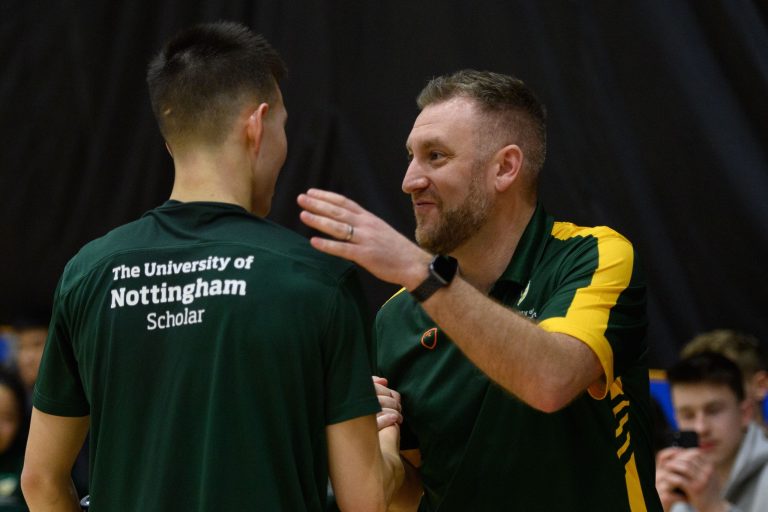
- Group coaching: discussion at the start explaining what is required and guidelines about how to go about it
- Group summary: discussions throughout about the session, the effects of certain strategies/tactics and what you could try
- Individual work: everyone is aware that you will be giving hints and tips to players that need them, but not to everybody
What are the tests for effectiveness of the sparring session?
You must decide how to go about judging the effectiveness of your sparring sessions
- You could ask the players
- What do you like & dislike about this game?
- How would today help you in a real competition?
- What variations would you introduce to these matches?
- If you still have questions, what are they?
- Ask yourself & your team
- Do we think that the players understand the aim of the session?
- How quickly did they understand the games (rules) or were they too complex
- Which of the conditions (if used) had the impact we hoped for?
- Did everyone compete as we hoped for?
If you ask questions, be prepared for replies!
Send me a question
I’m always grateful if you have read this far.
If there is anything that you have read that has helped or that you disagree with, then please send me an email.
I promise to read all your comments
It would be great to hear from you contact@badmintonandy.com

![Introducing the badminton overhead – Challenge No.3 - Duplicate - [#36874]](https://badmintonandy.com/wp-content/uploads/2023/05/Badminton-Forehand-Overhead-3-scaled-1.jpg)
![Introducing the badminton overhead – Challenge No.2 - Duplicate - [#36821]](https://badmintonandy.com/wp-content/uploads/2023/05/Badminton-Forehand-Overhead-2-scaled-1.jpg)
