

Consistency in practice, but not in competition
The story of trying to find out why
Do the improvements (consistency) you see in practice
appear in competition?
What is ‘consistency’ and what does it look like
I needed an answer
Do you have an answer to help me, or have you had advice from other coaches?
After technique, consistency seems to be the next goal of many coaches and players. It always surprises me that technique and consistency seem to be spoken about more than tactics. and certainly more than mental skills/strategies.
This post is a summary of my thoughts during the first 10 yrs of my coaching journey.
I’d been watching matches I’d seen lots of shuttles hit out or in the net with what seemed no pressure on the players. So I thought I’d better start helping my players become more consistent.
My story includes conversations with my coaching friends and my best recollection of my coaching thoughts.
During my search, especially in the early years, I tried to understand ….
- What was ‘consistency’ and what did it look like
- Could it be measured
- Most importantly, how it could be improved
I talked about consistency with my friends, but we never really defined what it was.
Maybe we didn’t understand all the different aspects, often we just ‘blamed’ the players!
What did I see?
In competition
I didn’t expect perfection; my players weren’t that good!
However, the number of high service returns that went into the net or hit off the court was far too high.
How could someone just hit a return of serve into the net?
They just weren’t consistent enough - I told myself!
During longer rallies, my players kept the shuttle in court and worked hard to create openings. Then, often when an opening appeared, they made a ‘simple’ mistake; again, they just weren’t consistent enough.
I started to count the number of errors they and their opponents made and compared them to the number of winners. The ratio often worked out at 3: 1 (errors to winners).
Some errors were forced by the opponents’ good shots, but many came from simple errors- shots that I thought should have hit over.
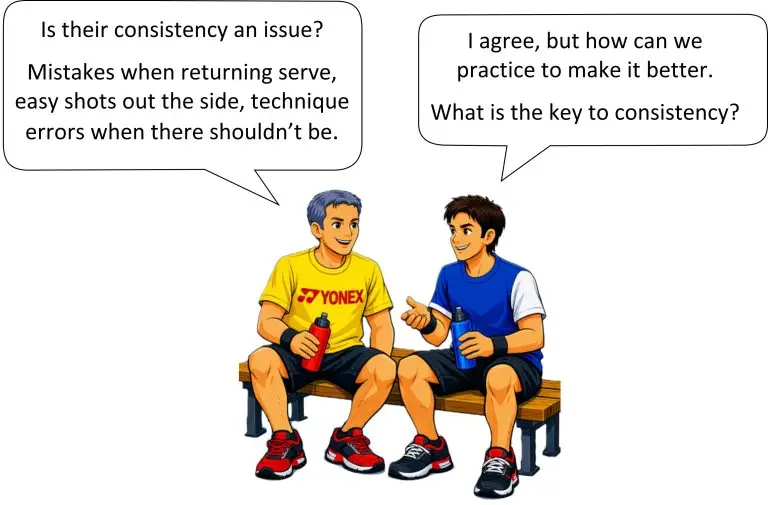
I thought consistency was not making ‘simple mistakes’
That’s what I thought… but maybe I was wrong?
What did I see in practice?
I knew that my players could play the strokes; I’d seen that in practice.
They had hit so many strokes in sequence I knew that they could play. We had done routines, multi-shuttle and practice games, all with increasing levels of success and improvement in practice. They knew what was required, and their technique was ok, most of the time.
Ok, there were mistakes in the practice, but I thought that was normal and anyway, the number of mistakes reduced in practice the more shots they hit.
We would stop and talk about what to do
Wasn’t the path to success just to ‘keep the shuttle in the court’.
I would shout out in practice to encourage them to keep going and to give them advice.
In single-shot shuttle practice, I would delay the feed so that, as they became tired, but they could reach the next shot. My aim was longer rallies with no mistakes.
During single rally practices (+15 shots), I would hit higher nets or lifts to give them time if I could see that they were struggling! The aim was to make them consistent in long rallies when fatigued.
They certainly became fitter in these ‘physical’ practices.
Consistency did improve towards the end of most sessions; the more we hit, the higher the percentage over
Was this now going to transfer to competition?
I needed to know
How did I measure improvements?
I decided to use practice situations to improve consistency by hitting lots of shuttles and trying to reduce errors. We would do sets of 15-20 shuttles with feeding to just one place.
I believed that the key to increasing consistency was for the player to get used to hitting lots of shuttles over, often in a row, in what I thought were pressure situations.
In the beginning, they would struggle to hit more than say 5-7 shuttles over without a mistake in a drop/net routine.
However, as routines progressed, they often achieved +90% success in shuttles going over.
The players could see that their shots were improving as they could hit 15 drops over with no mistakes.
They could do a 20-shot drop/net routine and even a 20 x 5 all court multi with very few going into the net or out. They now knew what to do to get a higher % over: they adjusted their margins, they hit everything a little bit higher to give themselves more time to move.
The rallies were longer; there were fewer ‘mistakes’
Problem solved….., or so I thought!
My problem
I tried to develop consistency using simple routines and punishments
If my players made mistakes, I either made the practices simpler (easier) by reducing the number of linking shots, or I reduced the movements.
I reduced the variability and decisions.
Or I took a different approach, I added penalties to motivate (I thought) the player into not making mistakes.
1 mistake = 1 press-up/burpee
In both examples, the players made fewer mistakes and the shuttles went over and in.
Problem solved, or so I thought
Players improved in practice
The rallies became longer, the players became physically better.
Then at the start of the next session, they would be almost as bad again.
So I decided to make the ‘consistency training’ a regular thing and either increased the numbers (20-30-40 shuttles x 5) or I increased the penalties (1 mistake = 5 press-ups/burpee).
Problem solved, or so I thought
Or was I just seeing ‘Practice Performance’ : increased performance based on repetition that came from these ‘known’ practices?
Or was I seeing ‘Practice Performance’ :
increased performance based on repetition of ‘known’ practices?
After a while, everything seemed to click
The players finally understood the routine.
They had worked out how to avoid the penalties; they hit the shuttle higher over the net, aimed further inside the lines, the ‘margin for error’ improved.
Players had mastered the movements, it seemed now that they could concentrate for continuous rally feeding of 20 even 30 shots in a row. I no longer had to remind them of things to do in the rally.
My shouting changed from advice to motivation and encouragement.
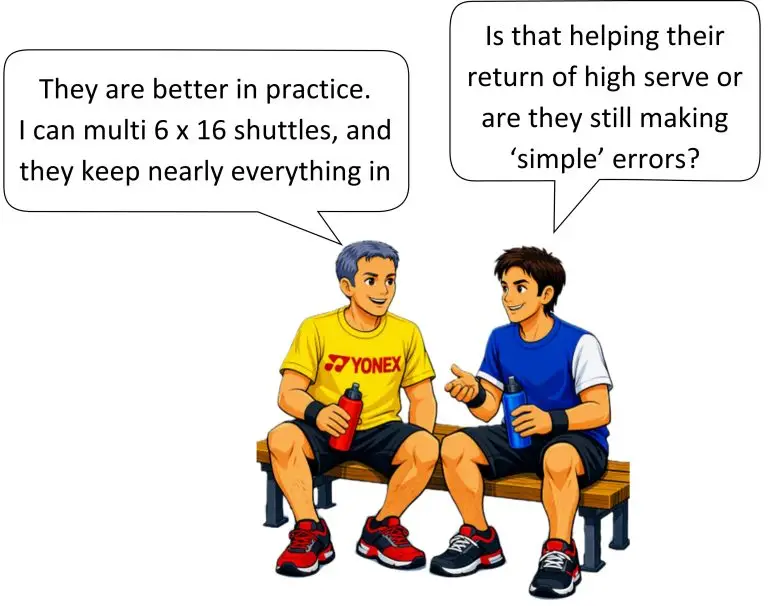
Some reported that they didn’t have to think about being consistent anymore, as it seemed automatic and 20 shuttles hit in a row was no longer an issue.
Problem solved, or so I thought
The next competition
I sat down to watch the match, and what did I see: shots into the net and hit out of the court.
When the score became close, my player made errors returning a high serve, in fact, 2 in a row!
The rallies were longer, and they certainly looked like they had improved, but those ‘strange’ consistency errors were still there. Especially at the crucial stages of the games.
Problem not solved – back to more consistency training
It was obvious that the previous work had improved parts of their game,
and the strokes looked better, but they still made errors.
The things I didn’t understand
Sometimes it's not the shot it's the situation
Consider the return of a high serve, or a low serve in singles; surely that was a simple shot.
Should any errors made when returning this serve must be ‘simple errors’, I thought.
However, it was pointed out to me that it may look like a simple error when a return of service is hit out, into the net, etc but we don’t know what is going through the mind of the player at that moment.
My mistake was not being aware that
the thoughts in a player’s mind could affect what seems a ‘simple’ stroke
That practice repetitions may not be helping
If they could do it in practice, why did they make the same mistake in competition?
I had designed practices to ‘reduce’ errors and produce longer error-free rallies. Often by reducing the stress on a player, then slowly increasing it as they achieved longer rallies.
Progressing from being able to hit 10/20/30/40 shots in a row without mistakes.
So why didn’t it help competition play?
My mistake was to assume that
more repetitions in practice helped consistency in matches
I called a Coaching friend
I needed help …

They said:
“Once competent technique is established, consistency is in part a mindset issue: it’s about the ability to make clear decisions”
Then added:
“… It’s also the ability to limit the possibility to make errors, especially on those important points or those parts of the game that the player decides matter”
Then reminding me:
“… technical issues will often show themselves when under pressure (physical, mental, tactical), …this isn’t a lack of consistency, it’s a technical issue and should not be confused with mindset or decision making.”
Finally, saying:
“The practices you are doing will certainly make them physically stronger, but I’m not too sure they are improving their thinking/controlling skills”
The words both confused and hurt me.
I thought I’d been helping, but now I wasn’t so sure
I received this advice
As I considered the advice my friend gave me, questions started to be formed.
Think about consistency being a mindset about decisions: having the ability to make a decision and to be in a state of mind to carry them out.
- But how do you train that, can a mindset be trained/developed?
Large numbers of continuous reps will not create the consistency you are looking for, especially if they are performed in controlled/simple/closed practices.
- But that’s the advice I’ve been given on Coach Education courses: large reps with no or limed errors = consistency
As often as possible, the practice should contain real game-like factors that challenge players.
- But don’t my ‘push-up’ penalties pressure and challenge players?
Include lots of repetitions, but break these into mini-rally practices and change the aim of the task often.
- But isn’t the opposite better: longer and longer sequences with more and more shuttles until they get consistent? (Won’t variation just produce more errors?)
Believe that confidence can affect consistency more than technical ability (as long as you don’t have any underlying technical issues).
- Now I was being told that confidence helps consistency. How do I build a player’s confidence when they have no consistency!
Help players understand how to hide (tactically) their limitations, especially at crucial points.
- I hadn’t thought about tactics to hide weaknesses and what were these crucial points?
Don’t try to create a desire for players to think about perfect badminton. Instead, seek how to create a winning mindset that accepts mistakes (amongst other factors).
- But don’t players need to aspire and aim for perfection? Were they suggesting that a coping mindset is better?
Consistency throughout a game is a false aim; it’s being as good as you need to be at the crucial time.
- They were suggesting that consistency training is not as simple as numbers and high % shuttles over the net, it also involves thinking.
Developing consistency is similar to
helping players with their Tactics and Mental skills
Send me a question
I’m always grateful if you have read this far.
If there is anything that you have read that has helped or that you disagree with, then please send me an email.
I promise to read all your comments
It would be great to hear from you contact@badmintonandy.com


![Early Preparation always - Duplicate - [#38141]](https://badmintonandy.com/wp-content/uploads/2026/09/early-preparation-always-scaled.webp)