Game-Like Practice is not the answer to everything
Although it does offer significant advantages
Have you considered the challenges and potential negative impacts
These 4 short conversational starters will hopefully
give you something to consider and discuss with a friend
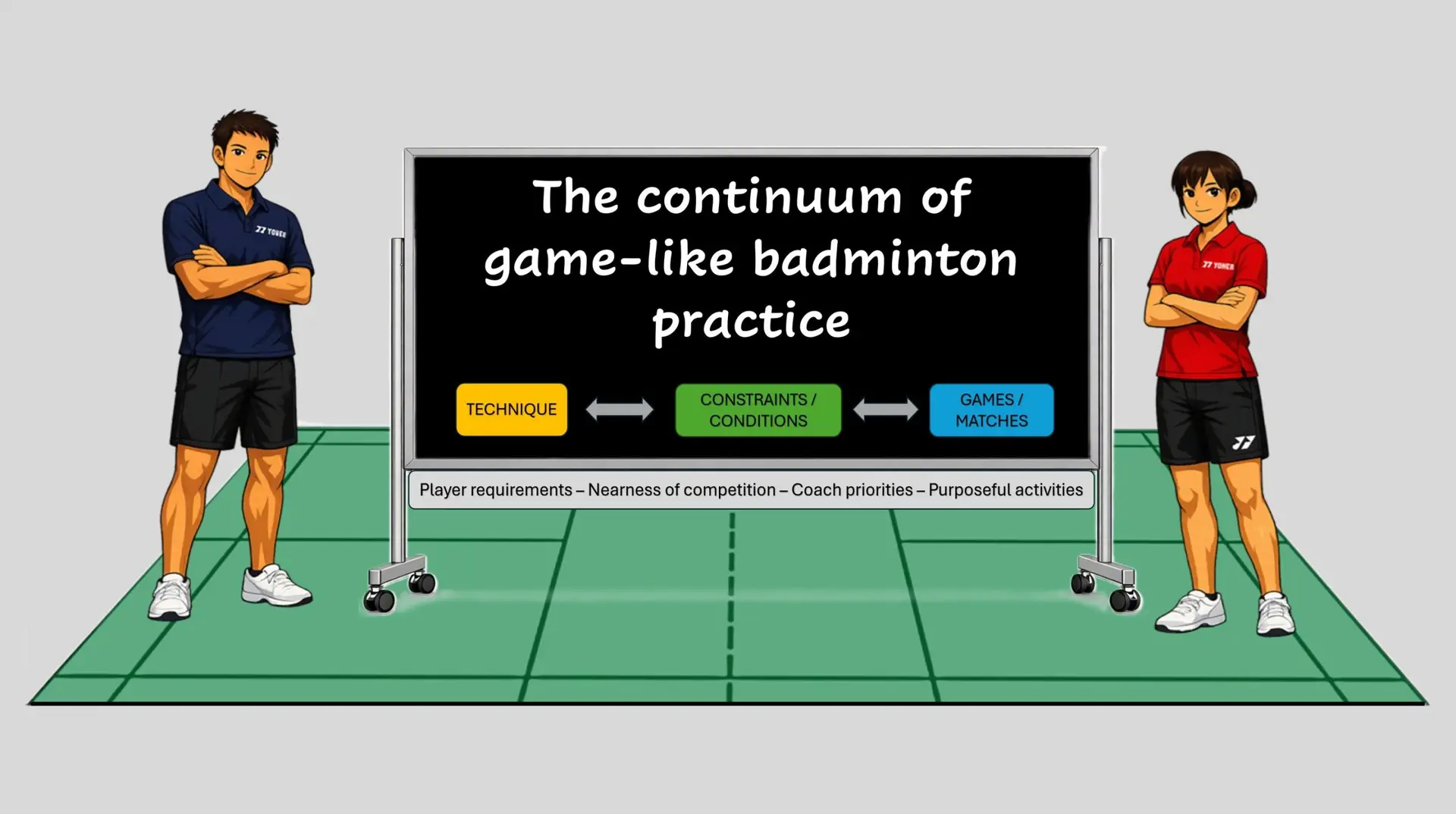
Understanding that game-like practice is only one of many practice design philosophies is important because it prevents coaches from becoming trapped by a single coaching ideology.
If you have coaching discussions, they can easily become a debate as a choice between “game-like practice” and ” practice drills” (often using one-shuttle feeds).
In reality, neither approach is inherently superior.
Each has strengths, limitations, and situations where it may be more or less appropriate. Effective coaches understand the benefits and trade-offs of different approaches and select the one that best matches the player’s current needs.
Exploring both the benefits and drawbacks of different approaches can broaden a coach’s perspective. Enabling them to make more informed decisions, adapt their methods to different situations, and remain focused on player development rather than becoming attached to a particular coaching philosophy.
Are you ready to take a viewpoint, find another coach, and have a discussion?
Beginners can become overwhelmed
If too much complexity is introduced too early, players may ...
- Become confused: “what you want me to do… try to win or try to try to not make a msitake?"
- Lose confidence: motivation and engagement may decrease if they don't expereince lots of successful outcomes.
- Show frustration: rally lengths may become very short, they may 'lose' practice rallies.
- Belive they are not learning: they struggle to understand and suggest that are doing lots but not seemingly improving anything.
- Resist having to make decsions: they belive that 'simple parctice' work best
Learning is often best when players experience an appropriate balance between success and difficulty.
One of a coach’s important roles in practice is balancing these two factors. Finding methods to ‘strech/challenge’, yet support players. Support can take different forms and may be as important as the practice design itself.
Good game-like practice provides enough challenge to stimulate learning while still allowing players to experience success.
Not every player is ready for full game-like environments immediately
Standard and age are not necessarily good indicators
Conversation starters
Which will you choose?
Success vs Challenge
How much success should a beginner experience in practice?
Can players learn effectively if they are constantly struggling?
Understanding the Player
What signs tell you a player is being challenged appropriately rather than overwhelmed?
Have you ever introduced game-like practice too early, what happened?
Decision-Making
What factors help inform you about the number of decisions to include in a beginners practice?
What decisions are essential for beginners, and which can wait?
Practice Design
What forms of support can a coach provide without removing challenge?
Can reducing game-likeness actually accelerate learning?
My favourite discussion starter
Should game-likeness be earned through competence, or developed alongside it?
Technical quality can be lost
The desire to win a rally or achieve an outome can may result in negative outcomes
As practices become more game-like, players often shift their attention away from how they perform a skill and towards the outcome of the rally. Their focus becomes winning the point rather than learning or refining the technique.
This is not necessarily a bad thing. After all, badminton is about winning rallies. However, it does create a challenge for coaches when observing some of the technique ‘solutions’ that players may find (use).
Effective technique does not mean perfect technique. In many situations, it means finding a movement solution/technique that achieves the immediate goal. The problem is that some of these techniques may contain hidden weaknesses, inefficiencies, or limitations that only become apparent later in different situations or after prolonged practice repetitions.
Players are remarkably good at finding ways to succeed in practice. Given enough freedom, they will often adapt their technique to achieve the desired outcome. Sometimes these adaptations are effective and useful. Sometimes they become compensations that limit future performance.
The best solution for the current practice
is not always the best solution for long-term development
Classic beginner solution that limits future development
When beginners first learn overhead shots, they often develop a square-on throwing or pushing action. Why? Because it helps them make successful contact and get the shuttle over the net more consistently.
If the coach then uses a half-court game with reduced movement, an opponent directly in front, and an emphasis on keeping the rally going, this solution is reinforced. The player finds a technique that achieves the immediate goal: fewer mistakes and longer rallies.
The challenge is that while the technique may be effective in the short term, it can create limitations later. Power generation, deception, slices, and the ability to hit the shuttle away from an opponent may all be compromised.
The player has solved the problem the practice presented, but not necessarily the problem badminton will eventually require them to solve.
A 'hidden' future limiting technique
Consider the difference between an underarm lift played with a sideways throwing action and one played with an upward flick action.
Both techniques have power and send the shuttle to the opponent’s rear court. Howver, one has technical limiting factors (the underarm throw); the other (the flick) offers greater long-term potential for deception, variation, and efficiency than the other.
If the coaching goal is simply “hit the shuttle to the back” or “get the shuttle quickly behind your opponent,” players will often discover that the sideways throwing action produces a powerful and reliable outcome. It solves the problem presented by the practice.
A similar action is often seen in high serves, where the player finds a way to achieve the desired outcome without necessarily developing the technique that offers the greatest future potential.
This raises an important question for coaches. Is the technique emerging because the player is trying to win the rally and achieve the task?
Or is it emerging because the practice and coaching have failed to guide the player towards a more adaptable long-term solution?
The player has found an effective answer to today’s problem. The coach’s challenge is deciding whether that answer will continue to work as the demands of the game increase.
Conversation starters
Which will you choose?
The Problem
Should coaches always intervene when they see an inefficient technique, even if it is helping the player succeed in a game?
Can a player be successful and still be learning the wrong thing?
Beginner Players
Should beginners be allowed to find their own solutions, even if those solutions are technically limiting?
How much short-term success should coaches sacrifice for long-term development?
Game-Likeness vs Technique
Can game-like practice sometimes produce worse technique?
How much technical compromise should coaches tolerate in pursuit of decision-making and adaptability?
Coaching Philosophy
Should coaches prioritise effective outcomes or effective techniques?
What if success in practice is creating your player’s biggest future limitation?
My favourite discussion starter
What if the technique helping your player win in game-like practice is the very thing preventing them from becoming a better player tomorrow?
Lower success rates
Game-like practices appear to have more errors and slower development
Some players enjoy practice because they experience regular success and visible improvement.
One potential drawback of game-like practice is that success rates often decrease as uncertainty, decision-making and pressure increase.
If challenge levels are poorly managed, players may spend too much time failing and not enough time experiencing success. This can reduce motivation, enjoyment and engagement.
Players should be stretched beyond their comfort zone, but not so far that the task becomes unmanageable.
- Player (and parents) often face these challenges, real or not ...
- More shots are uncessful or end with outright errors
- Confidence can fall, particularly in less experienced players.
- Improvement may feel slower or non-existent because success is less obvious.
- Players may become frustrated if they rarely achieve successful outcomes.
The goal is to create an environment where players experience enough success
to stay motivated, while facing enough challenge to continue developing.
Conversation starters
Which will you choose?
Success vs Learning
Can a player be improving even when their success rate is falling?
How much success is needed to keep players motivated and engaged?
Parents and Player Perceptions
How do you explain to parents that more mistakes may actually indicate better learning?
How often do success rates influence a player’s enjoyment of practice?
Measuring Progress
What should coaches measure in game-like practice besides successful shots?
How do you show players that decision-making and adaptability are improving?
Game-Likeness
Can a practice become too game-like for the player’s current stage of development?
Should players experience success before they experience pressure?
My favourite discussion starter
If game-like practice reduces success rates, how do you know whether a player is being challenged appropriately or simply being overwhelmed?
Coaches may misapply the concept
Not all games create learning
Many coaches hear the term game-like practice and immediately organise matches or competitive activities. However, the purpose of game-like practice is not simply to make training look like a match.
A practice can look highly game-like and still produce very little learning.
Effective game-like practice should be designed around a clear learning objective. Players need opportunities to experience the decisions, information, challenges, and tactical problems that support their development. Simply putting players into a game does not guarantee this will happen.
The challenge for coaches is to design activities that are both game-like and purposeful. Practice should allow for learning opportunities, have moments for players to recognise these opportunities and feel safe to try and take them
Game-like practice is not about playing more games. It’s about creating game-like experiences in practice of all forms that help players learn.
- Poorly designed game-like practice can:
- Create lots of activity and competition but very little meaningful learning.
- Reward techniques that achieve short-term success while limiting long-term development.
- Produce lower success rates without providing enough support for players to learn from their mistakes.
- Overwhelm players with too much uncertainty, leading to frustration and reduced confidence.
- Make it difficult for coaches to identify whether players are improving or simply adapting to the task.
Like all practice types, game-likeness should not become a coaching ideology
Its value lies in how effectively it supports learning, development, and future performance
Conversation starters
Which will you choose?
Understanding the Purpose
What makes a badminton practice game-like and purposeful, rather than simply a game?
What opportunities should be present before you call a practice “game-like”?
Practice Design
How often do coaches mistake having players active for learning?
Can a match be the least effective game-like activity in some situations?
Coach Decision-Making
How much responsibility does the coach have for the behaviours that emerge in practice?
If players repeatedly adopt poor solutions, is it a player problem or a practice design problem?
Learning vs Winning
Can competition sometimes hide poor decision-making or technical habits?
Is it possible that players become experts at winning the activity rather than improving their badminton?
My favourite discussion starter
Can coaches become so committed to game-like practice that they stop questioning its effectiveness?
Is there a problem with having game-likeness as a philosophy
Ask yourself .....
Has game-likeness become a coaching ideology rather than a coaching tool?
Should coaches challenge game-like practice as critically as they challenge traditional drills?
Is the goal to create game-like practice, or to create learning?
Can a practice look exactly like badminton and still teach very little? If so, what is the coach missing?

Send me a question
I’m always grateful if you have read this far.
If there is anything that you have read that has helped or that you disagree with, then please send me an email.
I promise to read all your comments
It would be great to hear from you contact@badmintonandy.com