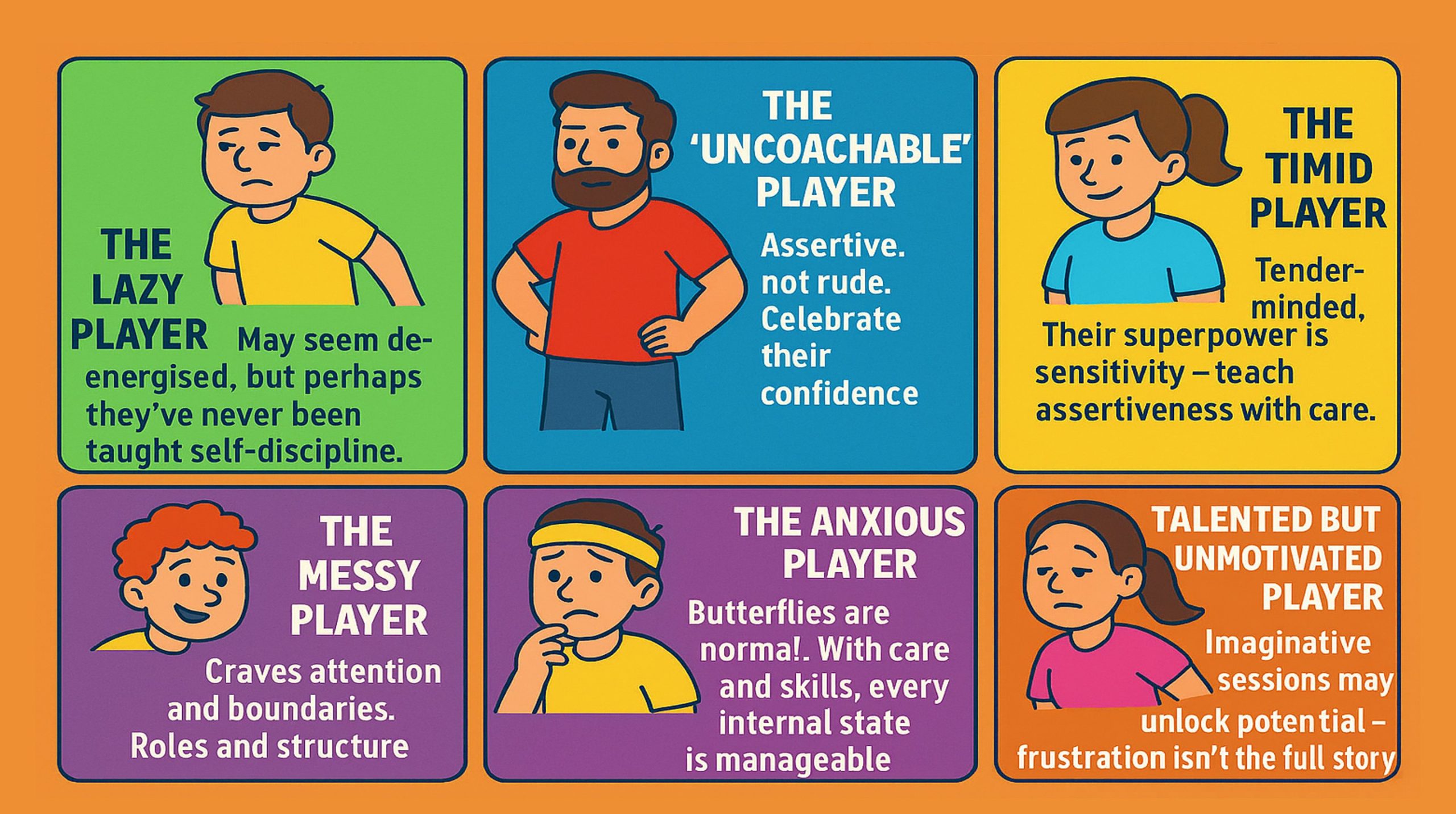
That lazy player
That seems de-energised and disinterested. That player may not be lazy.
Perhaps they’ve never seen self-discipline, nor been taught it!
That ‘uncoachable’ player
Who pushes back, who speaks a little plainly.
That player may not be rude, just assertive. Celebrate their confidence. Embrace it, enjoy it, and go from there.
That player who’s timid in the challenge
There’s a better description than ‘weak-minded’…it’s tender-minded.
Recognise their super-power, and set about teaching them how to tackle assertively.
That player who messes about a lot
That one who wants attention on them.
Maybe there’s a reason for this or maybe there’s not. Either way, they yearn for boundaries…boundaries, borders and rules.
That player who’s engulfed in anxiety
The one who looks like a nervous wreck.
Don’t discard them for their butterflies. Every internal state is manageable with skills and competencies and care and attention.
That player who is really good but never practices
That really frustrating one.
Perhaps they need practice sessions that capture their imagination
Players experience their characteristics
This is an extract from the Facebook post
“We experience our characteristics; we don’t do them on purpose. And these characteristics, in the main, are neither right nor wrong, they just are!
They’re not our fault, they’ve evolved in us as humans because they all work to help us get along and get ahead.
Young and old alike, lots of ability or lacking ability, it’s always the same. No one chooses their characteristics until they are exposed to techniques that develop the skills and competencies they need to manage them, to flex them, to shift them.
Herein lies the opportunity for a coach – to deliberately influence the practice environment, and work with the characteristics you see.
Help players flex or adapt, to discover a world of possibilities, challenges and enjoyment
So here’s a respectful suggestion – don’t (necessarily) expect people to come into your session with characteristics that are perfectly aligned with your desired behaviours.
Try to avoid making an immediate judgement about the characteristics you see.
Look to help people build the skills to flex and shift and adapt.
That’s coaching!”
Help players flex or adapt, to discover a world of possibilities, challenges and enjoyment
When I read this it stopped me for a second.
It described so many players I’ve coached. It brought back memories of challenges, frustrations, and work-around ideas, plus of course, lots of smiles, success and joyful sessions.
My wish is that all coaches would take a moment and consider how to help all players, including those ‘problem players’ and work hard to inspire and motivate them.
Deliberately influence the practice environment, and work with the characteristics you see.






![Introducing the badminton overhead – Challenge No.3 - Duplicate - [#36874]](https://badmintonandy.com/wp-content/uploads/2023/05/Badminton-Forehand-Overhead-3-scaled-1.jpg)
![Introducing the badminton overhead – Challenge No.2 - Duplicate - [#36821]](https://badmintonandy.com/wp-content/uploads/2023/05/Badminton-Forehand-Overhead-2-scaled-1.jpg)
