
The preparation to create a great sparring session
The guidelines and recommends to consider
Based on 16 frequently asked questions
An effective session is more than just playing matches
Why plan?
Do you think that coaches and organisers need a set of guidelines
Coaches and organisers talk about the need for having a sparring session, but how many plan and consider what will happen?
I hope these ideas will give you something to consider and maybe even challenge you.
When you design sparring sessions, do you consider :
- What will happen in the session
- The aim of the games that will be played
- The effect it may have on the players
- How to ensure that those attending (players & coaches) take away something from the session
Here are a list of questions that I hope will give you lots of ideas and thoughts
They have been gathered from the ones I’ve been asked, plus there are questions that I’ve asked other more experienced coaches.
The answers are my own thoughts or those from collective responses to my questions
Often the most interesting responses have come from organisers, not necessarily coaches
Within some of the advice, there are bullet points for your consideration.
If you are looking for 100% answers, then stop reading now
You will have to make judgements for yourself: that’s coaching 🙂
How would you reply, what advice would you give?
What is the purpose of sparring?
What is the definition of competitive sparring?
How can I prepare so that they get the maximum from a sparring session?
When should I play more free games?
What is the difference between sparring and conditioned games?
Why do players not like some of the games, and show resistance?
How do I cope with players who show resistance and argue?
What is the purpose of sparring?
There are many reasons to incorporate sparring or gameplay (matches) into your sessions.
I hope that the ones I’ve listed below are obvious to you, or are there a few that surprise you?
- How often do you use sparring sessions for the purpose listed below
- Matchplay: preparing for a competition or a specific opponent
- Testing of new skills: it’s the best, maybe the only true ‘test’ of a new or developing skill
-
Enjoyment: it must be fun to play competitive matches (do you agree
 )
)
- Team bonding: yes, it is possible to create Team enthusiasm through competitive matches
- Tactical development: to develop general and specific strategies in a ‘safe’ controlled environment
- Tactical thinking: ideas and prompts for player-coach discussions
- Selections: I’m not sure if this is the best use, what do you think?
There is a skill (an art) in preparing the games to match these different aims,
become an expert at creating the environment you want
What is the definition of competitive sparring?
Let’s explore Free play and Themed play
I found this question difficult, as in my view competition can mean many things.
The purest form of competitive sparring has to be where the only rules are ‘normal ‘ rules, and there is a prize worth attaining to compete for.
I do believe that there should be a competitive element in nearly all sparring, even with themed or conditioned games.
This competitive element will need to be defined, may be encouraged and not restricted by rules or the environment

Sparring that isn’t competitive needs to be appraised for its usefulness
How can I prepare so that we get the maximum from a sparring session?
The coach who asked this question came from a viewpoint that it would be better if the players knew what could be achieved in these sessions but was unsure how to educate them.
He’d tried explaining why sparring was important to them but felt that they just thought of it like match play and did what they had to do to win.
He mentioned that his players didn’t see the value as he did, or so he thought.
The benefits gained from sparring and the opportunities created are numerous
However, not all the benefits are immediately obvious, as some players believe it’s just ‘a competition’.
If you feel that your players do not understand how beneficial it could be, then have you tried these ideas below?
Be aware that once your players start to understand how they can use sparring sessions to help themselves, then they may start to question the type of games and conditions placed on those games.

Introduce these points very early in a player coaching/training journey
- Layering: be deliberate in your methods by adding new information/experiences over a long period of time (weeks, even months)
- By doing, by engagement, by refection: all 3 are different but essential, do you agree?
- Mix up experiences: this is called interleaving. Different ‘ah-ha’ moments; don’t just repeat the same themes continuously
- Linking it to tournament experiences: ask them what they needed, then create games/situations to show that sparring can help
- Challenges and puzzles: create hidden learning points in the form of challenges within the games
Not all players initially understand what could be gained from sparring,
but the ‘struggle’ and effort is often worthwhile
When should I play more free games?
The closer the session is to competition, the more free play should be encouraged
However, it’s also a time for individual themes.
Some may wish to gain confidence from winning, others from testing themselves in different parts of their game.
There will also be those players who want to prepare themselves for competition against a specific player.
You will need to know how to encourage each player so that they can achieve each of their aims during the free play sparring.
There are also other times when free play is important. Sometimes your group may need a break from all the ‘coaching’.
Try to be sensitive to the overall mood of the players and be prepared to play games with the intention of having fun through competition. Please remember that badminton is a game and games need to be played.
There are times when free play is important.
Sometimes your group may need a break from all the ‘coaching’.
What is the difference between sparring and conditioned games?
There isn’t much of a difference; it’s just the name used for the session, plus a few small changes here and there.
Even during free play sessions, I would hope that individual players have their own aims, goals and possibly even conditions concerning how they are going to play.
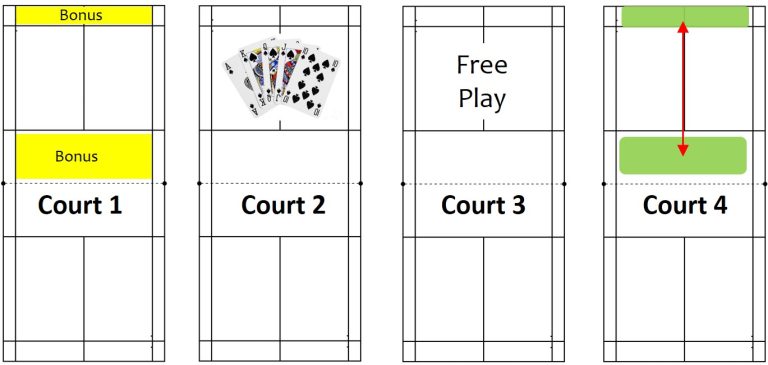
I’d prefer to use ‘Sparring’ or ‘Match play’ on the player’s weekly programme rather than Conditioned Games.
However, when coaches talk amongst themselves, they may certainly ask what conditioned games they intend to include within the session.
Of course, depending on the aim of the session, the games may seem more or less similar to real competition.
My advice is to be aware not to stray too far away from competition and the elements of free/unrestricted competition.
Coaches: how many types of games are in your book,
what multiple uses can you make of them?
Why do players not like some of the games, and show resistance?
You need to be prepared to work through the situations
What do you think could cause upsets or arguments – be clear in your mind that you know the trigger?
You could be responsible for creating some resistance
Not all resistance from players needs to become an argument. How you handle the request/challenge will influence the value players get from the session
- Could these be the triggers?
- Players will not accept anything but free play as they see no value in restrictions
- It is hard for everyone to understand the rules, the conditions – set by you
- They don’t agree with the rules – set by you
- Conditions that prevent players from winning points by ‘normal’ good play create anger and pushback – conditions set by you
- Players do not want to expose themselves to competition! – many reasons for this!
Be sensitive to the fact that all the above reasons are real to the people who express them. Although in time I’m sure you could help them change their viewpoint, hopefully.
You cannot be blind to these thoughts and just ignore any complaints. You do have to act!
** What will you do if the push-back is from your fellow coaches and organisers?
Everyone is entitled to a view, but not everyone is in charge of the session!
However, if you are in charge, that doesn’t give you the right not to listen & react
How do I cope with players who show resistance and argue?
Plan and consider your responses
Whatever you do, your thoughts should help prepare future sessions to avoid these player pushbacks next time.
- Stay cool – as the leader it’s important NOT to become aggressive and emotional. Of course, you may need to speak with authority and passion but be deliberate in your actions
- How would you react – consider if you were a player involved in the session how would you feel, do your players have something that you need to consider?
- Talk to the player(s) – remind them of the aim of the session, go back and read No. 3 above “How can I prepare so that they get the maximum from sparring?”
- Be flexible and change – maybe a change is required! Not every session has to follow your plan. It’s your plan so you can change it
- The ultimate sanction – you could remove the player from the session. Radical but a possibility!
What strategies do you use to avoid player pushbacks and arguments?
Send me a question
I’m always grateful if you have read this far.
If there is anything that you have read that has helped or that you disagree with, then please send me an email.
I promise to read all your comments
It would be great to hear from you contact@badmintonandy.com


![Early Preparation always - Duplicate - [#38141]](https://badmintonandy.com/wp-content/uploads/2026/09/early-preparation-always-scaled.webp)
![Keep your racket up - Duplicate - [#38056]](https://badmintonandy.com/wp-content/uploads/2026/09/keep-your-racket-up-scaled.webp)