
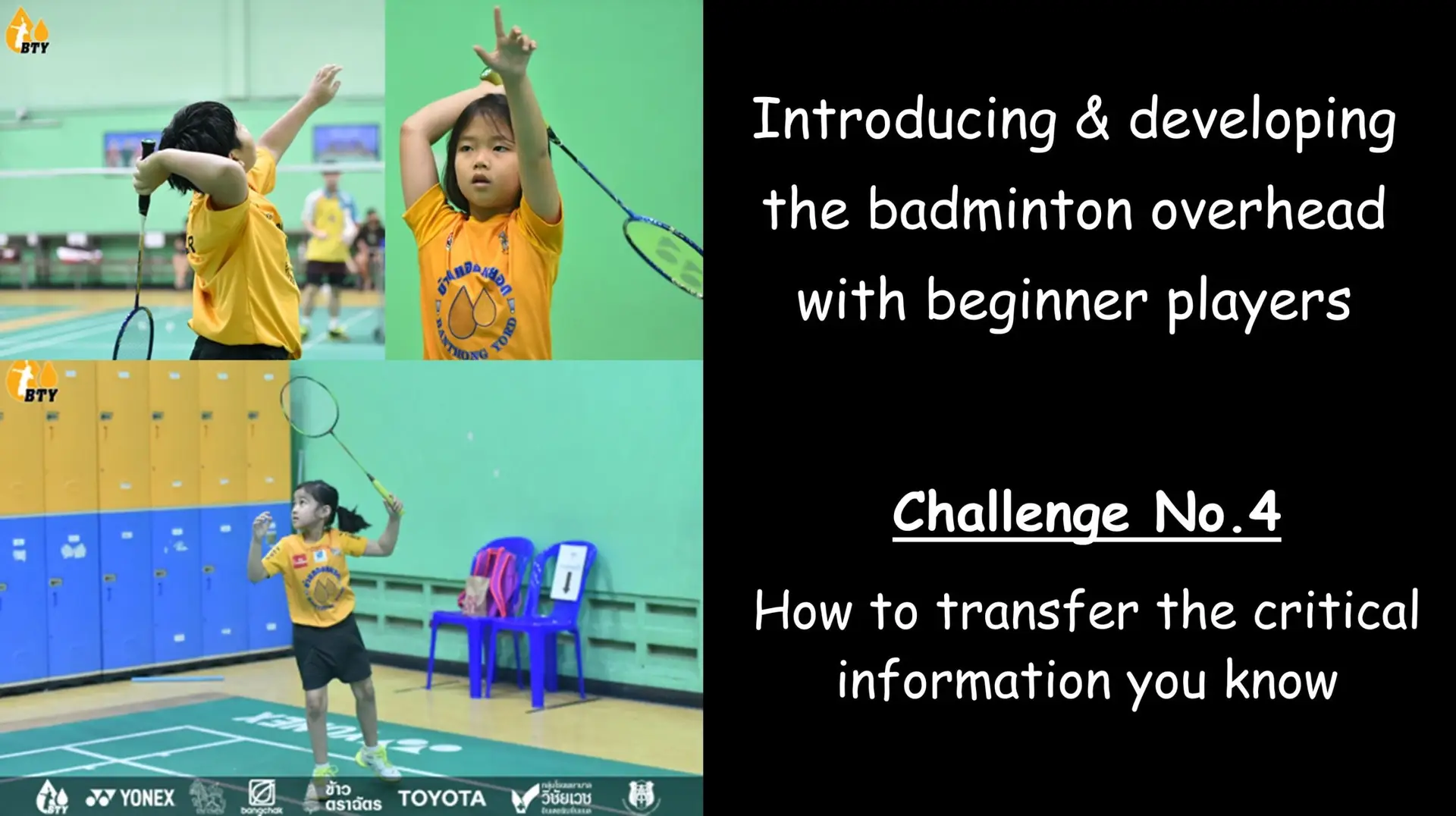
The badminton overhead is full of critical information
How to transfer the information you know is important
What’s the most effective way to pass this on to beginners?
How important is it that the players know all that you know
This post examines the various ways (the methods) that coaches use to communicate information to players.
My aim is for you to consider why verbal (telling/instructing/questions) seems to be the go-to method.
Why is this the case, why should you consider if there are other ways.
There are essential aspects that beginner players need to perform when being introduced to badminton overhead striking and somehow they need to be introduced. This is one of the challenges that is examined as part of this mini-series aimed at coaches working with beginner players.
You may feel challenged or ‘prickled’ at some of the points raised. My aim is to give you ideas to help make the learning a little easier and to create more smiles than struggles in your coaching sessions 🙂
The methodologies you use to establish the early critical aspects are
the key to future development
The conversation that started this mini-series
If you haven’t read the introductory post, click on the image to read more.
It outlines the challenges coaches face and some of the descion they are faced with.
There is also an insight into what happened when I spoke with 2 other coaches about these challenges and how at times, we disagreed!
I’ve outlined some of the thoughts we had during our conversation.
Why it’s important to discuss this challenge
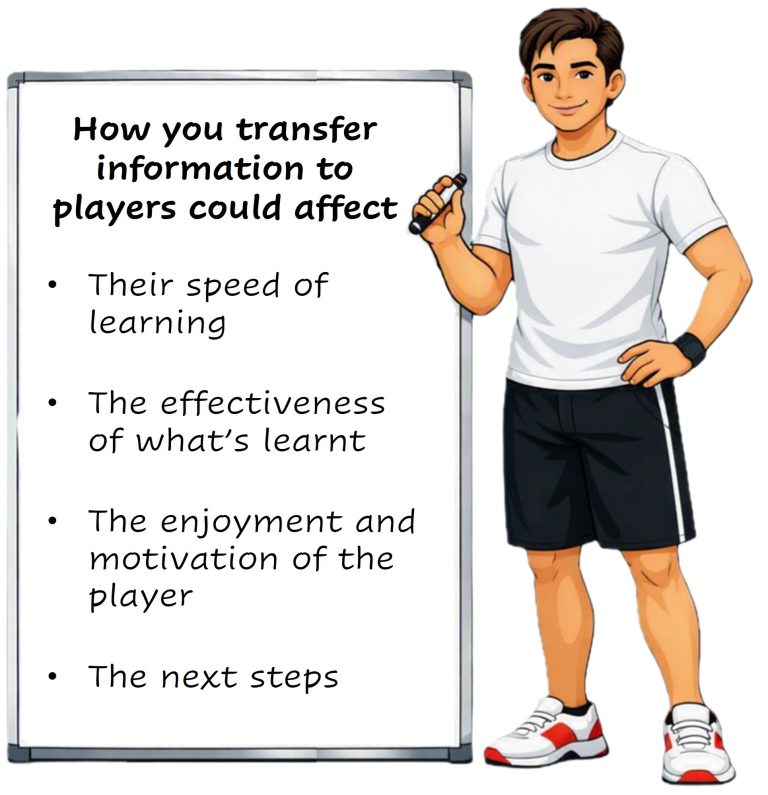
Without a coach providing information a performer’s learning will be slower, possibly less effective and may be less enjoyable.
I’m sure you could provide an argument against these 3 points, but that’s for another post.
However, how you choose to transfer the information could also have the same 3 impacts!
Coach education often provides more information about what to include in your practice rather than how to communicate it.
The default method for transfer of information (Tutor to Coach) in most courses and subsequently the one used in assessment and then real-life coaching is to verbally communicate all you want the player to do. How effective is this style?
How much of the information that you know do you give verbally?
Or, do you ‘hide’ some of them within the tasks and practices you set? : the task (practice) provides the key outcome without the performer initially knowing and being aware.
Does this make sense to you?
Is it possible to establish & develop critical information without ‘telling’ ?
Using mainly verbal instruction
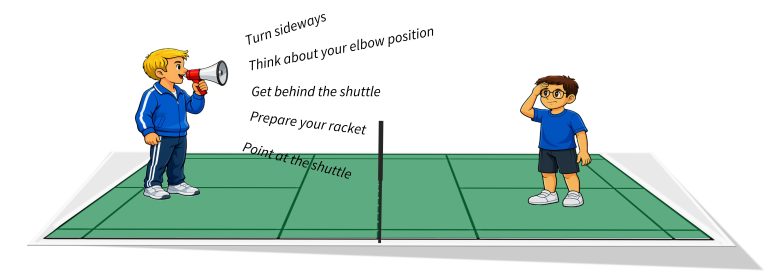
When coaching beginners in any stroke, and especially complex ones like the overhead forehand, coaches are often motivated to give information. The critical (essential) information that they know.
The issue I see is that most often it’s given verbally and, crucially as a one-time list that also includes a similar list of do’s and don’ts.
This verbal ‘information’ dump can feel satisfying to the coach; it’s what they believe that they are there for.
We’ve all stood courtside and heard the coach try to instil knowledge into players (even beginners) by explaining precisely how to move your arm/elbow, how to prepare and exactly where the racket should be pointing, etc, etc. Their demonstration is near perfect; the words match all their actions.
However, even if the players say that they understand they soon either forget or, more likely cannot turn all the words into actions.
It can be especially difficult for beginners to turn the coach’s precise instructions into movements that are perfectly sequenced and controllable.
To complete the verbal coaching, coaches often ask a series of questions to determine if the players can repeat back the crucial (often technical) aspect that they have been given. During the exchange, coaches will often either guide or prompt players to remember the ‘important’ points.
Are they doing this to establish understanding ? There must be a reason, and is this type of recall really the type of understanding that makes a difference on court in a game?
If you like to tell players a list of important factors,
how often are they able to put them into action?
Practice by doing

What would you coaching look like
To me, it meant a shift in emphasis in the methods I’d been shown on coach education courses and the way I’d been coached.
The delivery methods vastly reduce the information given verbally. Often to the point that other coaches may not hear all the points they expect and emphasise in their own coaching.
I’ve heard it called ‘lazy coaching’ and that it’s so far from the truth.
The fact is, I think it’s harder to coach this way; you have to be mentally agile and be constantly making decisions and choices from the options in your head.
Of course, you will verbally set out the practice, the task, and maybe the challenge. But crucially, the technical ‘list’ will be as short as you can make it.
Plus, the information won’t sound like a manual – well, not the current manuals! 🙂
The challenge of this practice type is to provide the player with a great learning experience through the execution (doing) of the practice/task, but without extensive, complex technical verbal instructions.
Observing from off the court it may look like the players are
performing simple tasks with limited coach instructions
Can you deliver a practice in such a way as to
- Ensure that players get into action, (doing) sometimes before you’ve finished talking – that’s ok 🙂
- The task/practice is easy to understand : the challenge, how to start, the general intention, what the outcome looks like
- How achievable is the practice for your players right now? It needs to be at least 60% achievable – challenging but not impossible.
- Often the task is similar to something they have done before, or contains elements that are similar to something they have done previoulsy (build on previous parctice/learning)
- Use constraints to provide a ‘funnelled’ learning experience that tries to establish a development
- At the end of the practice, it’s clear to the coach and player (maybe) what the next step/development could be
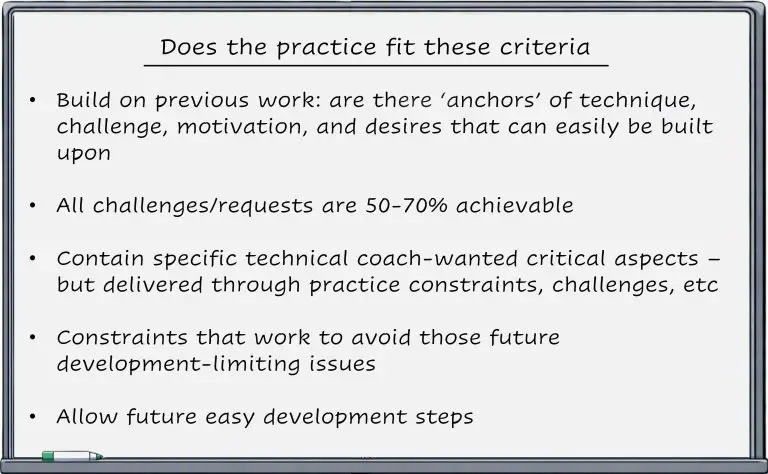
The challenge for coaches is deciding how to set (constrain) for each practice
with aim of developing a skill (or part skill) through a task – not excessive verbal instruction
Practice using ‘cues’ in different ways
What do you understand when someone says "I use coaching cues to help the player"
There will be verbal instructions or guidance; however, the difference is that they will draw attention to various aspects rather than a list of technical requirements.
In addition to the practice/challenge providing a condition/constraint, the player can also be given a cue or observation to follow.
The cues and visual aspects can easily be acquired by the coach (if they collaborate with others), however, the greatest challenge will always be why and when to use them.
Consider the Do’s & Don’ts below : what thoughts and questions do they create?
Do’s when coaching overheads to beginners
- Show images of starting and end positions – ask players to replicate them
- Ensure that the task/practice is easy to understand : the challenge, how to start, the general intention, what the outcome looks like
- Create practice situations that enhance technical elements – but don’t tell the player what you are doing. Let the practice provide the development, or change the practice
- Start in the Backhand court (Round-the-head court) – feeding over the non-racket shoulder has many advantages
- Use shadow movements with a full powerful throw as part of the warm-up, or just before on-court striking attempts
- At the end of the practice, it’s clear to the coach and player (maybe) what the next step/development could be
Don'ts when coaching overheads to beginners
- Ask the players to concentrate on body part movements that happen in the middle of a power throw
- Use slow-motion throwing in practice, and certainly not with stop-start movements
Conversation starters for you and your coaching friends
Why not find a few other coaching friends and start a conversation to explore the questions and statements below.
Hopefully you will find them stimulating and a little bit ‘prickly’, that is my aim!
Coaching the badminton overhead is a fascinating, complex process 🙂
Is telling (verbal information, prompts and questions) a faster way of learning?
(Discuss what learning looks like)
What did you discover from Coach Education about coaching overheads with beginners?
The tips and tricks
Does giving (preloading) information to beginner players help?
Or are previous experiences more valuable?
Telling information produces faster learning with beginners
Surely the best way is to just ‘Tell” players the information they need? Telling them is a faster process so they can then start to practice all that they’ve heard.
You are experienced, you know what’s required, and you know it works, so just tell them. Isn’t that what good coaches do, pass on information that works?
The information you know is important there is no doubt about that, but just telling someone really doesn’t work. Well, it may work for a very short while if you are fortunate but very soon it can seem to disappear. So what do we do next, we repeat and try again.
Coach Education helped coach overheads to beginners
Surely the best way is to just ‘Tell” players the information they need? Telling them is a faster process so they can then start to practice all that they’ve heard.
You are experienced, you know what’s required, and you know it works, so just tell them. Isn’t that what good coaches do, pass on information that works?
The information you know is important there is no doubt about that, but just telling someone really doesn’t work. Well, it may work for a very short while if you are fortunate but very soon it can seem to disappear. So what do we do next, we repeat and try again.
Preloading information is more productive than using expereinces
Surely the best way is to just ‘Tell” players the information they need? Telling them is a faster process so they can then start to practice all that they’ve heard.
You are experienced, you know what’s required, and you know it works, so just tell them. Isn’t that what good coaches do, pass on information that works?
The information you know is important there is no doubt about that, but just telling someone really doesn’t work. Well, it may work for a very short while if you are fortunate but very soon it can seem to disappear. So what do we do next, we repeat and try again.
Challenge No.4

Send me a question
I’m always grateful if you have read this far.
If there is anything that you have read that has helped or that you disagree with, then please send me an email.
I promise to read all your comments
It would be great to hear from you contact@badmintonandy.com

![Introducing the badminton overhead – Challenge No.3 - Duplicate - [#36874]](https://badmintonandy.com/wp-content/uploads/2023/05/Badminton-Forehand-Overhead-3-scaled-1.jpg)
![Introducing the badminton overhead – Challenge No.2 - Duplicate - [#36821]](https://badmintonandy.com/wp-content/uploads/2023/05/Badminton-Forehand-Overhead-2-scaled-1.jpg)

![Introducing the badminton overhead – Challenge No.1 - Duplicate - [#36631]](https://badmintonandy.com/wp-content/uploads/2023/05/introducing-the-badminton-overhead-challenge-no-1.jpg)