
![Introducing the badminton overhead – Challenge No.1 - Duplicate - [#36631]](https://badmintonandy.com/wp-content/uploads/2023/05/introducing-the-badminton-overhead-challenge-no-1.jpg)
What's your plan when introducing the overhead
Especially with beginners during the first 6 – 12 months
How do you create those important early experiences
A plan is essential, but what do you include and why?
How much attention should you give to how it’s delivered?
The conversation that started this mini-series
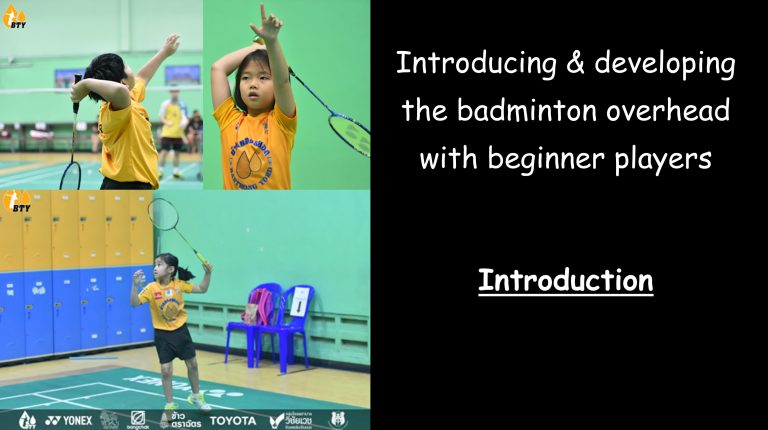
If you haven’t read the introductory post, click on the image to read more.
It outlines the challenges coaches face and some of the descion they are faced with.
There is also an insight into what happened when I spoke with 2 other coaches about these challenges and how at times, we disagreed!
I’ve outlined some of the thoughts we had during our conversation.
Establish some key thoughts in a plan
What would you include
This post examines the challenge of putting together a plan to introduce the badminton overhead, especially when working with young players who are new to the sport.
The content of the plan and the ways (methodologies) you choose to deliver those critical elements.
You may feel challenged or ‘prickled’ at some of the points raised.
It’s very easy for beginners to develop what seems like an effective technique,
but in fact, the ‘solution’ they come up with is probably a ‘future-limiting’ one
You have several questions when planning what to include. I’ve listed a few below. Some of these may be easy to answer, and other aspects may need research and thought.
There certainly isn’t a fixed step-by-step sequence. There also isn’t a set of ‘magic’ practices that solve all your issues.
I’d recommend that you create a plan that has general guidelines and prompts for you to follow.
Create practices that provide positive experiences for players to help with development.
Experiences that contain the technical elements you want to introduce, but often without the player being aware of them. Try to make them repeatable but with built-in variations.
Include themes and cues that the players can repeat without much coach control. Allowing players to enjoy (and engage with) their development.
Challenge yourself to create a development structure that includes: enjoyment, challenge, intrigue, wonderment, engagement, robustness (possibly the hardest) and success.
The key is to create as many practices and experiences as possible
that restrict opportunities for inappropriate (future-limiting) techniques to appear
Questions to discuss with another coach
Use the discussion to build a plan or identify gaps
What are the core technical elements that you like to see in a badminton overhead technique?
– specifically for a novice player in the first 12 – 24 months
What could be established before starting overhead work?
– are there any previous experiences and learning before starting overhead development that may help?
How does your knowledge compare to other coaches?
– would you be willing to share your plan (your ideas) to get feedback and some new/alternative viewpoints
How flexible are your thoughts?
– do you have at least 2 or 3 different ways (methodologies) to coach specific parts of the plan, or just one go-to method
What do you want the players to know and hear?
– how do you want to ‘package’ your information? Are there advantages to players not knowing all that you know?
Plan, but be specific to the individual
Ensure your delivery is specific to the player and their stage of development
It’s important not only to assess what a player can do technically and physically but also emotionally.
How do they react to instructions, the period of time that they can practice before becoming ‘saturated‘, do they like challenges, and how do they react to error?
Understanding these aspects about the group or person in front of you is probably more important than the amount of technical information that you know.
When and how you decide to give information is dependent on the ‘person/group’ characteristics. It can be the difference between success and struggle, for both the player and you, the coach!

Not everything is always important
There will be technical aspects that whilst important do not need to be included in your beginner plan. There are also coaching methodologies (how you practice) that need to be adapted to suit the needs of your beginner players.
Resist the temptation to throw everything you know or have seen others do into your plan. More is not often better!
Only you can decide what aspects need to be emphasised; this linked post suggests the 4 technical ‘must-haves ’.
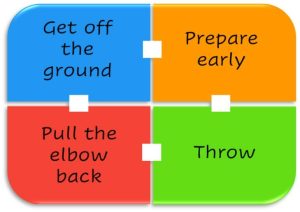
What are your must-have’s in a beginner overhead forehand practice?
- the technical must-haves (my list has only 4, then I select one or combine them)
- the psychological must-haves (maybe harder to decide than the technical must-haves)
- the must-have practice experiences (maybe the most important of all!)
Not every player needs to be coached in the same way (content & methodology)
but your coaching should be full of similarities
Plan the methodologies you will use
Do you have a strategy of how you will act and the coaching methods you will use
A plan isn’t just a list of technical points to show or, worse, tell the players.
The way you coach, the practices you set, the adjustments and interventions you make: these are vitally important.
These methodologies and coach actions describe how you will go about your coaching. Some will be effective at times, and at other times not.
Even if you aren’t sure about the methodologies you use, I’m sure if you consider what you do that you will find a few that are easy to spot.
- How much information do you prefer to give, when and how
- Do you set challenges and expectations or are you reluctant to ‘push’
- How do you deal with mistakes, errors, player judgements
- How deliberate are you in your conversations with players
- What’s your view on asking beginner players questions
- Do you like to practice the same thing repeatedly, or deliberately include variations
- What are your thoughts about players being aware of their developments, techniques, motivations
- (How do you judge your coaching performance or don’t you)
Consider if selecting your coaching methods and designing the practice
is more important than the technical/tactical content
Common methodologies that require consideration
Do these deliver the effectiveness for player development
Do you agree that on balance, although these do work sometimes, across a range of beginner players, these methodologies or beliefs are not effective?
Be careful of these methodologies when working with beginners – each has a hidden danger
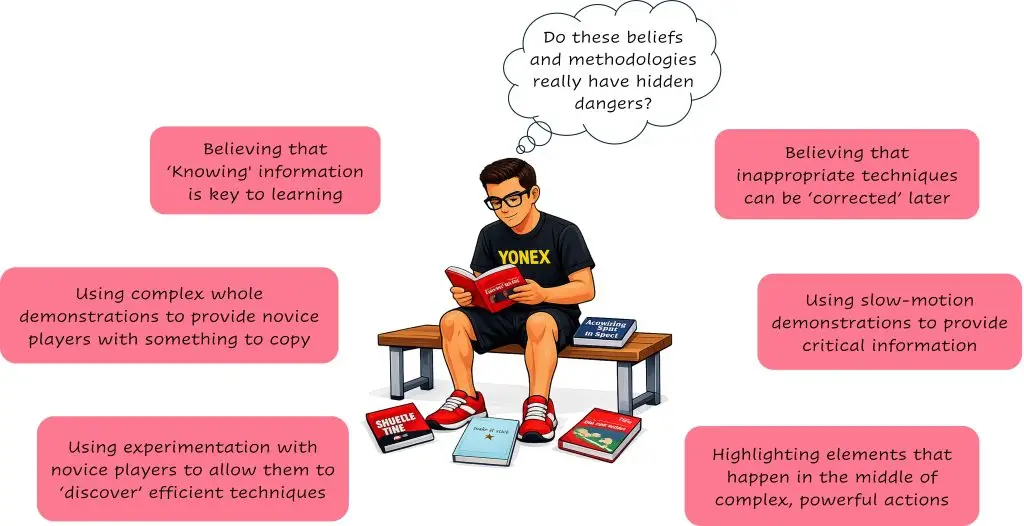
Believing that ‘knowing’ information is key to learning
Do the players have to know all that know? Be careful in what you select and how you transmit information to players. Does Players knowing lots = success.
Using complex whole demonstrations to provide novice players with something to copy
You may be able to demo these complex badminton overhead forehand movements, but can these beginners achieve success and gain progressive value from copying you?
Isolated movements and combinations of whole movements require progressive practice, not just replication.
Highlighting elements that happen in the middle of a complex powerful action
Can beginners control and adjust their limbs in the middle of powerful overhead throwing movements? Can you?
Do you know exactly what your joints and limbs are doing in the middle of an action? Maybe at the start and end, but once the power starts can you control exactly exactly happens?
Using slow-motion demonstrations to provide critical information
Easy to demo and practice, but is there an effective carryover into powerful movements?
Do you see a positive outcome from using slow-motion demonstrations for overhead throwing actions, or is it just another way for you to transfer information?
Believing that inappropriate techniques can be ‘corrected’ later
“Let them hit”, “too much coaching is bad”, “I can correct later”
I’ve heard all of these from passionate coaches working with beginner players: but do these coaching philosophies really work?
Challenge no.2
![Introducing the badminton overhead – Challenge No.2 - Duplicate - [#36821]](https://badmintonandy.com/wp-content/uploads/2023/05/Badminton-Forehand-Overhead-2-scaled-1-300x168.jpg "Introducing the badminton overhead – P1")
Send me a question
I’m always grateful if you have read this far.
If there is anything that you have read that has helped or that you disagree with, then please send me an email.
I promise to read all your comments
It would be great to hear from you contact@badmintonandy.com

![Keep your racket up - Duplicate - [#38056]](https://badmintonandy.com/wp-content/uploads/2026/09/keep-your-racket-up-scaled.webp)
![Introducing the badminton overhead – Challenge No.3 - Duplicate - [#36874]](https://badmintonandy.com/wp-content/uploads/2023/05/Badminton-Forehand-Overhead-3-scaled-1.jpg)
![Introducing the badminton overhead – Challenge No.2 - Duplicate - [#36821]](https://badmintonandy.com/wp-content/uploads/2023/05/Badminton-Forehand-Overhead-2-scaled-1.jpg)