
Its important to use the break between points
Have you thought about what you could do to prepare yourself?
Players who understand how to use the rally break have an advantage
The advice below focus on what to do in the rally break.
It’s an opportunity that should be used. If you have never practiced what to do and think during this time, start now, you may be surprised at all you can achieve.
– What could you be doing and thinking?
– Are there proven strategies other players use?
– How can you incorporate it into practice?

When, What, How
All the suggestions in this post start as soon as the last rally finishes.
The moment the shuttle hits the floor you should be using the time to help yourself. You have until the next rally starts.
There is no set time (although the rules may change one day), but be aware : the umpire may encourage you to start faster if they think you are taking too long.
What to do if you have won or lost the last point

When you have lost the point
When you have won the point
- Don’t just flick it back quickly under the net if the shuttle lands on your side of the court
- Make it your ritual to pick it up, walk back to the centre of the court and then hit it to your opponent
- Start to diminish any emotion or use it to your advantage
- Start to create a plan.
- Realise that you are in charge of everything that happens in the next 10 - 20 seconds
- Immediately congratulate yourself for winning the last rally, this is important! Be your biggest supporter.
- If the opponent had made an error, then ‘Thank them!’
- Start to create a plan
- Realise that you are in charge of everything that happens in the next 10 - 20 seconds
As you move to the centre of the court
Questions to ask yourself
- Look at and be aware of your opponent and their immediate actions.
- What can you see or feel from the way they are moving?
- Do you think that their mental state has altered?
- Do all this and ask yourself the QUESTIONS
- Realise that you must use the next 10 seconds to try and gain an advantage
- Do I need to change the shuttle – focus on the condition of the shuttle?
- Do I need to say something to myself? (look out for "6 ways to improve your self-talk"
- What did I learn from the last rally or previous 3 rallies?
- Has my impression of my opponent changed in any way?
- Do I need to change my plan?
The actions for you to take
- Complete all the 4 actions above
- Create a plan
- Trust your plan
- Start your Serving or Receiving Ritual
You don’t have to make any changes or decisions in the Rally Break. Maybe your plan in the last few rallies has been working, so there is no need to change it.
The advice above is asking you to use the time between the last point finishing and the start of the next.
Do it so often that it becomes a habit.
Diminish and start to control your emotion
You may have heard this advice before. However, do you follow it, and do you understand the subtleties that it contains?
You may consider every rally to be equal; it only adds 1 point to your score if you win.
This is true, but emotionally, each rally is not the same!
Learn to control and use those emotions that cause you to act
This advice is NOT suggesting that you take away all the emotion
How would you feel in these situations?
Find a quiet place and assess how you react in the situations described below.
How many of these have you previously experienced, what did you feel, and how did you cope?
Don’t judge yourself, just think of the situation and write down how you reacted, how it makes you feel.
I’ve used these questions with many players. It’s interesting that some get very emotional over them and others see the situations completely differently.
- You were leading 12-5 and they come back to 12-10 in one run of points
- Your opponent wants to change the shuttle every rally
- You were losing 14-17 and then your opponent makes 3 simple unforced errors, the score is now 17-17
- You’ve just hit 2 return of serves out the side and you are about to receive service again
- Your coach is shouting loudly offering instructions from behind the court
- Your Team need you to win this match and you are losing 18-15 in the 3rd end
I’ve met some players who say that they have a plan for each of the situations above
The difference between players in a close match is often how they react to situations and prepare for the next rally
Self-talk, Trigger words and Physical actions
If you are not actively using positive self-talk or Trigger words you are missing out!
Self-Talk
Do ever think or even worry that you have conversations in your head?
It’s called “Self-Talk” and we all doit it.
Many of us don’t realise the power it has and all the forms it has: unstructured and rambling, negative or positive, planned and rehearsed.
During a rally break, there is plenty of time to talk with yourself. I guess maybe you do that already.
Have you noticed how much you can say in such a short time?
I suggest that you try out and develop self-talk strategies with the goal of finding something that works for you. Your intention is to be comfortable with the voice in your head.
Talk with your coach or a friend and discuss how you all use self-talk. Hopefully, they can give you ideas that you could try.
Having control of your self-talk is more important than having perfect technique,
it’s far more important!
Trigger words or Phrases
Do you have any Trigger words or Phases?
Are they used at specific times and how did you create them?
Often, they are single words or short phrases that people say. Words that have been practised and, importantly, trusted.
These words, said in the right way, will trigger a mindset or physical feeling that you desire and enjoy.
Sometimes say them out loud, but they can be equally powerful when said quietly in your head.
Here are some of the Trigger words and Phrases that I know players use.
- "Steady"
- "Hold"
- "Vamos"
- "Be Cool"
- "Breathe"
- " This is my time"
- "Play like a dog"
- "I'm strong"
- "This is what I train for"
- "Now is the time to act, I feel it"
Are you a coach?
Do you encourage your players to find their own words? Maybe they already use some of these above?
Sit down and work with the players to discuss what words they may be using right now. You could be surprised at how many have experimented with trigger words.
Please don’t underestimate the power of trigger words. They can move players from a state of panic or confusion to one of confidence and readiness. Some players have written cards in their bag to read while warming up at tournaments.
Encourage them to use them in specific situations, possibbly on a daily basis, if those situations happen in the practice.
However, they MUST mean something to the player. Merely repeating the words given to them by a coach will not be as effective.
Physical Actions
You don’t need just to use words to change how you feel during the rally break. Many players use physical actions to help themselves. I’ve seen these 3 very common ones. They seem to be linked with finishing one rally and starting the next.
If you currently do any of the 3, are they deliberate and do you use them to intentionally prepare yourself?
- Bouncing on the spot
- Walking in small circles
- Blowing on your hand
How to focus your attention and create ‘thinking moments’
Sometimes it’s so stressful during the rally break you just cant think!
Is this true for you?
You might not agree with this statement, but it does happen. In some situations, players (including you) can make very strange decisions.
Choices like deciding to hit that crosscourt slow drop on the return of serve, because you haven’t used it all match, and you believe that it will surprise them! Is that a great plan when you are 18-19 down and receiving?
How to create those moments when you can “think” and start to control that rush of emotion building up inside you.
Breathe
Everyone needs to breathe, but doing it with purpose and for a reason is different.
There are many good reasons for using breathing techniques at critical points. Try exhaling now (breathing out with a little force) and imagining blowing out all your tension and anger.
Do you think you could make it work for you?
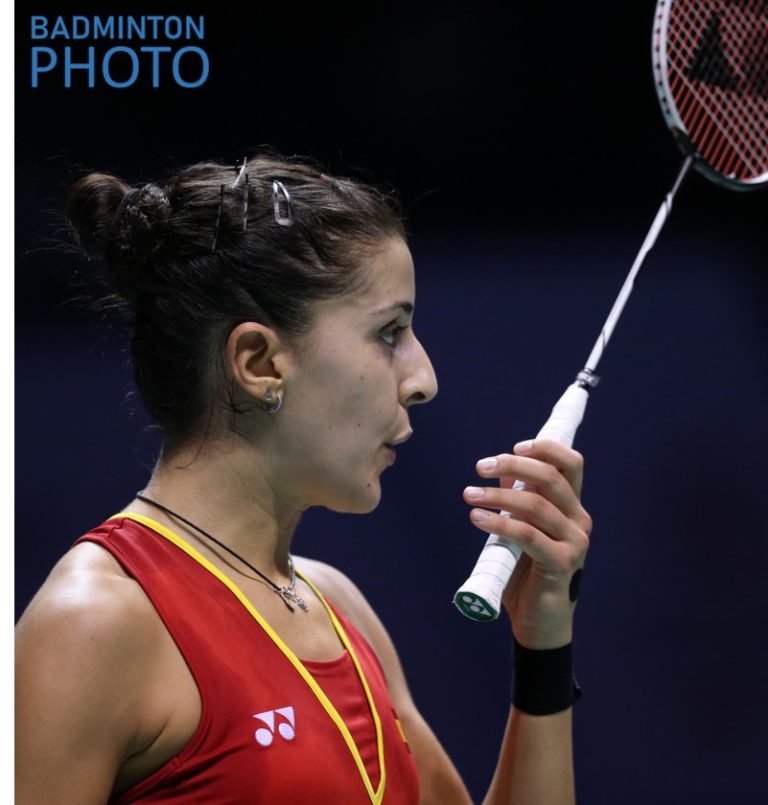
I think that this is a technique you should take seriously if you find that your emotions overwhelm you between points.
Many players have developed rituals to use in the rally break that involve breathing.
The obvious ones are where you see players blowing onto their racket hand.
The drying effect on your grip may be minimal, but the ritual can help the player to create a trigger that leads to all the toughst about.
If you work with a Sports Physiologist, I’m sure you can develop various breathing techniques to use on and off court.
Remember, you need to practice. You may need to work with someone other than your coach to maximise the effect.
Bubble over the court
My mentor Roger Mills (All England Mixed Champion and multiple England National winner) used to tell me a story about a method he used.
He said it was very effective when playing in a hall with hostile crowds, and his concentration and mind started wandering.
In order to eliminate the crowd noise from his mind, he used his bubble method
During the match, he would take a moment and imagine that there was a large bubble all over his court. Itw as was perfectly sealed all around the court. This separated him from the crowd; their efforts to distract him could not work. There was now a moment of silence in his head
Roger said that he would then look directly at his opponent during the rally break and say quietly to himself ….
“it’s just you and me, your crowd can’t influence me anymore, let’s play!”
Straightening your strings
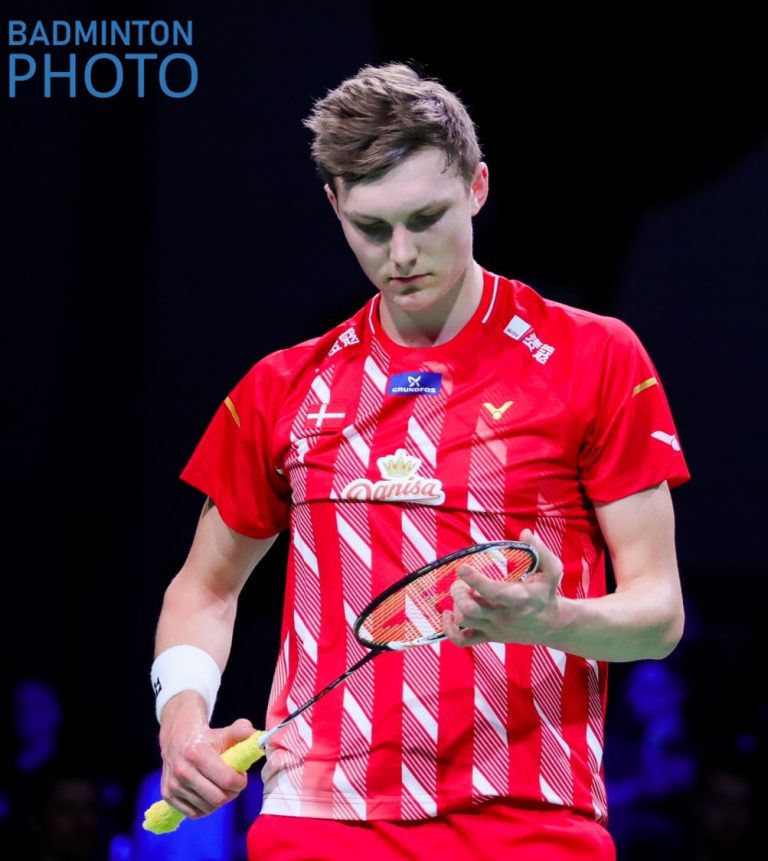
Have you ever noticed players looking at, or appearing to move their strings at the end of a rally?
It’s not just to check if they are straight and broken. Of course, in a small way it is, but it’s often far more than that. Look at their faces when they touch their strings.
This method, if practised, can immediately change your focus. Use this action as a Trigger to start thinking about what to plan for the next rally or phase of the game.
Believe that the touching or looking deeply into the strings can help you.
If you think it’s strange and won’t work then start to look at matches of very good players and see how many could be using this technique.
Use your Coach
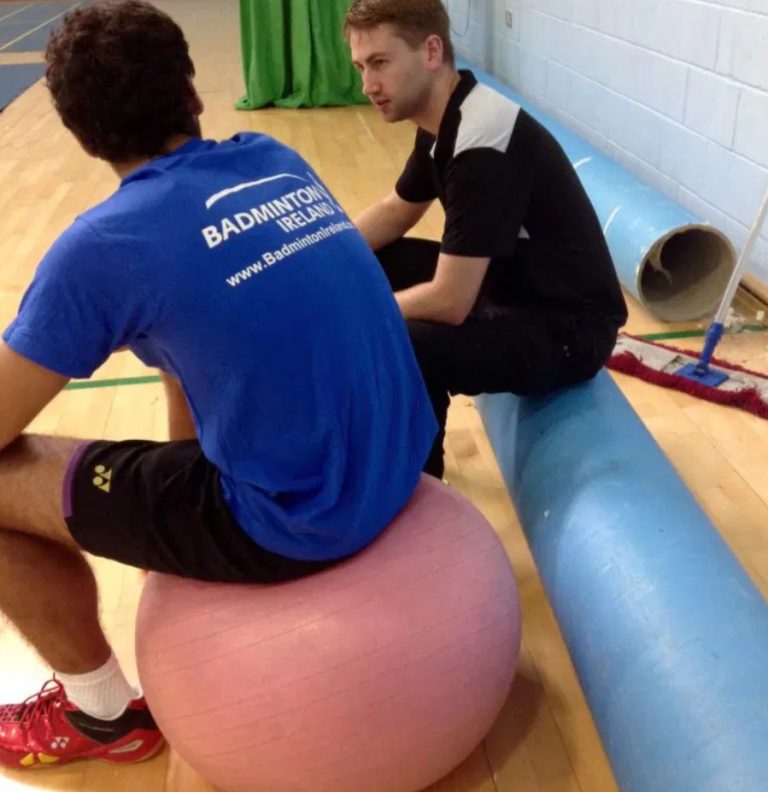
If you are struggling in a match and feeling confused or distracted then use your coach. If they are sitting behind you then look at them. They are there to help so use them!
Some people may see this as a player showing weakness or a coach dominating a player. If it works for you, then call it “Teamwork”.
It’s not as simple as just looking at the coach or having the coach shout back at you.
My recommendation is to consider using this method to improve your rally break rituals and strategies.
Work together and talk about how you both can help. What different methods could you use?
Checking the shuttle
As with checking the strings, checking the shuttle can cause you to remove yourself for a moment from the emotions of the match.
Have you thought about making it a habit to check the shuttle whenever you feel emotional?
Or, if you want, before every serving rally.
Even if you have lost the rally, hold it, check it before giving it back. Please don’t just push it back under the net.
Making this a habit can create those moments that you will be able to use to prepare.
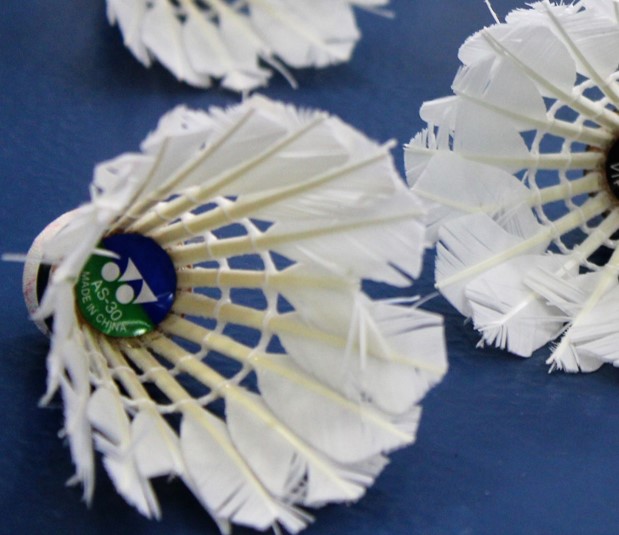
It all starts with your Ritual
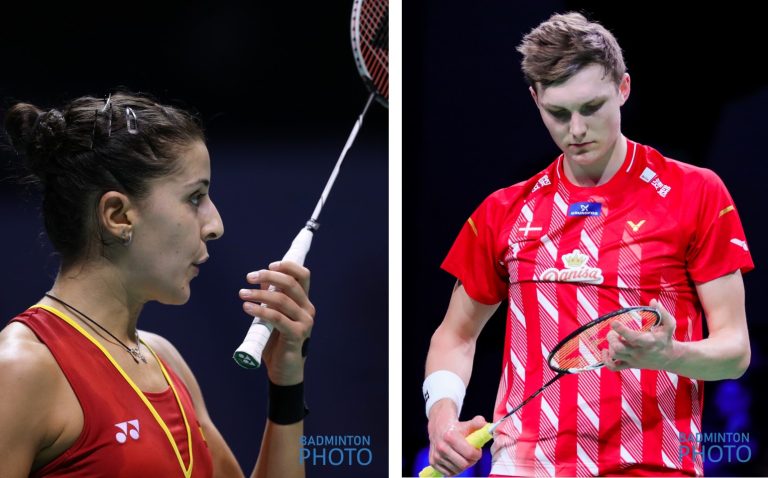
This is the most powerful of all the points here.
All of the above points contribute to a ritual. It’s up to you to decide what to include.
If you don’t use a ritual of some type then how can you prepare for the next rally?
I believe that you must try and develop a ritual that works for you. They can change over time and you may have different ones for various situations.
However, just having a ritual that you use during the rally break doesn’t mean that you will win the next point. But, you will be giving yourself an increased chance.
A ritual can be defined as…..
‘a certain behaviour or action that a performer carries out with the belief that these behaviours have a specific purpose or power, to influence their performance’
Practice with Intent and Learn to use the rally break
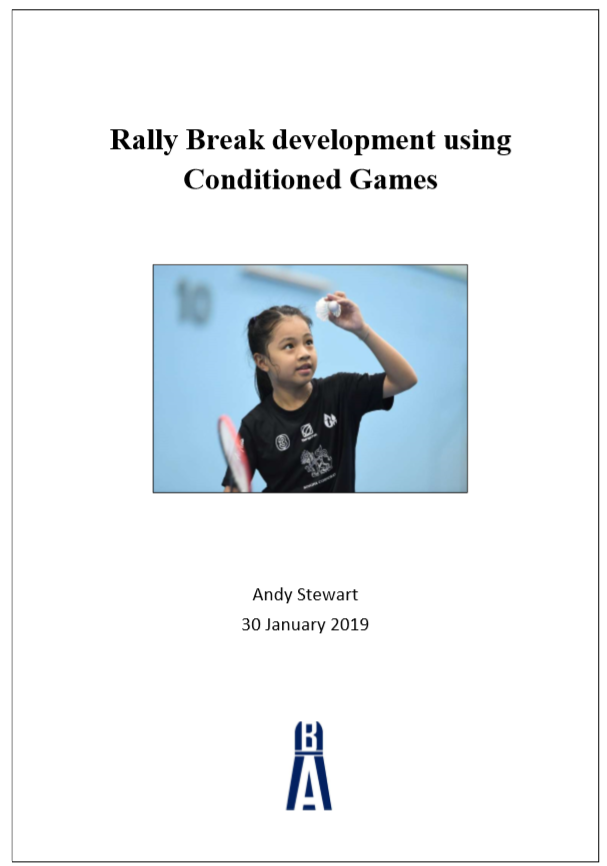
This is probably the most difficult of all the tips here to implement.
It will require you to create situations for your practice. You need to be committed to trying new actions and thoughts.
Hopefully, you will have the support of your coach.
If you are a coach, you will need to persuade your players of the value.
Start improving your rally breaks immediately, the next time you play practice matches.
I recommend that you include lots of conditioned games in your practice session.
Click on the image and you will find 5 Singles Conditioned games to try in your next match practice session.
What to include in your practice
- Discussion with other players, coaches and Sports Physiologists about the use of Rally Breaks.
- Whatever you decide to include in your ritual, NOW is the time to practice and try it out.
- Conditioned games that have the objective of allowing you to practice your rituals.
- Observation of better players: what they do between points and when preparing to serve or return.
- A desire to try new things – be brave if you wish to succeed
Warnings and Challenges
Just playing the games will not give you the thoughts, spoken words, actions or rituals to use in the rally break. You must contribute and be prepared to work, to tire mentally.
The purpose of using Conditioned Games is to provide you with opportunities and scenarios where a rally break technique could help you.
You may initially experience some displeasure or feel uncomfortable when trying them.
Don’t expect immediate improvement from your suffering. Work with people to improve just as you would with a stroke or movement technique issue.
Be aware that your Coach may also be challenged. They may be required to change the style and content of their sessions. Not all coaches will be experienced or confident in doing this.
Send me a Question
I’m always grateful if you have read this far.
If there is anything that you have read that has helped, or that you disagree with with, then please send me an email.
It would be great to hear from you contact@badmintonandy.com
![Introducing the badminton overhead – Challenge No.3 - Duplicate - [#36874]](https://badmintonandy.com/wp-content/uploads/2023/05/Badminton-Forehand-Overhead-3-scaled-1.jpg)
![Introducing the badminton overhead – Challenge No.2 - Duplicate - [#36821]](https://badmintonandy.com/wp-content/uploads/2023/05/Badminton-Forehand-Overhead-2-scaled-1.jpg)
