How to maximise the advantages
to create a great shadow badminton footwork session
are there any pitfalls to avoid
A great shadow footwork session is much more than just moving quickly
What is Shadow badminton
The 5 different types
Is a shadow footwork session just about moving around the court (or an imaginary court) as you would in a game, is it really that simple?
Have you considered all the different types, the directions you move, the patterns you make, how you are directed, the intensity, the speed, the duration and finally, what you should be thinking.
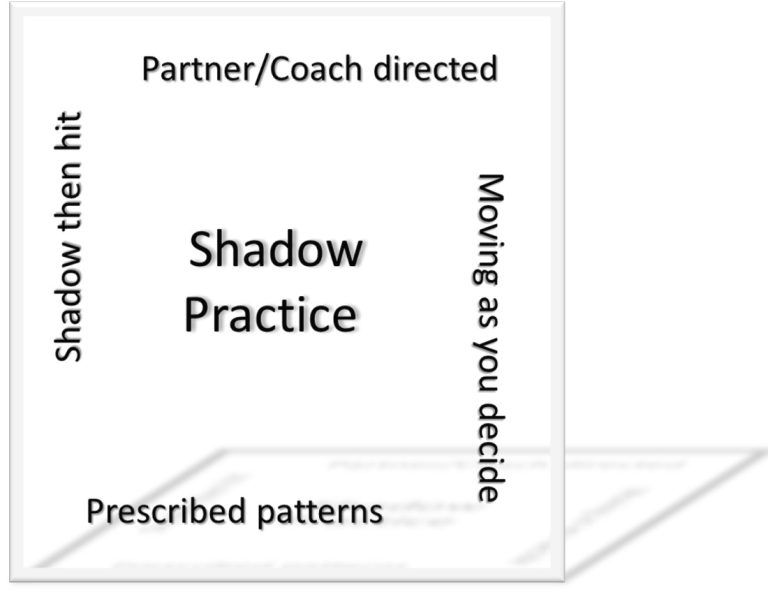
Prescribed patterns
Players know exactly where they are moving to and from and repeat these patterns.
These sequences can involve any number of points on the court.
It varies from 2 points to upwards of 6. Any more than 6 makes it difficult for you to remember.
Partner/Coach directed
One player points or calls out where the other is to move, using thrir hand or a racket.
Often they indicate the speed: “fast”, “go”, “jump” !
These sequences can be prescribed, or more often it’s a theme: “attacking”, “defensive”, or a mixture
Moving as you decide
it’s exactly that, players decide where to go on court.
I recommend that you develop a great ‘game-like’ imagination. Decide what type of theme you want to replicate.
Shadow then hit
Players perform a shadow stroke/movement, then strike a shuttle delivered by a feeder.
Its not always seen as a shadow practice, but many of the recommendations here still apply
Shadow Speed Tests
Targets are positioned within the court; players move to each target, in either a sequence or random order.
The time taken is measured; patterns can vary.
Have you tried these 5 different types, which do you prefer?
Do you know of others?
Use your imagination
Maybe the most important factor!
When you are in the middle of your shadow practice, what are you thinking about?
To be effective, you need to be able to create a rally situation in your mind.
This applies to players, coaches and feeders. Create pictures and situations in your mind, and replicate the movements that would happen in a real game.
It’s not just remembering where to go next or what footwork pattern to use.
You can gain far more if you visualise the rally, the situations, the emotions, your reactions, the successes, and the failures.
Check that the movements you do could actually happen in a real match.
I’ve seen plenty of shadow work that doesn’t look at all like a game rally. How often do you play a FH block, then immediately play a BH block, followed by a net kill?
Does that really happen?
Close your eyes and try imagining that
Early Preparation
It’s almost as important as having a great imagination
Ensure that your racket is moving as it would in a game
Why would you not do this … but have you checked?
For example : when playing nets shots have it prepared early, slightly outstretched ‘as if to play a net’.
For overheads, imagine being flicked just over your head and needing to prepare early.
Sometimes, prepare early as if you are about to deceive your opponent.
I’m worried that this is the least emphasised part of most players’ shadow practice.

Be aware of these points
- Prepare for a situation on the court: defensive, attacking, waiting, exploiting, etc. where would your racket be and how early would it be there?
- Be careful not to overlook EP – Early Preparation in favour of speed
- Often when your mind wanders it’s the Eraly Preparation that suffers first. Ensure that your racket preaores for something.
- Sync the racket with your imagination, therefore it will be prepared early but not always in the same position
Choices and Questions
When designing your shadow badminton training,
I recommend that you consider these headings
Duration
Consider the duration of each individual rally and the total time of each set. Then consider the total time of the session duration.
The individual rally/elements could last from 10 secs to upwards of 30 seconds for one rally. I’ve also heard of a single session lasting over 20 mins without stopping (watch the video at the end of the post).
- What do you think is an acceptable range of reps and sets, how long before you get tired and lose focus?
The speed of movement
I’ve seen movements done at game speed, much slower than game speed and also players moving as fast as possible from one imagined shot to another.
It can be difficult to maintain good form when speeds are increased. Partner directed movements can also complicate the speed element as it relies on the pointing/directing to be as game speed.
- What speed do you move at… be careful that you don’t just’ move’, pick a speed
The distance to be covered
This isn’t the total distance covered in a session, it’s the distance for each element of the movement.
A commonly used practice is to reduce the court distance to a 1 step shadow practice.
Watch the video from Peter Rasmussen
- What are benefits of 1 step shadow practice, have you tried it?
Certainty/Uncertainty
Are movements known or unknown?
Of course, if it’s a player self-directed shadow, then all the movements are known. However, the player could imagine moving in a controlled way and then suddenly (as in a game) have to move quickly and in a different direction than that initially thought of.
Partner-directed movements are almost unknown unless prescribed drills/routines are used. Do you have good and bad partners who direct you around the court? Are they as motivated as you?
- Are you sure that the uncertainty element is as in a game and that the partner-directed movement make sense?
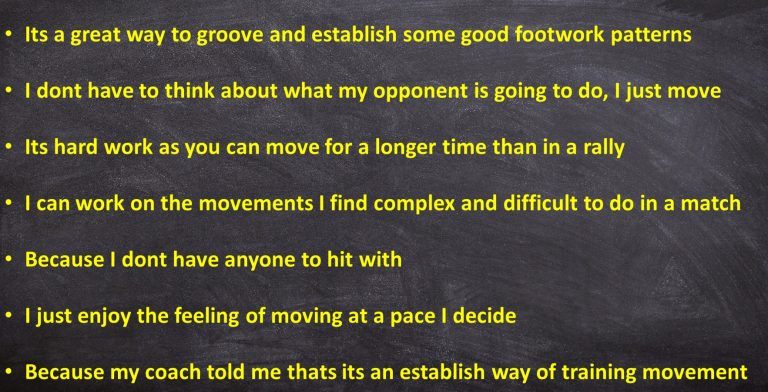
What others think
What do you think of these statements?
I’ve asked players why they think shadow training should be included in a training plan. Here are their replies, they make interesting reading.
If you were this person’s coach would you be happy or worried at their replies?
How many do you agree with?
Top Tip
Use your imagination, it’s vital
As without, practice will be far from effective, possibly not even worthwhile
Want to read and watch more?

Send me a Question
I’m always grateful if you have read this far.
If there is anything that you have read that has helped, or that you disagree with, then please send me an email.
It would be great to hear from you contact@badmintonandy.com