
Have you ever struggled to deliver progress
been frustrated that you can't seem to help your players
many times I've run out of ideas and wondered what to do
Do you just repeat the same instructions and practice in the hope
that eventually it works!
Don’t struggle and get frustrated because things aren’t working
Take a different approach, find the most effective way
6 different ways to work when coaching
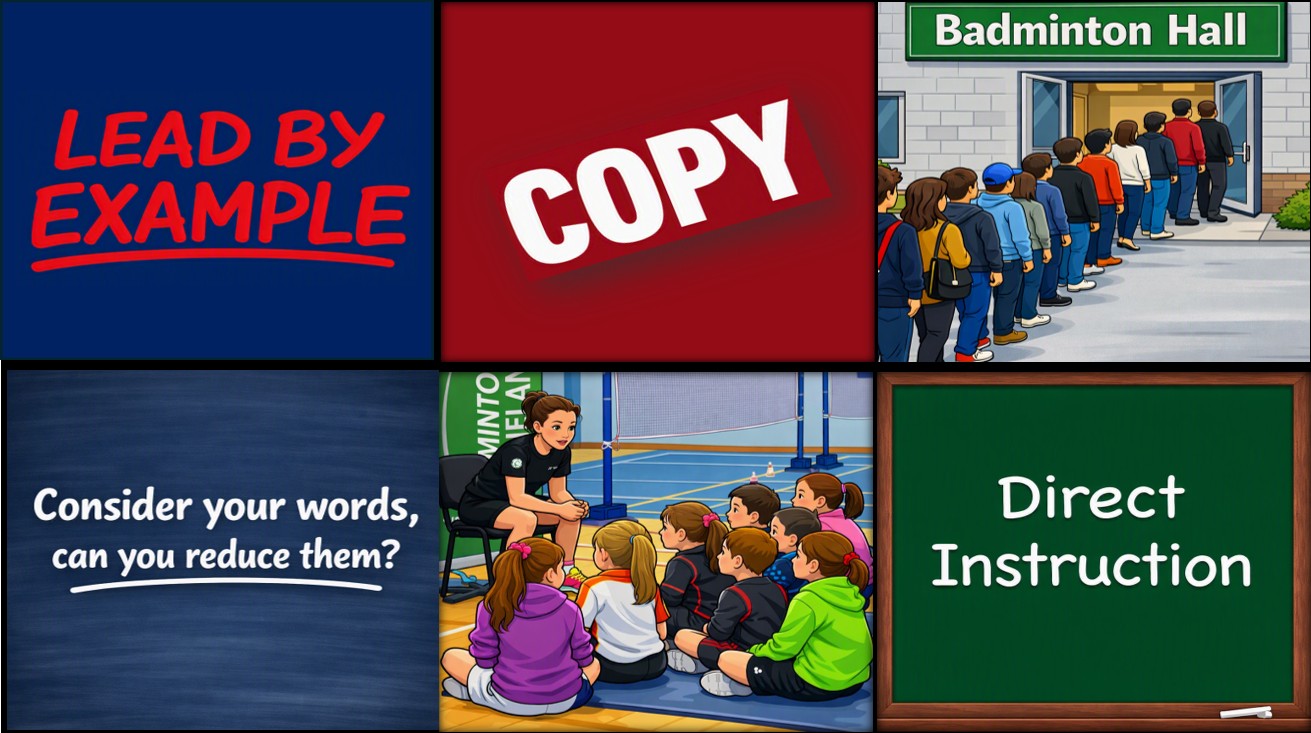
By example
f you can, then do all the things you ask your players to do.
Behave and exhibit those qualities you try to instil into your players.
This is different to the enxt suggestion using “Copy me”. With thsi method, you act as normal and by your own actions hopefully people start to do what you do.
- Start with the easy things that are obvious to players and parents
- If you ask your players to warm up, then do it yourself
- If you want them to change into their playing shoes then you do the same at the start of the session
- Doing this by example will reduce the need for you to 'tell'

It may surprise you to realise that others start to do the things you do.
They may start to remind you when you don’t do something that you ask them to do!
This equally applies to the way you go about your practice (badminton coaching). Think about how you want your players to react to errors, do you react in the same way?
If you want them to show excitement when things go well, you should do the same. Be yourself and ‘live’ your advice, or if you feel you have to, act in the way you wish them to see.
There is no need to ‘teach’ lots of things if you set the example yourself.
Set the tone by your actions and watch others recognise that.
There is no need for words; just do what you want others to do
Copy me / Copy them
Do as exactly as the method suggests
Ask people to copy and to try it for themselves.
If you aren’t confident that your technique is good enough, then find another player. The other players you use don’t have to be perfect, just exhibit those aspects you want others to copy.
Then ask players to try and repeat what ‘they’ see.

Direct their attention to certain areas, but don’t always tell them specifically what you want them to see.
In your demonstrations, think about how you could emphasise a specific aspect and make it stand out.
You could use your voice to emphasise effort or slightly exaggerate a physical movement so that it stands out.
It’s also ok to direct someone’s attention to a specific point so that they know what to look for. Direct their attention rather than tell them what to look for.
If, during your badminton coaching, someone asks for some instructions, try to resist.
Suggest that they try it first or direct them to watch others.
This method sounds simple but there are potential pitfalls as it assumes
that the person watching can identify the important points and then replicate them
Use ‘Cues’
Create a picture in the player’s mind or instigate a feeling
Suggesting a feeling or phrase is an alternative to giving specific technical instructions.
Often, the cue will cover a number of technical aspects without the need to separately identify each of them.
You do not need lots of technical coaching if you find the right cue!
How good are you at including these ‘shortcut’ cues?
This is a great way to speed up or shortcut the learning process. They can also distract those players who want to know every small technical detail.
Paint a picture or allow the cue to create a feeling when it’s put into action. This is one of my favourite and most effective methods 🙂
Do you use any cues in your coaching?
I would really like to know which ones are the most effective? I’ve noticed that some Coach education bodies seem to be introducing more into their courses.
Look out for my ‘6 Ways to use effective coaching cues’
With a good cue, you can speed up or shortcut the learning process.
Plus, there is the benefit of not filling players’ heads with technical information.
Story telling

“The purpose of the story is not to tell you how or what to think, but to allow you to create your own insights and questions”
What stories do you tell?
Telling your stories is really important and an often overlooked way of teaching badminton.
I’m sure you’ve heard that storytelling can make learning more effective. Stories help us process and remember information. I use lots of stories to add to the learning and understanding.
Challenge yourself to increase the number of stories and anecdotes that can be used to reinforce or enhance understanding. Deliberately try to encourage the players to create images and feelings in their mind when they hear your ‘story’.
Refine each one with the aim of creating a learning point, feeling, or something to consider.
I often start mine off with “A really good player or Coach once told me that ….”, “they said that when …x.. happened they did this ….”
I find them very effective when developing mental or tactical skills. They can set the scene and allow others to understand the relevance of the skill or thoughts required by the player.
Use stories at the appropriate time. and make them memorable
They don’t have to be about you, but they have to carry a great learning point
Reducing Your Words
Have you tried reducing the number of words you use?
I am not suggesting that you coach in complete silence. Learn to say less at certain times. Sometimes, try not to say anything when your brain is screaming out to “help”.
Let the players try one more time without your help or instruction. This could be tougher than it sounds, I know!
Reducing the amount of words you use in your badminton coaching is certainly worthwhile, try to out.

Sometimes not helping is the best help you can give
It can be a challenging experience to say less.
I believe that when used at the appropriate times, you can still achieve success with your players.
If the thought of silence worries you, then try leaving lots of gaps between instructions. Then increase the lengths of these gaps.
Creating gaps between suggestions or instructions can be very challenging
However, you may be limiting development by saying too much
Direct instruction
I was coached this way
If you are like me, then it was the method I grew up with. The one my coach used the most, we were told everything.
Often, it’s the preferred method in nearly all the coach education courses I’ve attended.
Coaches are encouraged to give clear instructions that leave the person in no doubt about what is required. To break down the information into short bites. Each phrase explains exactly what to do.

When you instruct (which you will at times)
Ensure that all the information you give is effective and makes a difference.
Try to remove things that are difficult to understand or that can’t be implemented by the players. There is a skill in saying ‘just enough’.
Consider what those essential bits of information are that can directly influence the player at that specific time.
Remember, your delivery voice and tone don’t have to be harsh or authoritarian; it can be softer and full of suggestions. Direct instructions given in a caring way can be received completely differently by players.
Some people say that this isn’t the most effective method to establish long-term understanding. However, I have met players who prefer to be ‘told’ and would choose this method rather than the 5 points above.
Which of these 6 methods do you prefer?
Would you add more to the list?
I would love to hear which ones you think are the most effective and if you have changed your opinion after trying some of them, or if have I missed some important ideas.
Send me a question
I’m always grateful if you have read this far.
If there is anything that you have read that has helped or that you disagree with, then please send me an email.
I promise to read all your comments
It would be great to hear from you contact@badmintonandy.com

![Keep your racket up - Duplicate - [#38056]](https://badmintonandy.com/wp-content/uploads/2026/09/keep-your-racket-up-scaled.webp)
![Introducing the badminton overhead – Challenge No.3 - Duplicate - [#36874]](https://badmintonandy.com/wp-content/uploads/2023/05/Badminton-Forehand-Overhead-3-scaled-1.jpg)