
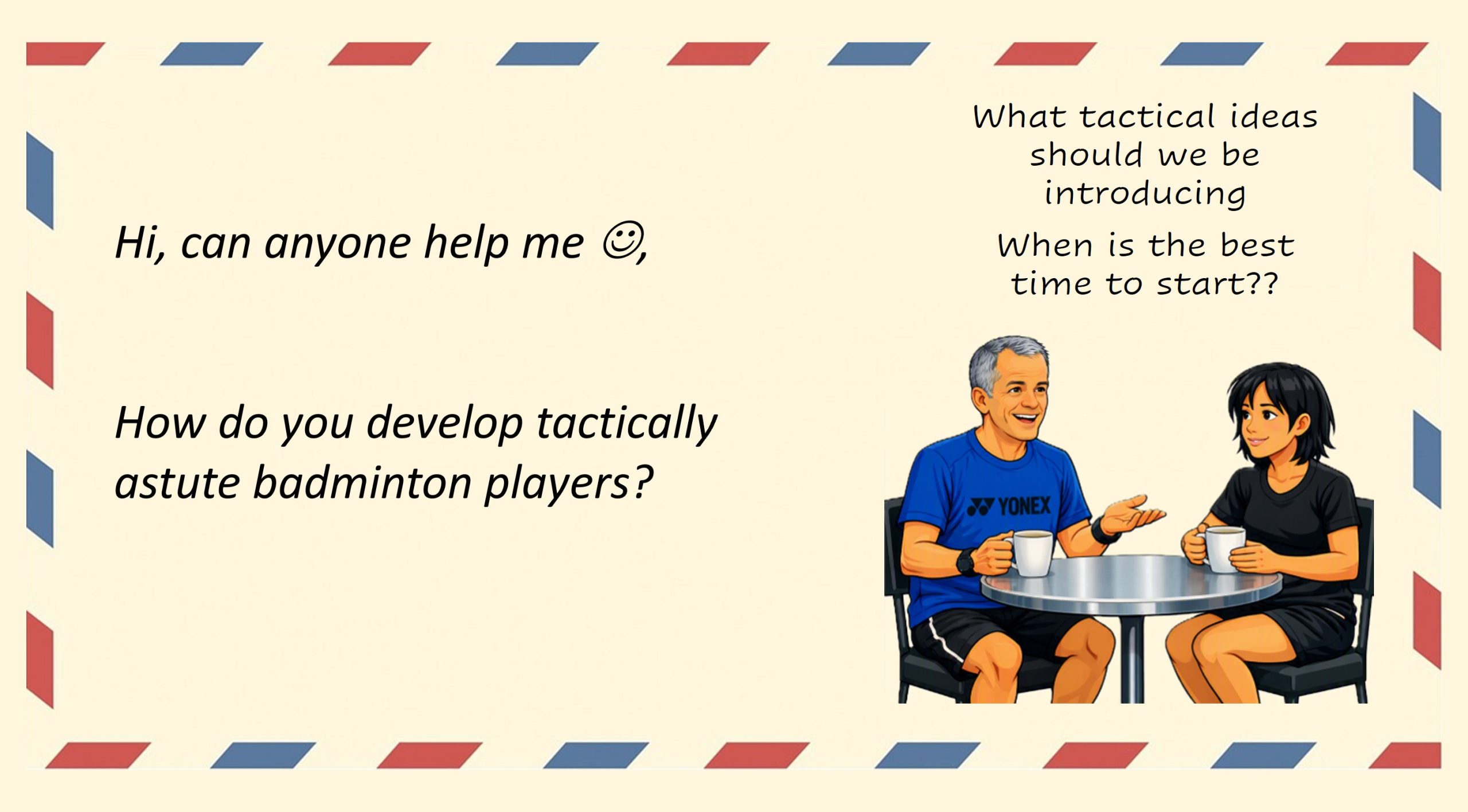
I asked a friend for a tough question
"Give me recommendations to develop tactically astute players"
I needed some help – what was the dictionary meaning of astute?
The conversations also included :
When would you start to introduce tactical concepts to your young players?
Developing tactically adaptable players
the dictionary meaning of astute …
‘having or showing an ability to accurately assess situations and turn it into an advantage’
I messaged back and asked for more, they sent this reply …
“When should I be introducing tactics”
and crucially
“How should I be doing this (coaching tactics)”
The question was certainly intriguing and tough
What did I know about introducing tactics to players, especially novice players ?
Has anyone published information concerning the fundamentals of badminton tactics ?
What tactical concepts are best to start introducing to players ?
I’ve split the questions
-
Where do tactical thoughts happen ?
-
When and how to introduce tactical thoughts ?
-
What tactical concepts are best to start introducing to players ?
-
Where is the published information?
There is a danger that the majority of your coaching may be focused
on improving technique in the belief that this will develop into tactical play
Where do tactical thoughts happen
Not just in rallies, they happen at other times as well
To help this discussion, I would like to broaden the definition of tactical thoughts so that it includes more than just what happens in rallies.
Tactical thoughts exist …..
- In the time between rallies (say 10 – 15 seconds)
- During the rally itself as a series of very quick rapid decisions and choices
- As an overview of the whole match, when trying to implement or adapt your tactics throughout the match – we could call this ‘Tactical courtcraft’.
- Away from the court or the hall when alone and preparing for the event. The planned and random thoughts that come in and out of your head.
- In practice, creating situations that enable you to experiment or refine certain tactics ready for competition.

Do you design practices and strategies to develop tactical thinking
in all 5 of these situations?
When and how to introduce tactical thoughts ?
The art, the skill of thinking tactically, should be introduced within the first interaction
Put places in environments that create an emotional state to make decisions
Ideas to try
Here are some suggestions for you to try in your sessions.
You will have to expand on them and develop further ideas. If you find that you like some of the suggestions, then please let me know. Alternatively, if you disagree, then please tell me why.
I’m always happy to hear your thoughts.
Simple on-court suggestions
- Encourage young players to “Try and hit the shuttle AWAY from me", please don’t always think they have have to hit it back to the coach or parent.
- Allow players to have choices in practices (as they would make in a competition), ensure that they include movement of both players – reduce the number of static feeding practices
- If you are a better player and use practice matches with your players, then use the tactics that are applicable to the standard of the person you are coaching – sounds simple but do you do this?
- Set up mini-games where you give players glimpses of your ‘weak’ areas (ie deep b/h) in the hope that they will see it and work to capitalise upon it – this is similar to the one above
- Praise and reward players when they verbalise the things they see opponents doing (this includes you the coach).
- Create situations that are full of aspects for players to exploit. Ask them how they intend to take advantage of their observations – this may take many forms.
Ask Questions
- Create on-court situations (as part of a game) and ask novice players about their experiences – discuss what happened, what could have happened, their ideas and thoughts. Let the conversations develop slowly.
- Ask players how they would exploit an opponent’s weakness – you decide the stroke or part of the court or the frailty.
- Create group discussions based around how they would ‘hide’ their own weaknesses – what strategies could they think of to achieve that.
- Then there are the quick-fire in-game strategies such as – “what if your opponent started to do this …..”, “what could you now when the opponent is in this position .. “, “how can we use the time between rallies”
What tactical concepts are best to start introducing?
I’m sure you have your own views: would you like to share them?
The way you introduce the tactics to players is equally as interesting as the tactic itself.
Have you given equal thought to the different ways that you could incorporate them into your practice? It isn’t just “do this when the shuttle is here”.
Do you use different methods that don’t just rely on direct instruction from you?
Consider using these when working with beginner players
- In-game strategies (A – B – C of singles tactics)
- Rally break thoughts
- Whats if’s and what would you do
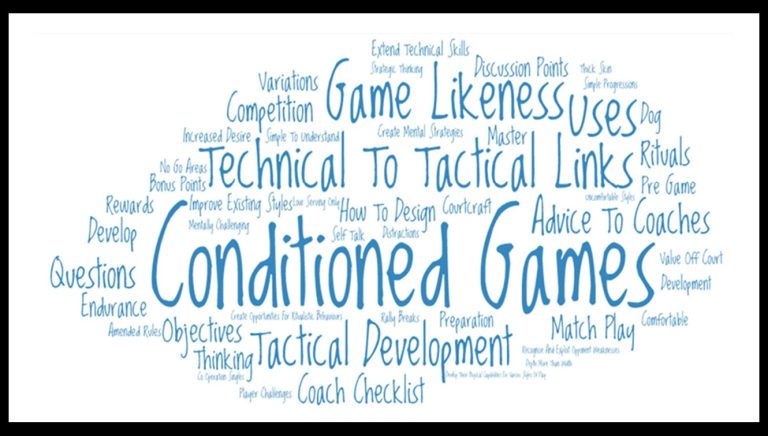
- Conditioned Games
In-game strategies
These are the tactical ideas that your players can use while they are playing the game, during the rallies. The concept is simple, its as simple as A, B, C 🙂
The original ideas aren’t mine. I first became aware of it when working with my mentor Roger Mills.
He proposed that for singles (he suggested that singles was the best game to start with) these concepte should be used beginners. However, there are many variations to explore within each, some of which will apply even at an elite level.
The first 3 concepts are below. They are tactical concepts that can be introduced in the form of games within a practice. Certainly not routines!
They allow for and actively encourage players (even novice players) to explore what they could do to use that specific tactical theme.
A – Away from the opponent:
That is striking the shuttle Away from x….x. There are 3 types of ‘Away’, can you guess what they are?
B – Backhands are a target
Backhands are weaker: how can you exploit them? How can you hide them (your own), if needed?
C – Concentrate errors
Reducing your own errors. Creating them in your opponent’s play. How can this aims be achieved?
Your coaching task is to create practices, challenges, and questions
that are aimed at incorporating the A, B, C above in a fun gamelike practice/match
Rally break thoughts
Players who understand how to use the rally break have an advantage
The concept is to use the time between rallies to your advantage. This time is far more than just collecting the shuttle or passing it back to your opponent. In fact, I recommend that you don’t pass it back under the net.
It’s an opportunity that should be used. If you have never practiced what to do and think during this time, start now.
It doesn’t matter if you have won or lost the previous rally. This is an opportunity to start the next rally with a positive thought and intent.
What could you be doing and thinking?
Are there proven things that other players are doing to trigger the emotions they need?
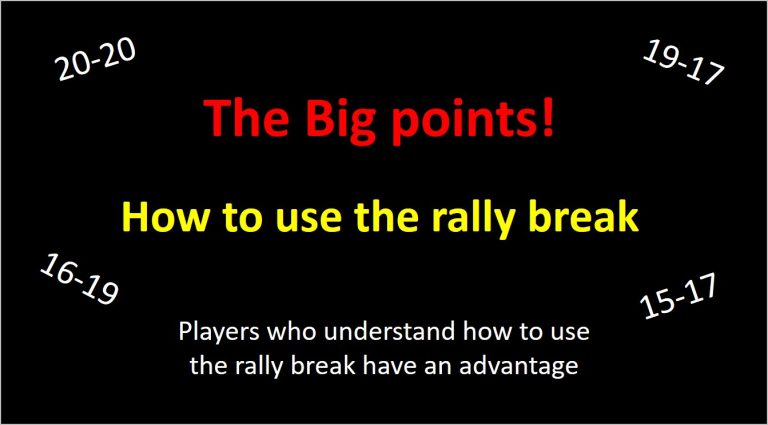
I recommend that you include ideas and suggestions in your practices, even with beginners.
Once your players know what they can do, the effect on a match will be immediate.
The tips in the post will focus on the time between points and the rally break, give you and your players ideas, and offer direct advice on how to practice using the rally break.
Do you talk to your players about
what they can be doing and thinking about during the rally breaks?
Whats if’s and What would you do
This is an alternative to teaching tactics by ‘telling’ (the coach directing ) players what they could/should do.
Once your novice players have an understanding of some strokes and movements, set them these questions and challenges. Some of the concepts and strategies will help novice players, and can also be used to develop elite players.
Coaches need to design practices that encourage players to think about and then find practical ways of resolving or answering these challenges on court. Some of your ideas may come in the form of Conditioned Games, but there are other coaching methodologies to try
How would you resolve these ‘what if’s’
- The shuttles are very fast, what can you do to still be effective and win the game ?
- You have a weak backhand, how can you hide it and make it difficult for your opponent to exploit ?
- Do you think it’s possible to apply stress to your opponents when they are serving or when you are serving, how can you do that ?
- What could you be doing or thinking about in between the rallies, is it possible to talk to yourself at these times ?
- The court is longer than it is wider, does this affect the way you may play ?
Conditioned Games
I really like Conditioned Games!
They offer an effective, supportive practice for Tactical and Technical development.
I like these games because they provide an experience to try out and learn/improve tactics.
Players and coaches can see if the technique practice actually translates into competitive match play.
Conditioned games also have the benefit of placing players in a different physiological state from their ‘normal’ practice. That could be a long discussion in itself!
Playing these types of games with their specific conditions/constraints enables the coaches to
… talk less (reduced direct instruction)
… question more effectively (based on players’ experiences)
… allow players to develop game skills in a game context.
These reasons alone should be enough for you use them extensively 🙂
Where is the information?
Books and YouTube videos
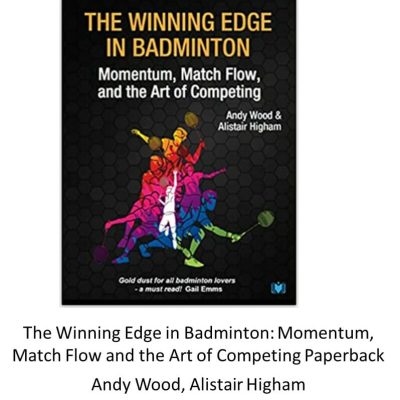
Have you read either of these books?
I’m still searching for specific guidelines and processes that coaches could use when introducing and developing tactics, especially tactical thoughts in younger players.

Would you have answered the question differently?
If you feel that I’ve missed any important points, it would be great to hear from you.
Please send me an email.
I promise to read all your comments
It would be great to hear from you contact@badmintonandy.com


![Early Preparation always - Duplicate - [#38141]](https://badmintonandy.com/wp-content/uploads/2026/09/early-preparation-always-scaled.webp)
![Keep your racket up - Duplicate - [#38056]](https://badmintonandy.com/wp-content/uploads/2026/09/keep-your-racket-up-scaled.webp)