
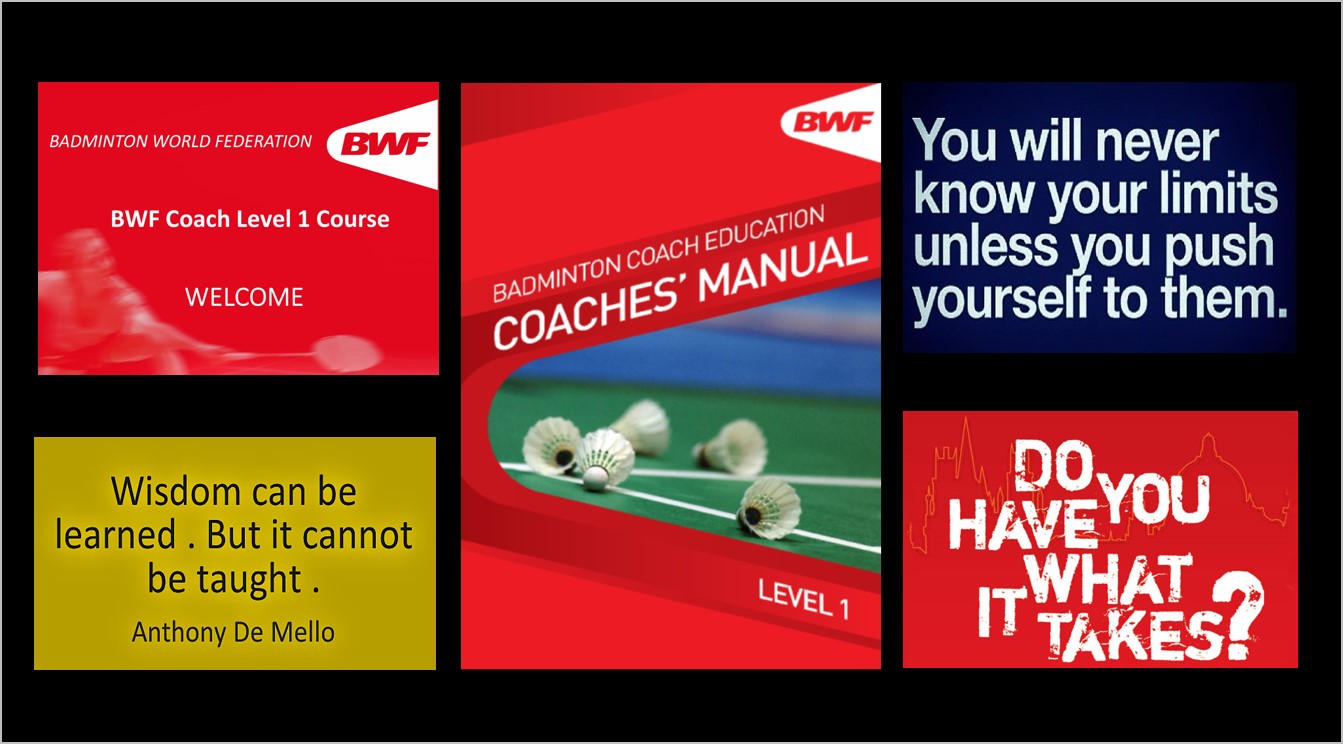
Are you interested in taking this qualification
If you are not sure how to prepare
hopefully these tips will help
Explore what happens on the BWFL1 course,
the things you need to know
This advice will not guarantee that you will be successful.
That is up to you and how you perform
Read the resources
They are all free and easily accessible
If you are considering taking a BWFL1, did you know that the resources are all online, and all the resources are free.
It is fantastic that BWF has allowed you not only to download the manual (in PDF) and also have access to all the videos.
Download a free Level 1 manual
I recommend that you download the manuals and that you print them out.
Become familiar with the chapter headings. You will need this for the course.

Online component
You will be required to complete the Online part of the BWF Level 1 before you attend the course.BWF Level 1 online
Allow yourself at least 2 – 3 hours, as there is plenty to read, watch and complete online
Once you’ve passed, you can download a certificate as proof. Send this to your Tutor before the course.

Not only will it reinforce the material, but it will also save you and the tutor time on the course. Less listening to the Tutor and more practical coaching on the court.
Click this image and do it now. Remember to allow at least 2 – 3 hours.
However, you can complete it module by module as the programme is aware of how far you complete each time you leave.
Videos
Go to YouTube and search for the BWF channel. There are so many very good videos that you will need a couple of hours to fully to appreciate the information.
Nearly all of them show and describe exactly what’s written in the manual. The information is simple, direct and easy to understand.
I recommend that if you can, you download them so that you are able to view offline. This will certainly help you on the course to understand the key points that the Tutor will expect you to use during your practices.
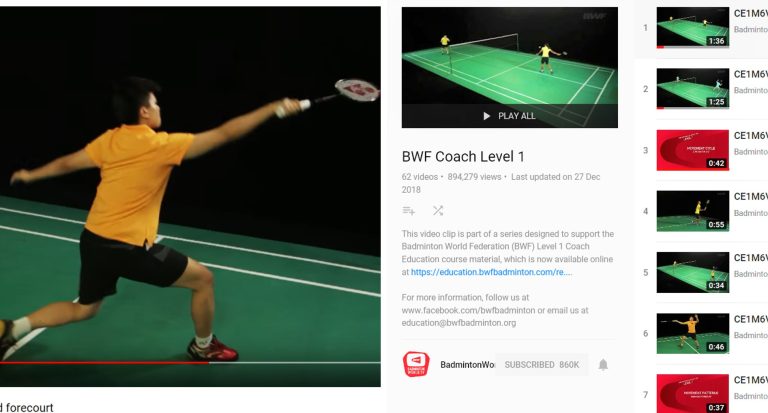
Don’t be tempted to sit back and expect to be taught everything by the Tutor
Find a mentor
My no.1 tip
However, it’s your ability to understand and deliver the information that is key, not how good your mentor is!
After reading the BWFL1 manual talk to your mentor. If you can, do this in the middle of the course as well.
I recommend that you find someone who has done the course before and preferably passed!
There is plenty of deep learning to be had from working with someone.
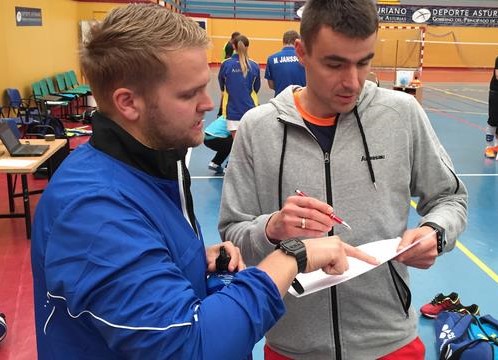
Be careful when working with fellow coaches or a mentor
- It can be very easy to ask one question and then sit back and just listen.
- It’s far better if you ask a question and then be challenged to work to find solutions
- If you think working with a Badminton Mentor sounds easy, then either you have a mentor who is not challenging you or you are just listening to their thoughts.
- Reward your mentor with questions and comments. Challenge them over areas such as how to progress a practice to make it harder or easier (its not just about increasing the duration or speed).
I’ve had my best coaching chat with my mentors
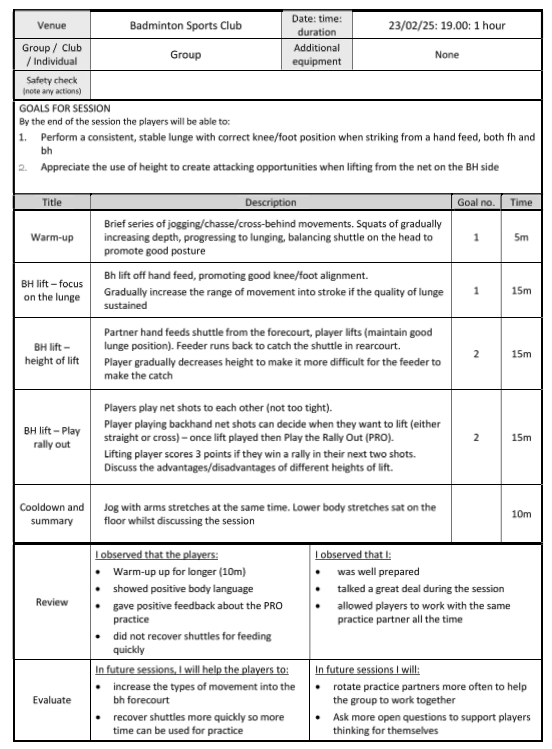
Practice your planning
There is a big emphasis on planning and devising strategies for development
In Level 1, the focus is on Group Lesson Planning and Goal Setting. Practice Progression and Evaluation.
The homework element may take you longer than you think. It’s not uncommon to take about 20 minutes to complete your lesson plan the first time you try. The boxes aren’t that big and you need to be precise and ‘to the point’ when you write the tasks.
I recommend that you do all your planning using MS Word. Then, if you are in doubt at any stage, you can email your mentor or Tutor between Day 2 and Day 3.
Ensure that you try to do the following
- Evaluate yourself honestly: your good points and your struggles
- Link to the overall goals: you will fail if you don’t do this
- Explain your tasks in detail: don’t just write ‘games’
- Link your tasks: show a progression or flow in the lesson
- Vary for warm-ups: try to replicate some of the skills and movement that you will use later
- Ensure you show the ‘Key Points’: these can be emphasised during the session
- Vary your lesson themes: not every lesson needs to be 100% isolated practice
- Include Fun elements: in warm-ups, in mini-tasks, in challenges
- Plan the first 3 lessons: do this before lesson 1 then you can amend as you reflect
The 10 Key elements to master
1. Practice Progressions
2. Key points for technique
3. Safety always
4. Creating Tactical Practices
5. Demonstrations
6. Understanding tutor feedback
7. Knowing the manual
8. Linking lesson plans to goals
9. Feeling comfortable about being challenged
1. Practice Progression
You will be expected to show different variations of all the practices that you use. Can you make subtle changes that develop a practice by making it more tactical, increasing or decreasing the challenge point, and creating an environment that develops a technical point.
There is a good chart to follow on Page 34 that will help you.
Be aware!
This is 2nd biggest hidden challenge on the course, in my opinion.

Tutors will be expecting progressions, so don’t hand or multi feed for 15 mins
2. Key points for technique
Use the terms and descriptions detailed in the manual. Each stroke and movement is explained in detail. Understand the key points.
Be careful, they may not be the ones that you use in your regular coaching.
Level 1 does not talk about: stick smash, China jump, backhand drag, forehand or backhand grips.
3. Safety always
Keep the court safe, clear the court of all shuttles at the start and end of your sessions.
Look out for left-handers and be careful where you place them on the court; you don’t want people hitting each other during your assessment.
If you have 6 or more players on court find ways to position them safely: stagger them, put them in 3’s, use buddy coaches, have tasks for those off the court.
4. Creating Tactical Practices
This is the number 1 challenge faced by nearly all coaches on this course.
You may struggle to understand exactly what is required. The manual offers some good hints on pages 34, 47, 49
You need to be specific with your work. Tutors are looking for a Tactical context, not just repeating a stroke many times.
The key difference between a Technical and Tcatical prtactices are …
… players making decisions as they would in a match
.. both players are using rackets and making choices (maybe one more than the other)
.. only 1 shuttle being used
Use the information contained within each stroke/movement breakdown
its found under the headings “When we Use It” & “Why We Use It”
If you are in any doubt during the courses about what Tactical elements are and how to introduce Tactical Progressions, ask the Tutor. They are there to help.
If you don’t include tactical elements in your sessions,
you will have some tough questions to answer during the interview
5. Demonstrations
Make sure that you do them.
It’s surprising how many people just stand and talk and don’t demonstrate.
If you can’t show a reasonable demonstration that clearly shows your key points, then ask another person in the course to do one for you. There is generally someone in the course who is a good player.
Don’t talk during your demonstration, the Tutors will pick up on this!
6. Understanding Tutor feedback
Throughout the course, the Tutor will provide you with feedback. Generally, it’s at the end of each day or before a big task.
This feedback could be to the group or to you directly. I recommend that you look out for these moments.
Yes, some will be obvious at the end of the day or session. The Tutor may use the flip chart to summarise the main points to improve on or to be aware of.
Too many coaches believe that the feedback doesn’t apply to them.
Be aware that if the Tutor takes time to write it on the chart, it’s worth doing!
Feedback could also be in the form of a quick chat during the day given specifically to you.
You must remember what’s said. Look out as well for those quick questions the Tutor asks you. Especially in situations that may feel like a friendly conversation.
I recommend that you make use of these moments, often they are not random, especially if they are over 10 coaches on the course!
7. Know the manual
You will need the manual with you during the course. Please don’t forget to take it.
I recommend that you take both a paper and an electronic copy. Remember to save the electronic copy to your desktop so easy to acess.
Don’t presume there will be Wi-Fi at the hall.
Become familiar with its layout and where to find the different headings.
8. Link lesson plans to player goals
This applies specifically to the coaching logbook and your 8 – 10 sessions
Each lesson (and part of it) has tasks that must refer back to the goals.
There is a column that requires you to state the Goal number; complete this for nearly every task.
Many coaches fail to connect their tasks and themes in their lessons to the agreed player goals that were identified immediately after the player assessment.
9. Feeling comfortable about being challenged
Expect that the Tutor will ask you questions during the course.
These could be just to check your understanding about a particular point or concept.
It could also be to give you an opportunity to explain why you did or didn’t do something. The Tutor may have a view on what you did and feel it necessary to ask you to explain more about your thoughts.
Remember that the Tutor is there to help you and to assess if you meet the criteria set out by BWF.
Be ready for these types of questions …
“Can you explain the reason behind how you did XXX”
“How could you do that differently next time?”
“Did that have the response you expected?”
“Where in the manual did you find that information?”
The temptation can be to sit back and expect to be taught by the tutor
They will need to ask you questions as part of the assessment – be ready
Do your homework
There are several points during the course when you will have to do some work at home.
My advice is, if you can, do it as soon as possible.
Pre-course
You will be sent a pack when you sign up to the course, it contains course information plus a questionnaire to compete. This will help the Tutors understand more about you and your experience.
It’s important to explain what you would like from the course and what your goals are.
The more the Tutors know about you, the more they can arrange the groups.
Online component
Complete the Online part of the BWF Level 1 before you attend the course.
Remember to allow at least 2 hours as there is plenty to read, watch and complete online
Once you’ve passed, you can download a certificate as proof. Send this to your tutor before the course.

Lesson Planning and Delivery
You will have to prepare and deliver between 8 – 10 lessons with your players. I recommend that you identify these players before you sign up for the course. Don’t leave it until after Day 2, you will struggle.
The easiest way to complete the lesson planning is to use the Word templates supplied in your Pre-Course Candidate pack. Complete them electronically, as many of the parts can be copied and pasted from lesson to lesson.
If you complete the forms in your own handwriting you may risk the Tutor not being able to read it. This will mean a longer final interview and lots of questions from the Tutor,

Send me a question
I’m always grateful if you have read this far.
If there is anything that you have read that has helped or that you disagree with, then please send me an email.
I promise to read all your comments
It would be great to hear from you contact@badmintonandy.com


![Early Preparation always - Duplicate - [#38141]](https://badmintonandy.com/wp-content/uploads/2026/09/early-preparation-always-scaled.webp)
![Keep your racket up - Duplicate - [#38056]](https://badmintonandy.com/wp-content/uploads/2026/09/keep-your-racket-up-scaled.webp)