

Do you practice making decsions?
Often players who make the best decisions win matches
Including decision-making is no.3 of the 8 guidelines
This advice is based on work done by Roger Mills a professional badminton coach and my friend
As you read the information, think about how you structure your badminton practice.
How deeply do you consider what you do, it’s effective, and if it prepares players for the demands of competition?
Before I discovered these guidelines, I didn’t realise
how many different elements within the practice could be adjusted
The guidelines
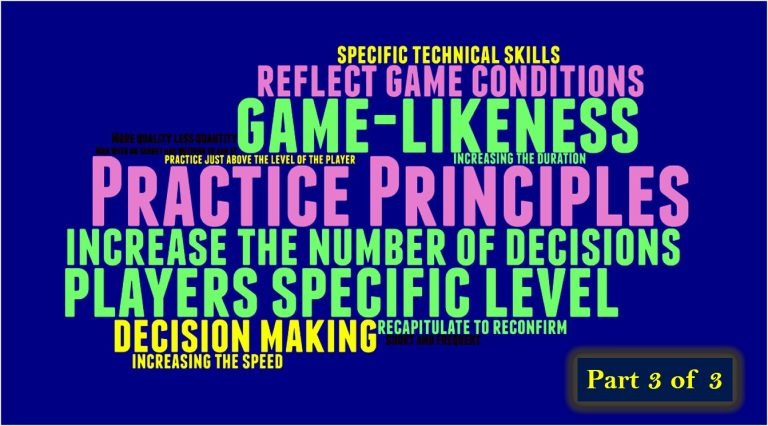
- Set the practice at the players specific level
- Practice must be game-like:- reflect game conditions as closely as possible
- Practice with decision making, when a player’s specific technical skills allow
- Always be prepared to recap a previous practice to reconfirm a previously learnt skill
- Practice should be made harder not just by increasing the speed or the duration but by increasing the number of decisions
- To motivate a player in practice set the level of the practice just above the level of the player
- A man with no target has nothing to aim at (Confucius)
- Keep practice situations short and frequent. More quality less quantity
Practice with decision making, when a player’s specific technical skills allow
The amount and type of decisions are critical
When learning new skills, and developing existing ones, it is often necessary to limit the number of decisions to be made by the learner.
The type of decision is also critical.
This allows the player to concentrate on one or two details and not be ‘swamped’ with too much information.
However, there is a danger to using badminton practice that does not contain decisions, especially if they form the majority of a players experiences.
Reducing the amount of decision-making can still lead to development, but will the player be ready for a competition when faced with an opponent who is trying to outwit (beat) them?
Competition requires players to be prepared to make choices and
to respond to rapidly changing conditions, practice situations must reflect this
Advice for coaches
The problem for the coach is when to introduce decision-making
I suggest that it should generally be earlier than you think, take a risk!
The following list will hopefully give you some effective suggestions. It’s your choice how many and to what degree they influence the practice.
Be aware that as the number of decision-making opportunities increases, the error rate often initially increases.
How would you use these suggestions?
- Give the players something to choose themselves within the practice. Try NOT to dictate a regimented outcome for all strokes.
- Treat the players within the practice as ‘opponents’ rather than feeder and player. The 'opponent' may play within conditions or themes at times.
- Try to ensure that one player doesn’t know exactly where the shuttle is going. A general idea of what might happen is acceptable.
- Create something that looks and emotionally feels like a game. How would you ‘feel’ in a game?
What are the dangers of not including decision-making
To fully engage with our sport requires a ‘thinking and creative approach’.
Static single repetitive feeder practices will improve the hitting or movement technique, but how much transfer will there be into a competitive environment or even a competitive rally?
You must decide for yourself if you see the transfer into games. It’s not always evident. Coaches complain “they can do x or y in practice but not in matches”, or, “what don’t play the right shots at times in a match?”
Is it acceptable to question if badminton practice, such as multi shuttle, 2 v 1, static (limited movement) or repetitive hitting, helps develop those decision-making skills that are required to be successful in competition?
You need an opinion on how much non-decision-making practice you will do with your players.
I am sure that there are arguments for using these practices, and for certain examples,I would agree with many of them.
However, can you rely on these practice types to develop decision-making?
Always be prepared to recap a previous practice to reconfirm a previously learned skill
This may sound like common sense
How often do you include something in a session that was practised in the last one?”
Intentionally checking if the development you observed towards the end of the last session was ‘practice performance’ driven by the repetition in that session, or has it caused a longer-lasting change in performance?
By integrating quick reviews and active recall, coaches can solidify learning and check the extent to which it has taken place.
There are various methods to do this; it’s not all about asking a question : “What have you learned from the last session,” and it’s not just about repeating the last session’s practice.
Consider: Observing before Questioning
Warm-up hitting
Use the first 5–10 minutes and use your ‘coaches-eye’ to observe if there has been a change in aspect previously.
If in this unprompted, unstructured ‘practice’ (the hitting warm up) you see a positive development it could be a sign of deeper learning and change.
“Repetition without Repetition”
Instead of doing the exact same practice, create a new practice that requires the same skill you are hoping to see development in.
e.g., if you have been working on the Deep FH movement and striking (early preparation, hitting ‘around’ the shuttle), consider having practice partners hitting hard, fast, flat clears instead of smashes when the player is working on their FH defensive skills.
By not doing the same practice as previously, the coach can check for development without prompting.
There is no requirement to explain this to your player. I would advise that you use the ‘success’ of the previous practice to help start the next.
Crafted Questions
The aim is to ask questions which allow players to describe their feelings and reactions, or suddenly start to show you on the court what they did. That’s the best answer.
.. “Can you remember what we did? Please show me”
.. “How did that make you feel?”
.. “What happened as the session progressed?”
Encourage players to describe their feelings or reactions to their performance in the previous session (“I enjoyed doing x”, “We did x and this happened”)
Try to avoid any coaching prompting that results in the player starting to list all the technical points.
Request practical feedback from them; the answers don’t have to be exactly correct or in specific detail. They are players in front of you, not Coaches 🙂
It’s also ok if they recall the ‘coaching cues’ they heard, but prompt them to show you why they had an impact on the performance. “Show me how that (insert phrase/cue) helped you.
Summary
Plan sessions with the aim of using an element of a skill from a previous session. Initially, check (as above) to see if the skill element is robust enough to use in the next practice.
There is no need to explain to the player; just start the next development. You may be surprised at the results when you ‘Do’ rather than ‘Explain’
Practice should be made harder not just by increasing the speed or the duration but by increasing the number of decisions
Are you using all 3 factors?
Coaches often only increase the speed of the feeding, as in the case of multi-shuttle work. Or they increase the duration and create rallies in excess of those found in a competition.
Do you include any decision-making in your practices to make it harder?
It is a common misconception that
the only way to make a badminton practice harder is to make it faster or longer
Be aware that …
Increasing the speed of the feed or the players’ movement may sometimes have a negative effect.
If the speed is taken “beyond the game” then the player will no longer be performing game-like movements. I do however, recommend that doubles practices are taken beyond game speed, especially in defensive practices.
Increasing the duration, especially in single work, can be positive and negative.
Long rallies (above 15 strokes) certainly exist. However, the largest percentage is far below that number. Be aware that you may be training different tactics and mental approaches if a large part of the training requires players to perform in lengthy rallies or practices.
Including decisions to increase the practice difficulty
Once a skill can be performed at game speed, increasing the number of decisions the player has to make will provide the most effective learning for a real game.
In a game, neither player knows where the other player will hit the shuttle.
However, both players are trying (we hope) to anticipate what may happen, and trying to affect the opponent’s choice of next stroke. All these actions happen in a real game, but not always in practice.
Including decisions and working around that concept will prepare players to perform in matches.
Increase the amount of decision making and the practice
will immediately become ‘harder’ and hopfefully more effective
Send me a question
I’m always grateful if you have read this far.
If there is anything that you have read that has helped or that you disagree with, then please send me an email.
I promise to read all your comments
It would be great to hear from you contact@badmintonandy.com


![Early Preparation always - Duplicate - [#38141]](https://badmintonandy.com/wp-content/uploads/2026/09/early-preparation-always-scaled.webp)