Reflection can be a powerful tool
A training diary is one of the best tools to help you improve
You may be surprised how it can help you in the future
Most successful athletes use training diaries –
Ttrends can’t always be observed day to day but become clear when you use a diary
Do you use one?
Can you remember what you did over the last 3 training sessions
how you felt and if you are progressing?
If you can, then you have a good memory, many players and coaches can’t.
But, can you remember what you have done over your last 10-30 sessions, I doubt anyone can.
Invest 5-10 minutes at the end of every day to record a few notes and pointers about the things you did that day that will contribute towards your badminton development, on and off the court.

It’s a habit that could pay off!
My preference is to use a notebook and pen. Some players also use mood stickers (more on that later) and also coloured pens to separate important categories helping for quick reference later.
Where to keep it,
you decide, in your bag or next to your bed
Record the obvious
Record what happened in your day both on and off-court, in the gym, in your life if you want
Be as specific as you want but keep it all to one page. I recommend these headings
Date
Day mood
Activity Title
Training feeling
Activity Description
Effort Level (RPE)
Training thought
Future thoughts
Try to be brief and specific when describing the actives
2 hrs training on court: RTH technical with variations, match play 1hr
20 min run outside RPE 8-9, (3 miles) or RPE 5 (2 miles)
1 hr gym: bodyweight circuit ‘A’, 20 mins on treadmill RPE 8
30 mins stretching and gym ball work RPE 4-5
If you want to go into more detail you can record your heart rate when you wake up, some people believe that it’s an indicator of your state of health and stress; I will leave you to research that.
What’s your daily mood
Use a smiley face emoji to quickly represent each of your activities, how you felt during the day, how you reacted to a new challenge, the list is endless.
It is a simple way to reference how you felt without the need for lots of words.
When you review the past month it is always interesting to see which face has represented your moods.
If there are too many ‘sad’ faces then maybe you need to adjust your training or lifestyle.
I recommend that you use stickers, buy yourself several sheets and make the task even faster and simpler.
If you click on the image or go to Amazon to buy a pack.

Perceived effort level: Rate of Perceived Exertion (RPE)
Test the information against these questions
he RPE scale is a common method for determining exercise intensity levels that you experience during a training session.
The measure is how YOU feel and how hard you feel your body is working.
The RPE scale runs from 0 – 10.
The numbers relate to phrases used to rate how easy or difficult you find an activity.
A workout may require you to run at a ‘medium’ pace, but that may differ from person to person, so set a level of 7. You will find it’s a good way to increase your endurance and not blow yourself out.
Alternatively, a hard singles session or sprint workout should be around level 9, you are unable to talk within 30 seconds when finishing.
It can also be adapted to use in the gym when lifting. Record the difficulty in terms of effort alongside the sets, reps and Kg.

Immediate thoughts
Use the training log to record your thoughts straight after the session, including your emotions if you want, it’s your log.
Record whatever you want before you forget them. Either whilst you are cooling down or eating once you are at home.
How you felt during the session
- “my backhand has really improved”
- ” that last set of sprints killed me”
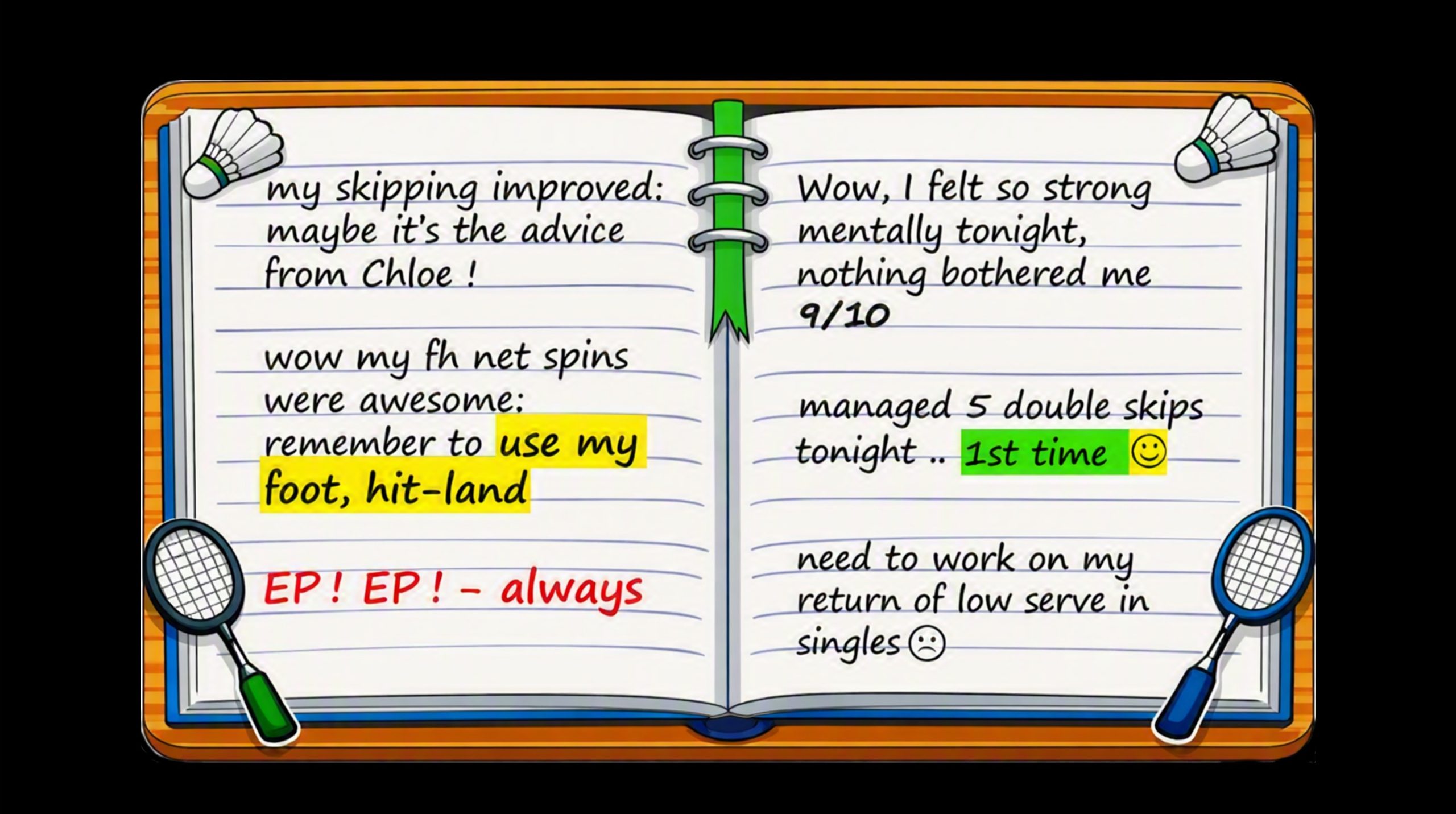
- “I felt so strong mentally tonight, nothing bothered me”
- “managed 5 double skips tonight .. 1st time :)”
Then add some general notes
- “need to work on my return of low serve in singles”
- “can’t seem to get my BH xc blocks over all the time: remember my EP (Early Preparation)
- My straight half-smash now has a little slice and it really working against Andy
Thoughts that intrigue or surprise you
- “wow my fh net spins were awesome: remember to use my foot, hit-land”
- “why has my skipping improved?: maybe it’s the advice from Chloe”
- “I think I really prefer 1 shuttle work with decisions where I can hit winners
- The multi shuttle is starting to become boring as its always the same session
Future thoughts
These are important and allow you to set a future goals
You can take away the immediate pressure of that week and identify goals or targets for the next 4 weeks.
It’s fun to write a note to your future self. Have you considered that?
Identify the aspects you need to improve or the things you would like to work on.
They need to be related to the training that day but they don’t need to be achieved immediately.
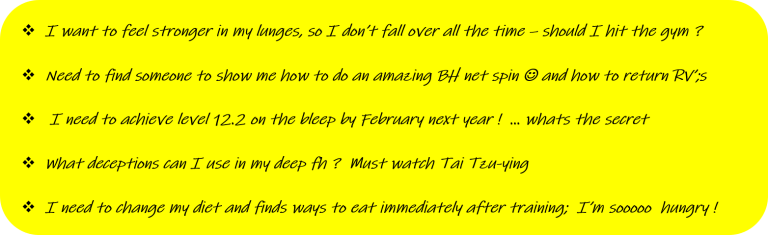
Send me a question
I’m always grateful if you have read this far.
If there is anything that you have read that has helped or that you disagree with, then please send me an email.
I promise to read all your comments
It would be great to hear from you contact@badmintonandy.com