This post is for everyone who steps onto the court
The times during a match or training when you will feel challenged
By the opponent, or challenged internally by your own feelings
I’ve included a little challenge or task at the end of each section,
give it a go 🙂
Love the battle
Above everything, please remember how much you love to play 🙂
There will be moments when you really want to perform and for some reason (or many reasons) you can’t. At these times think about why you play, the things you love about our great sport.
Remind yourself why you compete and how much you ‘love the battle’.
The start of being tougher on court is remembering that you enjoy this sport (hopefully). Don’t be that player who is at ‘war with themselves’.
Write down how you would feel if you didn’t hit a shuttle for the next 6 weeks
Self Talk
Banish any negative self-talk during play: leave that type of analysis until after the result
Instead, try some of the ideas below. Use trigger words or phrases that illicit the toughness in you. These will be different for each player and may change over time.
If you don’t currently use positive self-talk then try some of these ideas.
Consider the actions below; select 2 you like and write them in your training diary
Do it now
- Self-talk can come from many sources and triggers
- Spoken silently in your head: what would you say?
- Spoken out loud: do you have phrases that are short and powerful that you could use?
- Rehearsed at home and spoken to the mirror or silently in your head: write out something and give it a try.
- Written, considered phrases that you want to tell yourself: write a short note or letter to yourself. What are the phrases that help you tell yourself ?

- Trigger phrases sometimes combined with physical actions (more ideas below): what physical actions do you think you could do? A favourite is ‘looking at the strings’.
- Partner or Coach instigated. Try using others to prompt you to start the process. It’s ok to ask for help from your partner or coach during the event: explain to someone what you want from them and what you would like them to say.
Rituals
Ritualistic behaviour is very powerful and something I recommend
Throughout a game, easy or difficult, there are different stages that will require different mindsets.
Why don’t you consider establishing rituals between points that will cause you to get into the mental state you want.
The ritual isn’t about becoming aggressive or about controlling your emotions
The ritual is both the trigger and the opportunity to open a gateway into your mind
The messages you want to tell yourself will be varied: sometimes you will need to be relaxed, pumped up, alert, focused, planning.
The ritual is the trigger to start the process.
These need to be so intrinsic that they immediately open the opportunity for you to start. I recommend that they are short, easy to do and that you practice during training or away from the court so that this can be achieved.
Have you considered these rituals:
- Retaining the shuttle when possible. Do not immediately give it back, hold onto to it, use the time
- Checking the condition of the shuttle
- Adjusting your shirt or clothing: think of Rafa Nadel ?
- Checking your strings or just looking through them, use this act as a ritualistic trigger
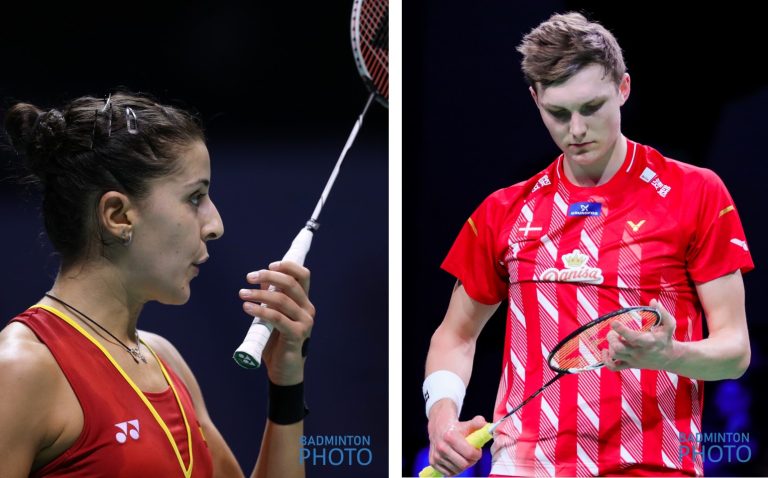
-
Having a physical serving ritual, combining it with a silent internal voice
Can you see a ritualistic pattern?
-
Self-talk (internal) in the preparation before serving
Can you imagine what the player may be saying to themself?
Which of the ideas above do you currently do?
Be a fighter
No matter how bad it gets, project the image that you are a prepared to fight until the end
Convince yourself to make it as difficult as you can for your opponents to win the next few points.
Demonstrate by your attitude that you will not give up or surrender easily. Opponents will come to recognise this quality within you and be aware that you are tough to beat.
I recommend to all 8-12 yr olds that they must try to get the shuttle over, even if it provides the opponents with an easy kill opportunity.
If you have watched lots of junior games you know that many errors are made from these ‘easy kill’ opponents: net kills go out the back or into the net.
Parents certainly know how many lost points there are from these situations 🙂
Encourage all junior players to “get it back over and at least allow the opponents an opportunity to make an error”.
Write down a list of words that describe a player who fights and never gives up
Self Control
If you make a mistake, learn from it and then walk away from it, don’t dwell.
This was a really good piece of advice given to me by my mentor coach, who was a Champion, a fighter and most importantly, had enormous amounts of self-control under tough situations.
“The difference between Champions and everyone else
is the way a Champion reacts to an error”
If you get wound up by your own actions then practice deep breathing between points to help relax and re-establish your self-control.
Try to reduce those outside influences that irritate you and cause you to lose focus and concentration.
Deal with the things you can control and ignore outside factors. Top players understand that it’s only the things on the court that matter.
Some imagine a bubble over the court sealing out all other factors other than those on the court, leaving only themselves and their opponent to do battle.
What would you advise as a great strategy
for maintaining self-control on the court in a tough situation
What does it take
Consider all the factiors above
Demanding toughness from yourself in competitions without practice is not sufficient. Become what you practice.
- Work out how to implement each one: do this even if you think it’s not something that you’d do. The questions should help you with a discussion.
- Do they all work for you?
- Incorporate them into your practice: on the court, in the gym, at home in front of the mirror.
- Try them in competition. Just like your backhand sliced crosscourt long drop, the journey to mastery will take some time and will not be overnight.
- Love the process of feeling comfortable when in tough situations.
- Mental toughness is a quality that can be developed and improved so work on it and believe in yourself!!
Send me a question
I’m always grateful if you have read this far.
If there is anything that you have read that has helped or that you disagree with, then please send me an email.
I promise to read all your comments
It would be great to hear from you contact@badmintonandy.com