
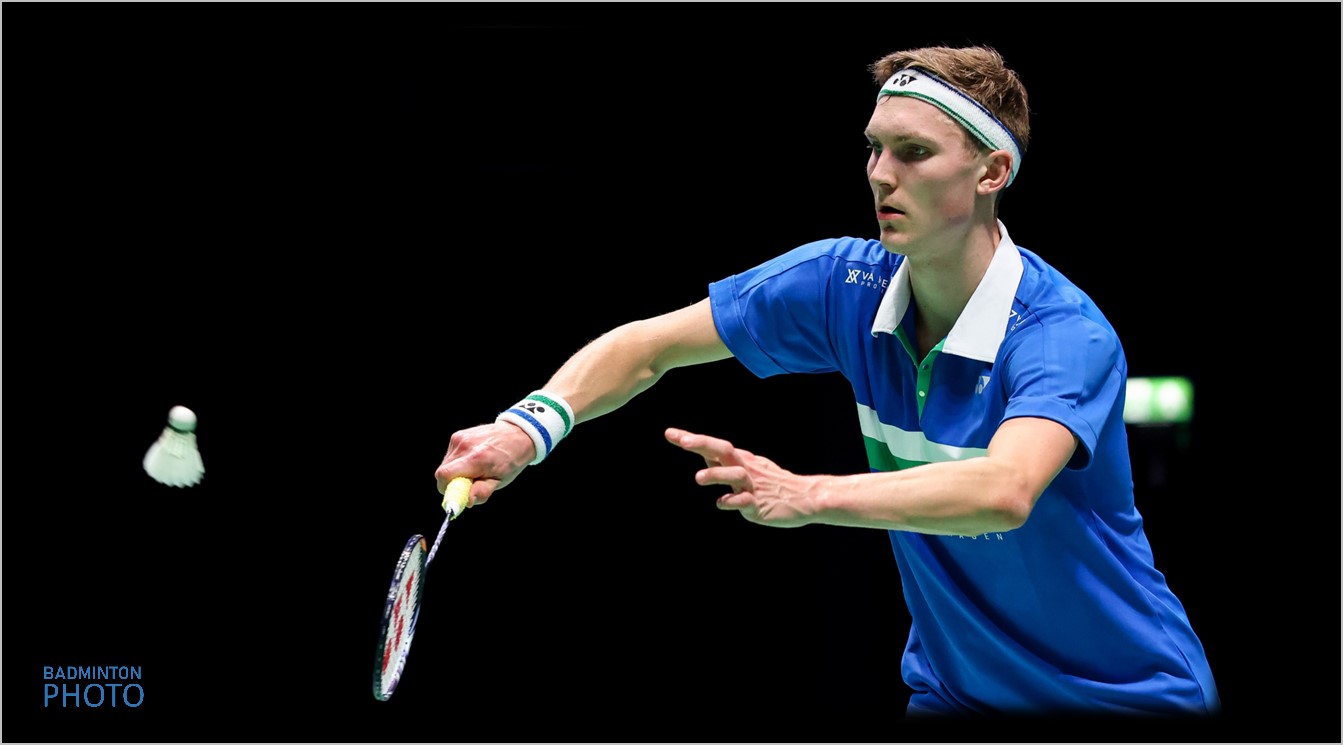
When is it best to discover a single's low serve?
Low serving in singles can be a great tactic if used well
However there are some difficulties when first starting
I think everyone should experience low serving in singles
plus there is more to be learned than just serving
“I want to start low serving in singles, but I’m not sure what to do. Can you help me?”
I was asked this question by a young player (aged 13yrs) and I struggled to know how to give an effective answer
Soon after a coaching friend asked a similar question
“What are the factors that I need to consider when asking my players to start using a low serve in singles?”
Start with a plan
Don’t just start serving
If you start low serving in singles and expect to be immediately successful, you may be disappointed, even frustrated.
You can prepare your skills before starting to low serve.
In practice, use lots of mini-rallies that all start with you striking a push/block to the net: not serves but ‘defensive blocks’ that land in the opponent’s forecourt, use F/H or BH.
This will help develop your use of stances and the transitions required immediately after.
It will also help your movement skills, as they are different from those used after high serving.
Certainly, your speed of thought skills will benefit from using ‘player starts’ in practice.
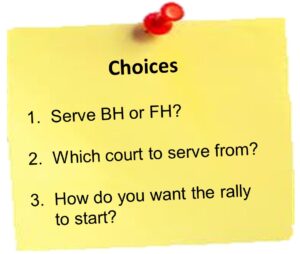
How would you answer these questions?
- Will you start by low serving using a forehand or backhand serve?
- Which side of your court left or right side do you think will have the most potential problems to overcome?
- How will serving low affect the start of the rally compared to starting with a high serve?
The skills you need at the start
You need to be good at these before starting to low serve
- Moving to the backcourt - are you comfortable and preferably fast at moving backwards into the rear court. Especially into your Round The Head court. You also need to be proficient in the deep rear forehand court.
- Moving forward towards the net - can you move with a strong, quick initial movement towards the net? Plus, the ability to flick towards the opponent's rear court.
- Changing stances quickly - you must be competent at understanding when and what stances to use. The movements and stances will vary depending on whether you serve low with a Fh or Bh service action. You can read more about Stances if you search this website.
- Tactical ideas - how good are you at considering where to serve to and how you want the shuttle to fly? There is also a huge benefit in using a ritualistic routine/behaviour when preparing to serve low, and also when repreparing to return any serves.
- Reacting & anticipating - have you practiced with lots of indecision and uncertainty in your previous practices? You will need to have started to develop quick thinking skills that happen almost 'without thinking'.
Players: how accomplished are you at these skills?
Coaches: have you established these skills?
Mindset is critical
Have a clear goal
It’s important in any serving or receiving situation to have a clear goal of what you would like to happen next.
Of course whatever you plan for may not happen, but the intent of your original action could still assist you.
You must prepare to low serve with the intent of how you want to act at the start of the rally. To do otherwise would be foolish.
Consider what mindset is required when low serving in singles
What are the thoughts a player could/should be thinking about before serving?
I recommend that you …
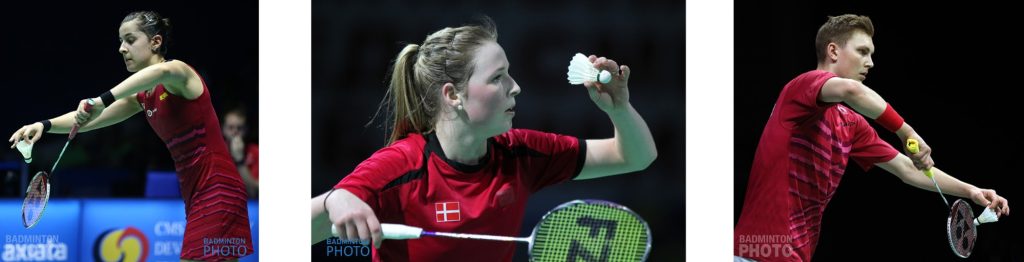
- Create a ritual before serving - it's as important as the technique you are trying to master.
- Include some key self-talk phrases - words that inspire your next few movements: "let's go!" ; "fast & quick to whatever happens" ; "get to the shuttle early" .
- Include some physical moments - small rituals with your body that help prepare/settle yourself to serve and move! Some players always prepare in the same way as they take up their serving stance, others touch their shirt, and others have synchronised racket arm and shuttle position before serving.
Look at great players and identify if they have a preparation ritual
Start to develop your ritual and mindset, it will help
Tactical considerations
Consider these ‘early’ tactics
When you first start to develop your singles low serve, I recommend that you consider some or all of these tactics below. They will help you at the beginning of your exploration.
As you develop and your confidence increases, your tactical thought will probably change.
Create several tactical ideas that you have practised and can use against different opponents in different situations in a match.
- Not aiming for the service line - aim to make the shuttle land approximately 30 - 40cm beyond the service line. Consider how this may limit certain replies.
- Serving towards the opponent's backhand racket face - try to force your opponents to play with a backhand racket face. At a lower playing level, it's often weaker and has less variety.
- Standing further back in court - position yourself further back into the court when serving. Certainly further back than your doubles serving position.
- Serving fast and quick - aim to make the shuttle fly quickly and flat over the net. Striking it slightly harder should prevent the shuttle from 'popping up', reducing the opportunity for the opponent to kill.
- Starting only your Backhand court - consider how it will make a difference to you and your next stroke. At the start: high serve from your FH court, low serve from your BH court.
What advantages could the above tactics give you?
Consider if they worth trying out in your next practice?
Practice vs Competition
This is maybe the most obvious tip: start in practice!
It’s best to start in a controlled environment, one where you have some control but also the real variations that happen in a match.
One of your regular practice match sessions is best. There is no need to tell anyone, even your coach 🙂
It may surprise you how many players start first in competition and wonder why they are then struggling!
Do not start in a competition, start in practice first!
Play lots and lots of practice matches, including ones where you really want to win. Stress test your low serve.
In Practice – try these ideas
- Use your new serve in a game against someone who you know you can beat or who is at your standard.
- Be prepared to either not worry about the score, or change back to your normal serve (high/flick) if you want the confidence of winning some points.
- Play some conditioned games such as 'Low serving only' or 'Each person has 5 serving rallies followed by 5 receiving rallies'.
- Try out new rituals - consider the earlier advice
In Competition- try these ideas
- Use your new serve in a match against someone who you know you can beat or have beaten before.
- Change back to your normal serve (high/flick) if you need to.
- Only low serve from your backhand side (the left court if you are right-handed).
- Remember to try out new rituals. It's important to take your time in between rallies.
It’s a learning journey
There is certainly a lot to learn
Hopefully, the points above will help, but there are many more.
I recommend that you talk with other players to find out how they developed. Don’t forget to ask about what thoughts they have in their minds as they prepare to serve.
This question is often more interesting and useful than asking for some technique tips.
Don’t forget to think about the art of returning a singles low serve.
By clicking on the image below of Chong Wei Leeyou can read a post specifically about how to improve your return of a low serve. I recommend that you read it soon 

Send me a Question
I’m always grateful if you have read this far.
If there is anything that you have read that has helped, or that you disagree with, then please send me an email.
It would be great to hear from you contact@badmintonandy.com


![Early Preparation always - Duplicate - [#38141]](https://badmintonandy.com/wp-content/uploads/2026/09/early-preparation-always-scaled.webp)
![Keep your racket up - Duplicate - [#38056]](https://badmintonandy.com/wp-content/uploads/2026/09/keep-your-racket-up-scaled.webp)