Practice Practice Practice
This post is about how to hide your backhand but of course, you must still practice and develop your backhand.
How you practice is an important and sometimes complex question 
Think about how many times you practice your backhand from a tough flat’ ish feed and the shuttle is returned by the feeder (opponent). Or do you have a feeder holding lots of shuttles, hitting straight ‘up’ feeds into your backhand court?
I’m guessing that you only practice this stroke once in a while, say every 4 weeks.
It really needs to be little and often, 15 mins every other session is a great start. Then spend another 5 – 10 mins at home each week imagining what that EP (Early Preparation) looks like.
Can you reproduce that “swish” noise when you shadow at home, and imagine seeing the shuttle fly fast and flat?
This backhand is not a soft (floaty) straight drop that lands before the service line
Strike it fast and flat !!!
Explore the following ideas when you do any backhand practice
– send them to your coach
Anticipate
Assume that your opponent will play down your backhand
That’s what they will do if they see that you have a weak backhand; you would do the same, wouldn’t you!
I’ve seen too many young players get stressed and anxious when they realise that the opponent is targeting this area.
There are so many things you can do to the opponent’s tactic against them, or at least neutralise it.
The tips in this post will help, but only if you work to develop a calm, controlled mindset. If you worry or feel anxious, then it is going to be tough.
This mental preparation will help you.
Expect, and then you can now prepare
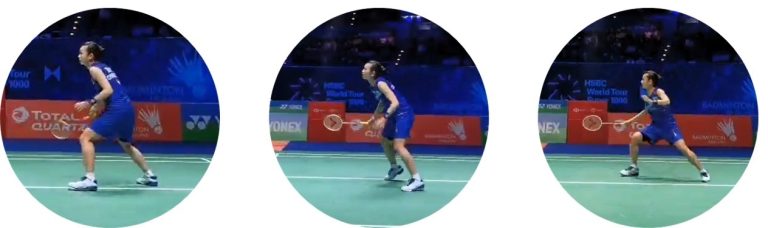
Move your stance
Think about your position on court
There are a few occasions when you can intentionally move your stance to reduce the chance that your opponents can “make you play a backhand”.
By moving your stance in anticipation, you can also reduce the reasons why your opponents may want to play to that area.
Sometimes it will be obvious to them, at other times they will read your ‘cues/signals’ and decide to play elsewhere.
If you don’t know about stances, then reda this post that describes the different ways you can stand and position yourself on court.
Badminton Stances – a guide to use and development
Try these out on court
Cross Block from your Backhand side
Yes, it’s as easy as that!
When you can, and you think it’s tactically ok to do so, play backhand cross blocks.
First of all, you must be able to play this stroke from smashes, fast drops and in driving rallies. All three situations are different, so you must practice all three.
Become comfortable with those grip changes, the different ways of holding the racket so that you can easily send the shuttle crosscourt, up and over, away from your backhand rearcourt
Its important to be able to play backhand cross court defensibe ‘blocks’
How can you practice your crosscourt backhand in a half-court
use lots of full-court movements and strokes in practice
Hit into their backhand
If you are playing tournaments against players of a similar standard, then it’s reasonable to assume that their backhand will be similar to yours.
It certainly won’t be as good as their forehand.
If you have a choice, then hit it down their backhand side
This is a ‘must-do’ for all players under 13 years old
It’s so obvious they sometimes forget!
Using a long smash or long flat clear towards the opponent’s backhand to try to get the shuttle behind them is a great tactic.
A very young player once told me that they didn’t think it was fair to set out to exploit the opponent’s weak backhand.
What would you say as a reply?
Play a pull / drag / long drop
Don’t try to play TIGHT to the net in a backhand drop style
This what your opponent will be expecting.
Can you feel them rushing to the net to kill your floaty backhand drop?
I’ve discovered that this stroke is called different names in Europe. “Drag” “Pull” “Long Drop”, whichever name you use, it doesn’t matter they all fly and land in the same way.
Strike the shuttle so that it travels FAST, FLAT and LONG
Landing just past the opponent’s service line towards their midcourt
Remember these points when you practice



![Introducing the badminton overhead – Challenge No.3 - Duplicate - [#36874]](https://badmintonandy.com/wp-content/uploads/2023/05/Badminton-Forehand-Overhead-3-scaled-1.jpg)
![Introducing the badminton overhead – Challenge No.2 - Duplicate - [#36821]](https://badmintonandy.com/wp-content/uploads/2023/05/Badminton-Forehand-Overhead-2-scaled-1.jpg)
